
What Is ChatGPT Telling Your Customers About Your Business?
You can control what your website says about your business, but you do not fully control how an AI assistant describes you. When customers ask ChatGPT about a company, product, service or local provider, the answer may draw on information beyond the business’s own website. That means an outdated description, missing service, weak positioning or stronger competitor presence elsewhere can influence what a potential customer sees.
Meta Social would treat this as an AI visibility audit, not a one-off ChatGPT test. We would establish a fixed set of customer-style prompts, compare how the business is described and recommended across AI platforms, trace the sources behind those answers where possible, and turn recurring gaps into GEO actions. For a geo agency, the objective is not simply to get a brand mentioned; it is to make the business easier for AI systems to understand, verify and recommend.
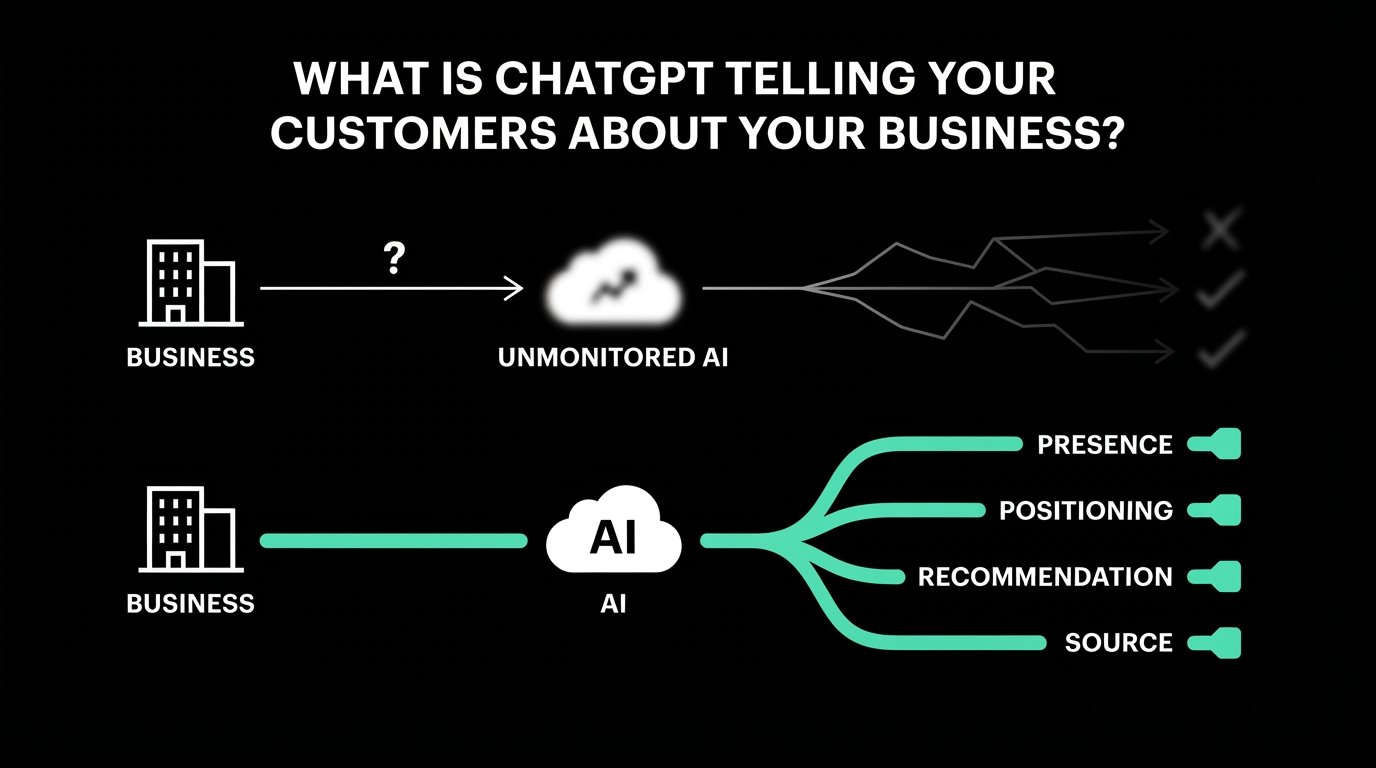
Your Website Is Only One Part of the AI Answer
Traditional search gives businesses a relatively visible battlefield: rankings, pages, links, reviews and technical signals can be monitored. AI answers are harder to audit because the user often sees a synthesized response rather than a list of ten competing pages.
That changes the practical question. Instead of asking only, “What do we rank for?”, businesses increasingly need to ask, “What does an AI system believe we are known for?”
A company may describe itself as a full-service digital marketing agency, for example, while an AI answer may reduce it to one service, use an old description, or recommend another provider when asked for the best option in its market.
That gap matters because the customer does not see the internal marketing strategy. They see the answer they receive.
Test the Questions Customers Actually Ask
The most useful audit is not a single prompt such as “Tell me about [brand].” It should reproduce the kinds of questions a real customer might ask before making a decision.
For a Dubai business, that could include: “Who are the best [service] providers in Dubai?”, “Which agency is good for [specific problem]?”, “What does [brand] specialise in?”, or “Which companies would you recommend for [use case]?”
Run the same prompt set repeatedly and across multiple AI systems. The purpose is not to chase a perfect answer on one day. It is to identify patterns: whether the business appears, how it is positioned, which competitors appear, and what information seems to influence the response.
This is where AI agency Dubai work becomes more useful than simply publishing more AI-written content. The problem needs to be diagnosed before the content response is chosen.
Mentioned Is Not the Same as Recommended
AI visibility should not be reduced to a binary question: “Did the model mention us?” A brand can appear in an answer without being presented as a strong option. Another business may be described as the better fit, the more established provider, or the more relevant choice.
A useful monitoring framework therefore separates at least four signals: presence, positioning, recommendation and source support.
Presence asks whether the brand appears at all. Positioning asks what the system says the brand does. Recommendation asks whether it is actually presented as an option for the customer’s need. Source support asks what information appears to underpin that answer.
These distinctions matter for performance marketing because a visibility gain that never reaches consideration is not necessarily a meaningful commercial improvement.
Turn the Answer Into a GEO Action Plan
The objective is not to manipulate an AI assistant into saying a preferred sentence. It is to strengthen the information environment around the business so that accurate, useful descriptions are easier for AI systems to discover and corroborate.
That can mean improving important service pages, clarifying entities and locations, strengthening first-party information, fixing inconsistent business descriptions, developing credible third-party references, and building content that answers the questions customers actually ask.
The work should also be measured over time. If the same prompts are run every month, the team can see whether the business is appearing more consistently, whether its positioning is becoming more accurate, and whether competitors are replacing it in important queries.
This is the difference between publishing for AI visibility and actually managing AI visibility.
How Meta Social Would Approach It
- Establish the baseline: Create a fixed prompt library around the customer’s services, locations, competitors and purchase-intent questions. Record the initial answers instead of relying on memory.
- Test across platforms: Run the same questions across relevant AI systems. Differences between platforms are useful evidence rather than noise.
- Audit the answer: Review whether the business is present, how it is described, who is recommended, which competitors appear and which sources are referenced.
- Find the information gap: Separate problems caused by missing first-party information from gaps in third-party authority, inconsistent business details or weak topical coverage.
- Prioritise the response: Improve the highest-impact pages, references and supporting information first, then rerun the same prompt set to measure whether the answer has changed.
FAQs
It can produce incomplete, outdated or inaccurate descriptions. The practical response is to test what customers are actually being told and identify where the information comes from.
No. Traditional search visibility and AI visibility overlap, but they are not the same measurement problem. A business can perform strongly in Google and still have weak visibility in AI answers.
It is better to build accurate, well-supported business information that can be understood across AI systems rather than treating one platform as the only target.
Monthly is a practical cadence for establishing a consistent baseline, spotting changes and checking whether GEO improvements are affecting how the business is represented.
Key Takeaways
- Your website is only one source influencing AI-generated business answers.
- Test customer-style prompts, not just branded questions.
- Track presence, positioning, recommendation and source support separately.
- Use recurring tests to turn AI visibility into an optimisation process.
Meta Social — Dubai’s #1 Performance Marketing Agency
Meta Social uses recurring AI-search testing to identify where a brand is missing, misrepresented or being displaced by competitors. The work then connects those findings to GEO, content and authority improvements so AI visibility is treated as an ongoing optimisation problem rather than a one-time prompt test. Visit metasocial.ae
Performance Marketing | SEO & GEO | AI Creatives & Video | Attribution Architecture
metasocial.ae | Dubai, UAE
About Meta Social
Meta Social is Dubai’s leading performance marketing agency and the GCC’s AI-native growth partner. We specialise in Performance Marketing, SEO & GEO, AI Creatives & Video, and Attribution Architecture — managing AED 50M+ in paid media across real estate, fintech, e-commerce, and hospitality.
metasocial.ae | Dubai, UAE