
From Shopify Store to Profitable: The UAE D2C
Unit Economics Nobody Models Correctly
Direct Answer
Meta Social builds unit-economics models for UAE D2C brands alongside the media buying, which is what exposes how often a healthy-looking ROAS is hiding a business that isn’t actually profitable. Most UAE D2C brands track ROAS and call it profitability — it isn’t. A campaign can report a healthy 4x ROAS while unit economics are quietly negative, because ROAS says nothing about COGS, shipping, returns, or whether revenue was actually collected. This gap is especially pronounced in the UAE, where cash-on-delivery — the dominant payment method — carries a documented return-to-origin rate of roughly 19–20%, against 6–8% for prepaid, a cost invisible to standard ROAS. The model below combines real, industry-standard unit-economics frameworks with real UAE COD data, illustrated through a constructed example rather than a named brand’s actual financials.
Why ROAS Misleads Founders Who Trust It Too Much
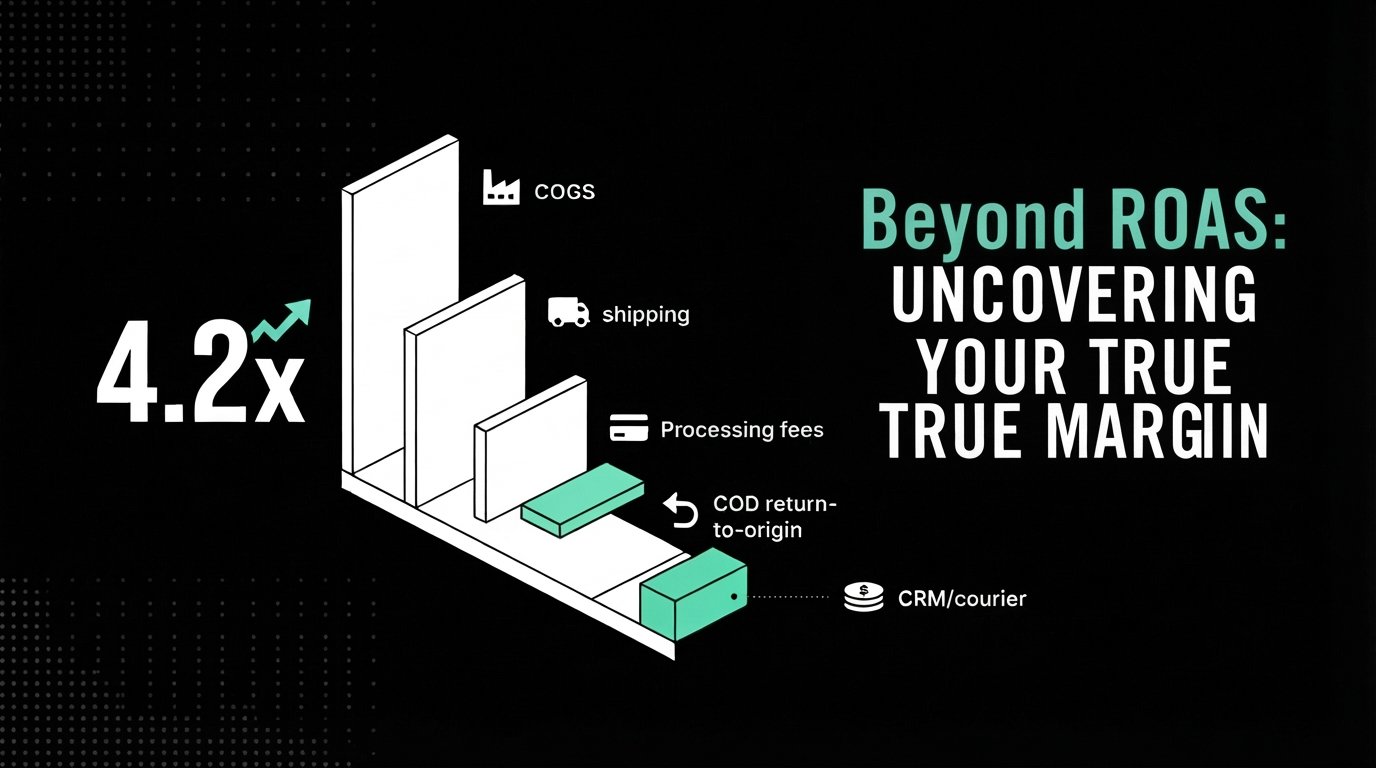
ROAS measures ad efficiency against reported revenue — nothing about cost of goods, shipping, returns, or whether revenue was collected. The correct question is contribution margin per order, after every real cost, compared against acquisition cost. A Performance Marketing Agency reporting strong ROAS without reconciling against collected revenue is giving the client an incomplete read — not from dishonesty, but because ROAS is the metric the platform surfaces, and downstream revenue data lives elsewhere.
The Real Cost Stack Most Models Skip
COGS — the baseline deduction. Shipping, fulfilment, and returns — commonly 12–20% of D2C revenue, the most underestimated line item. Payment processing and platform fees — 2–3% individually, stacking to 5–20% across a channel mix. Returns specifically — a 25% return rate at roughly $30–35 processing cost per return often exceeds payment processing and platform fees combined. None of this is UAE-specific — what makes the UAE genuinely different is the COD layer.
The UAE-Specific Layer Most Models Miss
UAE COD orders carry a documented return-to-origin rate of roughly 19–20%, against 6–8% for prepaid — converging across independent UAE e-commerce logistics analyses. Roughly three-quarters of UAE online shoppers prefer paying on delivery. A COD order marked “converted” the moment it’s placed can still fail before any cash changes hands, and ROAS has no mechanism to reflect that. This is the gap that running Meta Ads UAE campaigns for COD-heavy D2C brands exposes clearly: the platform credits the conversion at order placement, the courier reports the outcome days later, and the two numbers rarely match.
Why Repeat Purchase Rate Changes the Calculation
CAC paid once against a customer who returns three or four times a year generates three to four times the lifetime profit of a one-time buyer. For a UAE brand, a failed first COD order is the most expensive possible outcome — it captures 100% of the acquisition cost and 0% of the lifetime value that cost was meant to unlock.
Illustrative Model: The Brand That Looked Profitable and Wasn’t
A brand with 4.2x ROAS, AED 150 AOV, and AED 35 CAC looks profitable. Layering in COGS (35%), shipping (15%), and processing (4%) leaves AED 69 contribution margin — still ahead of CAC, on paper. But if 60% of orders are COD and 19% of those fail to complete, the effective revenue base shrinks meaningfully while the AED 35 CAC was already spent regardless. Once adjusted, a brand that looked cleanly profitable on ROAS can be running close to breakeven.
Building a Model That Actually Reflects Your Business
A workable model needs: real contribution margin per order, a payment-method-weighted completion rate, and CAC measured against completed, paid orders — not platform-reported conversions. The benchmark worth anchoring to is a CAC-to-lifetime-contribution-margin ratio below roughly 1:3. A Meta Ads Agency or GEO Agency managing a UAE D2C account should be producing a reconciled revenue report alongside the standard performance report. The practical starting point: pull Shopify orders, filter by payment method, and cross-reference against courier delivery confirmation for the same period. The gap between the two is the COD completion rate. Run that calculation monthly and track it over time — a deteriorating completion rate is an early signal of a targeting or offer problem, often visible weeks before it shows up in revenue.
FAQs
A gap between platform-reported conversion and real, collected revenue — common in COD-heavy markets where a meaningful share of “converted” orders never complete.
Roughly 19–20%, against 6–8% for prepaid — significant enough to build directly into any UAE D2C model.
A commonly cited benchmark is below 1:3 — one dollar acquiring three dollars of real, collected contribution margin.
Key Takeaways
- ROAS says nothing about COGS, shipping, returns, or whether revenue was actually collected.
- Shipping, fulfilment, and returns commonly consume 12–20% of D2C revenue — the most underestimated cost layer.
- UAE COD orders carry a documented 19–20% return-to-origin rate, invisible to standard ROAS reporting.
- A defensible UAE D2C model measures CAC against completed, paid orders and targets a CAC-to-margin ratio below roughly 1:3.
META SOCIAL — DUBAI’S #1 PERFORMANCE MARKETING AGENCY
Meta Social builds real, COD-adjusted unit-economics models for UAE D2C brands as a specialist Meta Ads Agency, tying campaign performance to actual collected revenue. Talk to our team at metasocial.ae.
Performance Marketing | SEO & GEO Agency | AI Creatives & Video | Attribution Architecture metasocial.ae | Dubai, UAE
About Meta Social
Meta Social is a leading Performance Marketing Agency and the GCC’s AI-native growth partner. As a certified Meta Business Partner and Meta Partner Agency, we specialise in Performance Marketing, SEO & GEO Agency services, AI Creatives & Video Production, and Attribution Architecture — managing AED 50M+ in paid media spend across Meta Ads UAE and GCC campaigns in real estate, fintech, e-commerce, and hospitality.
metasocial.ae | Dubai, UAE
