
How Consolidating 14 Campaigns Into 4
Improved Lead Quality Without Increasing Budget
Direct Answer
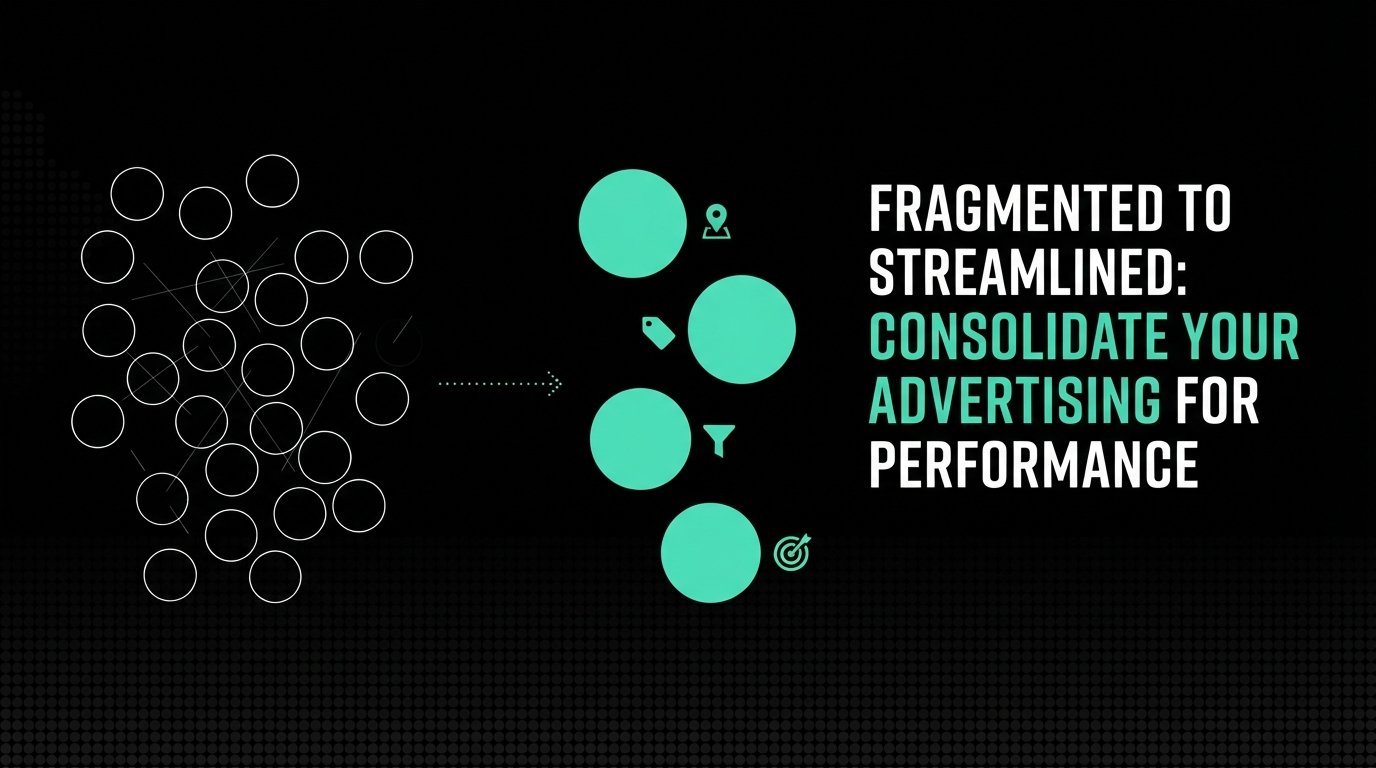
Fourteen campaigns split by city, product, and audience segment look organized on paper. In the auction, they’re quietly bidding against each other for the same small pool of people— and each one stays too small to ever exit the learning phase.
Consolidating that structure into four broader campaigns, on the exact same budget, is one of the highest-leverage fixes a performance marketing agency can make. Lead quality improves within weeks — not from a new offer, but because the algorithm finally has enough concentrated data to learn who’s actually worth showing the ad to.
Why More Campaigns Doesn’t Mean More Control
The instinct to split an account into many narrow campaigns usually comes from a reasonable place — wanting clean, isolated reporting for each city, product, or segment. But every campaign is its own separate learning environment. Splitting one audience into fourteen slices means each slice struggles to reach the roughly 50 conversions Meta’s algorithm needs to stabilize delivery, so all fourteen stay stuck in an unstable, expensive learning phase instead of even one reaching a confident, optimized state.
What Was Actually Happening Inside the Account
Several of the fourteen campaigns targeted audiences with heavy overlap — same city, similar age ranges and interests, just labeled differently per product line. In Meta’s auction, campaigns from the same advertiser targeting overlapping audiences compete against each other for the same impressions, driving up cost for both and diluting the signal each receives. The account wasn’t short on budget or bad at targeting — it was structurally working against itself, one campaign bidding up the cost of another. The kind of issue any meta ads agency should catch in week one of an audit, before touching creative or targeting.
The Consolidation Process
The fix started with an audience overlap check across all fourteen campaigns, grouping the ones targeting substantially the same people. Campaigns with a genuine strategic reason to stay separate — a different funnel stage, a distinct offer — were kept apart. Everything else merged into four broader campaigns, using ad set-level segmentation inside each to preserve the granular reporting the original structure was built for, without fragmenting learning data across a dozen underpowered campaigns.
Why Lead Quality Improved, Not Just Cost
Once conversion volume concentrated into four campaigns instead of fourteen, each reached the algorithm’s learning threshold within days instead of never reaching it at all. A stabilized campaign doesn’t just deliver cheaper — it delivers to a more precisely modeled audience, because the algorithm finally has enough signal to distinguish a genuinely good-fit lead from amarginal one. The lead quality gain wasn’t a separate initiative. It was the direct result of giving the algorithm enough concentrated data to do what it’s actually good at.
What This Means for How Campaigns Get Structured Going Forward
At Meta Social, campaign structure is now a strategic decision made before launch, not a reporting convenience added after. A Meta Partner Agency setting up a new account should ask how many proposed campaigns will realistically clear the learning-phase threshold on their individual budget — one that can’t is better merged into a broader structure with ad set-level segmentation instead. The same discipline applies to organic structure: a GEO agency spreading content too thin across dozens of narrow pages runs into the same diluted-signal problem search engines face deciding which page deserves authority.
FAQs
Check how many of your active campaigns have cleared roughly 50 conversions in the last 7 days. If several campaigns are consistently below that threshold month after month, they’re likely too small individually to ever stabilize, and are strong candidates for consolidation into a broader structure.
It’s not universal — campaigns targeting genuinely distinct audiences or funnel stages should usually stay separate, since merging unrelated audiences can muddy the algorithm’s signal rather than sharpen it. The risk is specifically in over-segmentation of the same audience, not in having multiple campaigns for genuinely different purposes.
Run an audience overlap report across all active campaigns before touching anything. Meta shows this data directly in Ads Manager, and it will immediately reveal which campaigns are competing against each other for the same people — that overlap is the clearest signal for which campaigns are genuine consolidation candidates.
Check frequency and CTR trend rather than CPA alone. A campaign with healthy, stable CTR and normal frequency that simply hasn’t converted yet is very likely still inside its learning or sales-cycle window. A campaign with declining CTR and climbing frequency is showing a genuine problem worth acting on immediately, regardless of how many days it’s been live.
Key Takeaways
- Splitting one audience across many narrow campaigns fragments learning data, keeping every campaign individually stuck in an unstable learning phase.
- Campaigns targeting overlapping audiences compete against each other in the same auction, quietly inflating cost for both.
- Consolidating into fewer, broader campaigns with ad set-level segmentation preserves reporting granularity without fragmenting algorithm data.
- Lead quality improvement followed directly from faster learning-phase completion — not from a separate targeting or creative change.
Meta Social — Dubai’s #1 Performance Marketing Agency
Meta Social structures every Meta Ads UAE account around what the algorithm needs to learn effectively — not just what’s convenient to report. Get in touch at metasocial.ae
Performance Marketing | SEO & GEO | AI Creatives & Video | Attribution Architecture
metasocial.ae | Dubai, UAE
About Meta Social
Meta Social is Dubai’s leading performance marketing agency and the GCC’s AI-native growth partner. We specialise in Performance Marketing, SEO & GEO, AI Creatives & Video, and Attribution Architecture — managing AED 50M+ in paid media across real estate, fintech, e-commerce, and hospitality.
metasocial.ae | Dubai, UAE