
Meta's Budget Algorithm Starves Your Best Ad Set,
Then Makes It Look Like the Ad Set's Fault
Direct Answer
Meta’s A/B testing tool declares a test “significant” at just 65% confidence — far below the 95% threshold most marketers assume from a statistics class. A peer-reviewed analysis of 2,766 real marketing experiments found the false-discovery rate for “significant” results running 18 to 37%, depending on the threshold used.
As a performance marketing agency running creative tests across Meta Ads UAE accounts, Meta Social holds a stricter internal confidence bar before recommending a client shift real budget behind a result — because Meta’s own “winner” label isn’t the same claim a statistics class would call significant.
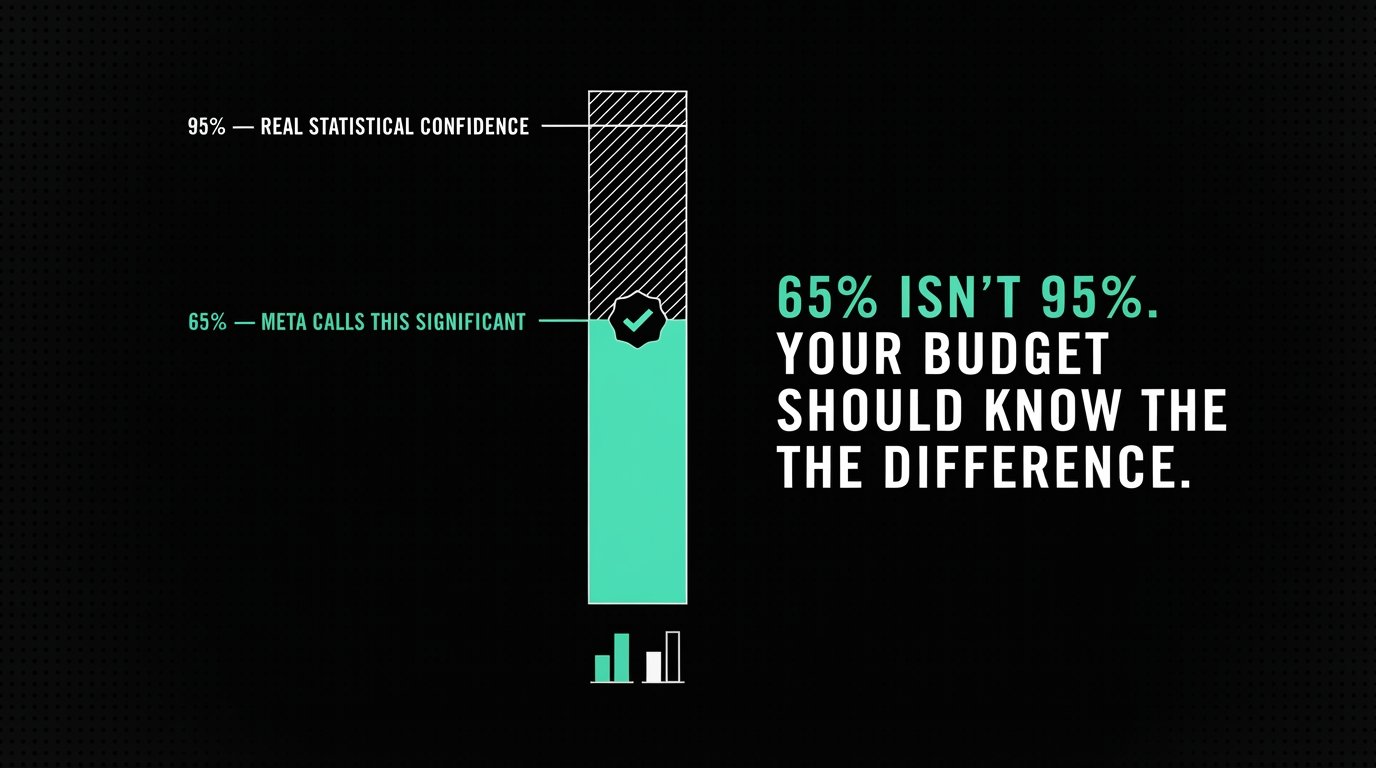
What “65% Confidence” Actually Means
Meta’s testing tool declares one variant a winner once it’s roughly 65% likely to be the better performer. That’s a genuinely low bar.
For comparison, rigorous experimentation typically requires 95%, sometimes 90% at the loosest, before treating a result as reliable enough to act on. Meta’s default sits well below either.
Why the Gap Matters More Than It Sounds
At 65% confidence, a meaningful share of declared “wins” are close enough to a coin flip that pure noise could explain the result. This isn’t a hypothetical risk — it’s a mathematical property of the threshold itself.
A test that would fail to reach significance under a 95% standard can still get labeled a clear winner inside Ads Manager, with nothing in the interface signaling the difference.
The Real Data Behind the Risk
A peer-reviewed analysis covering 2,766 real marketing experiments found the false-discovery rate for statistically significant results ran 18 to 25% at a standard 5% significance level, rising to 28 to 37% at a looser 10% threshold.
In plain terms: depending on which threshold was used, somewhere between roughly one in five and more than one in three “significant” wins in that dataset were likely false.
Why AI-Generated Variants Made This Worse, Not Better
More creative variants per testing cycle feels like more rigor. Without a proportional increase in traffic, it’s the opposite — each individual test becomes more underpowered as the same audience gets split across more variations. A meta ads agency treating higher variant count as automatic progress is often making the underlying statistics worse, not better.
When auditing an account running heavy AI-generated creative volume, this is one of the clearest patterns we look for: testing velocity that increased faster than the traffic available to support it.
What a False “Winner” Actually Costs
Scaling a creative that was actually a statistical fluke means reallocating real budget away from a genuinely equal or better-performing variant, based on noise rather than a real signal.
A Meta Partner Agency recommending a budget shift off the back of a single Meta-declared winner, without a second look, is passing that risk directly to the client’s spend.
How to Set a Real Confidence Bar
Treat Meta’s own “significant” label as a first signal, not a final verdict — let a declared winner run longer or accumulate more volume before committing serious budget behind it.
A GEO agency applying the same discipline to content testing should hold organic experiments to a comparable bar — a small early lift in one metric isn’t proof a change worked until it holds up over a larger, longer sample.
FAQs
Not necessarily — the declaration itself is still a useful early signal. The mistake is treating it as a final verdict. Keep it visible as a first checkpoint, but require additional volume or a longer run before shifting meaningful budget based on that label alone.
There’s no universal number, since it depends on baseline conversion volume, but a reasonable floor is continuing past Meta’s declared winner until each variant has accumulated enough conversions to approach the roughly 50-event threshold the platform’s own algorithm typically needs for stable delivery.
The underlying statistical risk is the same, though Advantage+ often tests across a broader combined audience, which can produce more volume per variant than a narrowly segmented manual test. The confidence gap doesn’t disappear — it’s simply less likely to be starved of data as quickly.
Submitting complete, accurate documentation on the first attempt is the biggest factor in shortening that window.
90% is a reasonable middle ground for most marketing decisions — rigorous enough to filter out a meaningful share of false positives, without requiring the sample sizes a full 95% academic standard demands. The key is picking a deliberate threshold rather than defaulting to whatever the platform declares.
Key Takeaways
- Meta’s A/B testing tool declares a “significant” winner at just 65% confidence — well below the 95% threshold rigorous testing typically requires.
- A peer-reviewed analysis of 2,766 real experiments found false-discovery rates of 18 to 37% for “significant” results, depending on the threshold used.
- Higher AI-generated variant volume without proportionally higher traffic makes each individual test more underpowered, not more rigorous.
- Treating Meta’s “significant” label as a first signal rather than a final verdict is the fastest way to avoid scaling a statistical fluke.
Meta Social — Dubai’s #1 Performance Marketing Agency
Meta Social applies a stricter confidence standard than Meta’s default before recommending budget shifts on any Meta Ads UAE account. Get in touch at metasocial.ae
Performance Marketing | SEO & GEO | AI Creatives & Video | Attribution Architecture
metasocial.ae | Dubai, UAE
About Meta Social
Meta Social is Dubai’s leading performance marketing agency and the GCC’s AI-native growth partner. We specialise in Performance Marketing, SEO & GEO, AI Creatives & Video, and Attribution Architecture — managing AED 50M+ in paid media across real estate, fintech, e-commerce, and hospitality.
metasocial.ae | Dubai, UAE