
Why Dubai Brands Should Stop Treating the City as One Audience
Dubai is not one audience. A customer living in Jumeirah, working in DIFC and spending weekends in Dubai Marina can have completely different needs, routines and buying triggers from someone living in Mirdif or the outer residential districts. Yet many campaigns still treat “Dubai” as a single location setting and then try to solve the resulting performance problem with more budget.
At Meta Social, we build location into campaign strategy rather than using it as a checkbox inside Ads Manager. The objective is not to create a separate campaign for every neighbourhood. It is to identify where location changes the customer proposition, then let the creative, offer, audience and measurement reflect that difference.
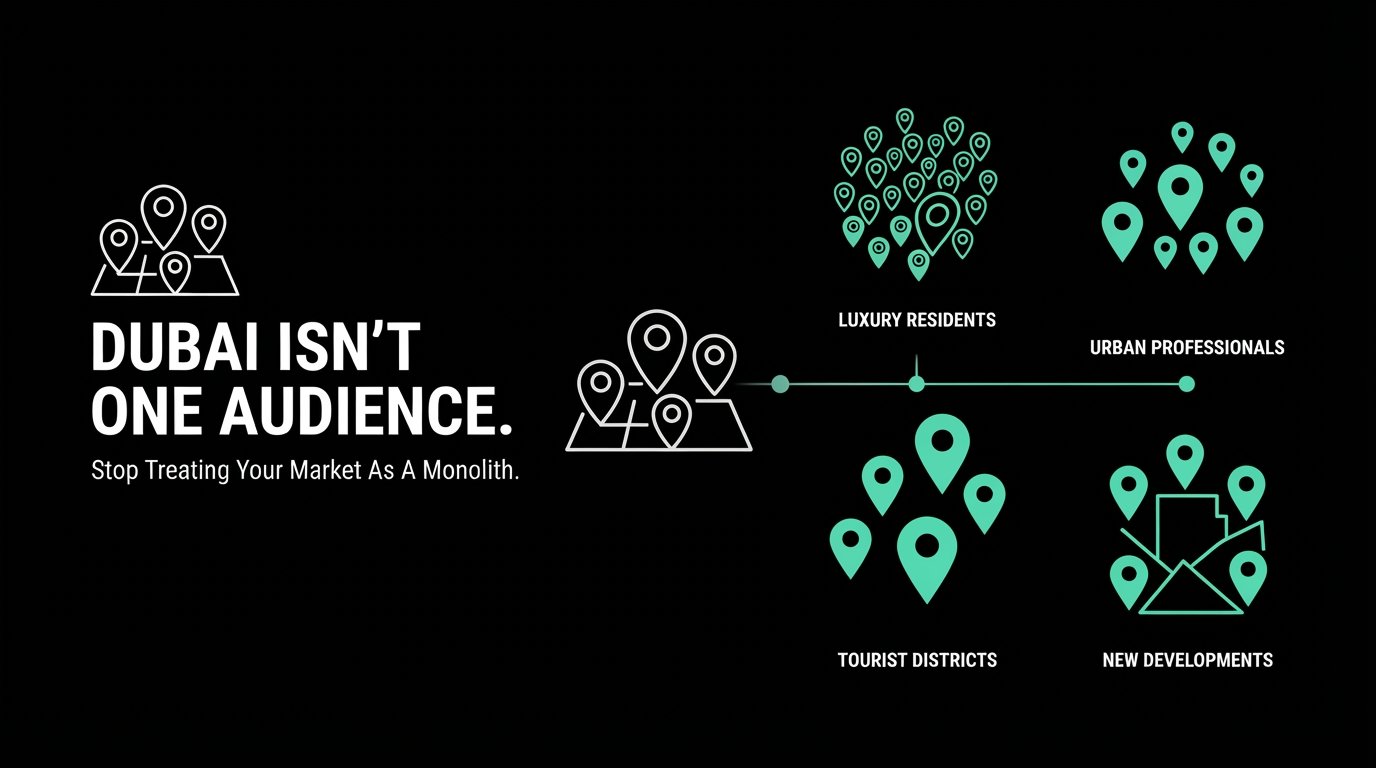
Dubai Is a Collection of Markets, Not One Market
Location targeting becomes more useful when geography changes what the customer is actually buying. A restaurant near Dubai Marina is competing for a different moment than a family-focused restaurant in a residential district. A property developer selling waterfront apartments is speaking to different intent from one promoting suburban villas. A clinic targeting nearby residents has a different conversion path from a destination clinic relying on people willing to travel.
The mistake is assuming that a smaller radius automatically creates better targeting. It does not. A tight radius around the wrong commercial context can be less useful than a broader audience built around a genuine reason to travel, visit or buy.
A Meta ads agency should therefore start with the commercial question: where does location actually change the reason someone would respond to this offer? The map comes after the customer logic, not before it.
The Real Advantage Is Not Smaller Audiences — It’s Better Context
Hyperlocal targeting is often described as a way to reduce wasted impressions. That is only half the story. Its bigger advantage is that it can give creative a more relevant context.
Imagine a hotel campaign aimed at people within Dubai. The same property can be positioned around a weekend staycation for residents, a convenient business stay for people working nearby, or a premium experience for visitors already exploring the city. The audience may overlap, but the reason to act does not.
That is why location should influence the message, not just the delivery setting. If every neighbourhood receives the same headline, visual and offer, the campaign is using geographic precision without actually becoming more relevant.
For a Meta Partner managing a Dubai account, this is where media planning and creative strategy need to work together. The strongest location strategy does not simply tell the platform where to find people; it gives the platform different reasons to make the ad relevant to them.
Where Hyperlocal Targeting Goes Wrong
The first problem is over-segmentation. Splitting a campaign into dozens of tiny audiences can create fragmented data, uneven delivery and too little conversion volume for the system to learn efficiently. Hyperlocal does not mean hyper-fragmented.
The second problem is false precision. A person may live in one neighbourhood, work in another and spend most of their discretionary time somewhere else. A location pin does not necessarily represent the moment when a customer is most likely to buy.
The third problem is measuring the wrong thing. A neighbourhood may produce a cheaper click but a worse customer. Another area may have a higher cost per lead but stronger qualification or revenue. If the campaign is judged only on CPM or CPL, the location decision can look better than it actually is.
This is where a GEO agency mindset is useful even outside AI search: understand the meaning behind a location, rather than treating geographic labels as the strategy itself. Context is what turns segmentation into relevance.
How Dubai Brands Should Build the Location Layer
The practical answer is not to create a campaign for every postcode. Start with the locations that represent genuinely different customer propositions, then test whether the difference shows up in business outcomes.
- Group neighbourhoods by customer behaviour or commercial intent, not simply by distance.
- Use different creative angles where the reason to buy changes by location.
- Keep enough audience and conversion volume for Meta’s delivery system to learn; do not split campaigns purely for the sake of precision.
- Compare locations on qualified leads, conversion rate and revenue — not just CPM or CPL.
- Use the resulting data to decide which geographic differences deserve permanent campaign treatment and which do not.
That is the difference between Performance marketing and simply buying local reach: the objective is to find where geographic context changes commercial performance, then move budget and creative accordingly.
FAQs
No. Over-segmentation can make campaigns harder to learn from and fragment conversion data. Separate locations when they represent meaningfully different audiences, offers or customer journeys.
Not always. A radius tells the platform where people are, but it does not explain why location matters to the customer. Strong campaigns connect geography to intent, creative and offer
Look beyond CPM and CPL. Compare qualified lead rate, conversion rate, revenue or other downstream business outcomes that reflect customer quality.
It is most useful when proximity, travel time, neighbourhood context or local demand materially influence the purchase decision. For businesses with a national or global proposition, broad targeting may still be more efficient.
Key Takeaways
- Dubai should not automatically be treated as one audience simply because it is one city.
- Hyperlocal targeting works best when location changes the customer proposition, not just the radius setting.
- Over-segmentation can weaken learning and fragment conversion data; precision should have a commercial reason.
- Judge geographic targeting on qualified outcomes and revenue, not only cheap clicks or leads.
Meta Social — Dubai’s #1 Performance Marketing Agency
Meta Social helps UAE brands turn location, creative and performance data into smarter paid-media strategies — without confusing more targeting with better targeting.
Performance Marketing | SEO & GEO | AI Creatives & Video | Attribution Architecture
metasocial.ae | Dubai, UAE
About Meta Social
Meta Social is Dubai’s leading performance marketing agency and the GCC’s AI-native growth partner. We specialise in Performance Marketing, SEO & GEO, AI Creatives & Video, and Attribution Architecture — managing AED 50M+ in paid media across real estate, fintech, e-commerce, and hospitality.
metasocial.ae | Dubai, UAE