
The Paid-Organic Feedback Loop
Most Dubai
Marketers Are Missing
Paid and organic should not operate as two separate content machines. Paid campaigns generate fast signals about which messages, searches and offers make people act, while organic channels reveal the questions, topics and demand patterns that deserve longer-term investment. The opportunity is to make those signals feed each other instead of letting them disappear inside separate dashboards.
At Meta Social, we treat the feedback loop as a growth system: a performance marketing campaign can test demand quickly, while SEO, GEO and content turn those learnings into assets that keep working after the ad spend stops. A Meta ads agency should not only report what converted; it should ask what the paid data taught the rest of the marketing team.
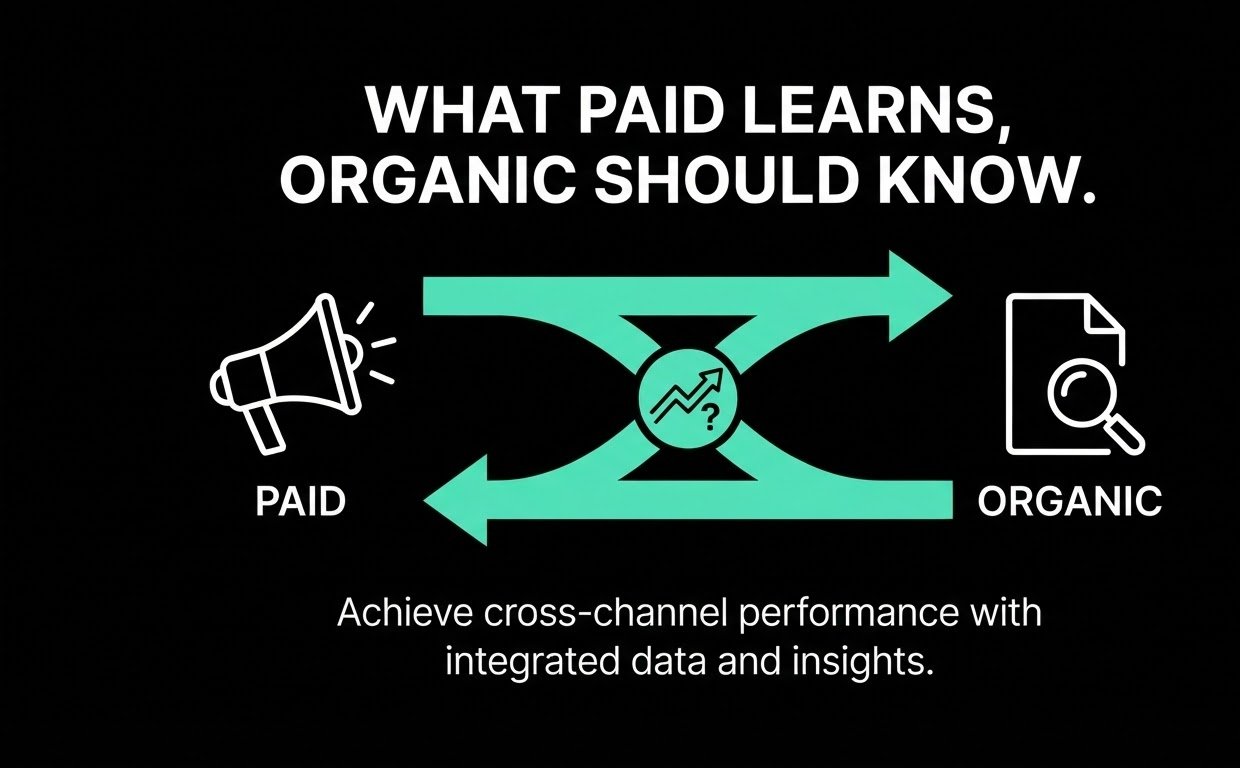
Paid Data Can Tell Organic Teams What Deserves Attention
SEO teams often have to make content decisions before they know which message will actually convert. Paid campaigns can shorten that uncertainty. Search-term data, ad engagement and conversion behaviour can reveal the language people use when they are ready to act. A Meta partner can use these signals to help decide which organic opportunities deserve deeper investment.
Google itself provides a paid-and-organic report that lets advertisers compare paid text-ad performance with organic queries and clicks. Google specifically points to using the combined data to discover additional keywords and improve presence on high-value queries.
The useful insight is not simply “this keyword has a high CTR.” It is that a query, promise or problem has demonstrated commercial interest. That can influence which landing pages deserve deeper content, which questions should become FAQs and which topics deserve a larger organic investment.
Organic Data Can Make Paid Creative Smarter
The loop also runs in the opposite direction. Organic content can reveal questions and language that paid teams have not tested yet. Search Console can show the queries generating impressions, while content engagement can reveal which problems attract attention even before a visitor becomes a lead.
That information can become creative input. A question appearing repeatedly in organic search can become an ad hook. A page attracting qualified visitors can reveal a stronger value proposition. A content section with unusually high engagement can become a new angle for paid testing.
This matters because paid media gives speed, while organic gives breadth and accumulated evidence. Using one to inform the other can reduce the amount of guessing each team has to do.
The Real Loop Is Bigger Than PPC and SEO
The strongest version of this system is not simply Google Ads feeding SEO. It connects paid social, search, content, SEO and GEO.
A Meta campaign might reveal that customers respond to a specific pain point. Search data can show the language they use around that pain point. Content can answer the deeper question.
GEO can then make that explanation easier for AI systems to understand and retrieve. The resulting organic visibility can create new audiences, queries and objections that feed the next round of paid testing.
A GEO agency can therefore use the same feedback loop to identify which questions need clearer answers and where the brand’s information is incomplete. The point is not to make every channel publish the same message. It is to make every channel learn from the others.
How to Build the Loop Without Creating Another Dashboard
- Create one shared list of high-value queries, customer problems, offers and messages.
- Use paid campaigns to test which propositions generate meaningful action quickly.
- Feed winning language and commercial insights into SEO pages, FAQs and content briefs.
- Use organic search and content behaviour to identify new hooks, objections and topics for paid testing.
- Review the loop around business outcomes, not separate channel KPIs.
The important part is ownership. If paid learns something valuable on Monday and the content team never sees it, there is no feedback loop. Likewise, if SEO discovers a high-intent question and the paid team never tests it, the organisation is paying for research it never uses.
FAQs
Yes, indirectly. Paid search can reveal search terms, conversion patterns and messaging that help teams prioritise organic content. Google also provides a paid-and-organic report specifically for comparing paid and organic search performance and identifying opportunities.
No. Google states that paid search investment does not directly affect organic ranking. The value is the data and testing speed paid campaigns can provide, not a ranking boost.
Useful inputs include actual search terms, conversion rates, cost, high-value queries, ad messaging and landing-page behaviour. Prioritise signals that indicate commercial intent rather than simply high traffic.
Organiccontentcanrevealcustomerquestions,objectionsandlanguagethatcanbeturned into new ad hooks or creative angles. Strong organic pages can also provide evidence about which topics attract qualified attention.
It should be frequent enough for insights to influence active work. A monthly or biweekly review can work for many teams, while high-spend accounts may benefit from a faster feedback cycle.
Yes, but the loop is broader. Search behaviour now includes AI-generated answers and follow-up queries, so teams should share insights across paid, organic, content and GEO rather than treating traditional search as the only discovery surface.
Key Takeaways
- Paid media can validate demand before an organic team spends months building around it.
- Organic search can reveal questions and language that paid teams have not tested.
- Google provides tools to compare paid and organic search signals, but the real advantage comes from acting on the overlap.
- GEO adds another layer: customer questions and paid insights can inform the information AI systems need to understand the brand.
- The goal is not identical channel messaging; it is shared learning.
Meta Social — Dubai’s #1 Performance Marketing Agency
Meta Social connects paid acquisition, SEO, GEO and creative testing so that every channel feeds useful market intelligence into the next—turning isolated campaign results into a compounding growth system.
Performance Marketing | SEO & GEO | AI Creatives & Video | Attribution Architecture
metasocial.ae | Dubai, UAE
About Meta Social
Meta Social is Dubai’s leading performance marketing agency and the GCC’s AI-native growth partner. We specialise in Performance Marketing, SEO & GEO, AI Creatives & Video, and Attribution Architecture — managing AED 50M+ in paid media across real estate, fintech, e-commerce, and hospitality.
metasocial.ae | Dubai, UAE