
The Arabic Ad Copy Gap: Why Direct
Translation
Underperforms and What Actually Converts
Directly translating an English ad into Arabic can preserve the words while losing the persuasion. Arabic-speaking audiences in the GCC do not necessarily respond to the same hooks, rhythm, proof points or calls to action that work in English. Effective Arabic performance copy is therefore closer to transcreation: the commercial idea stays consistent, but the way it is expressed changes to fit the audience and context.
At Meta Social, we treat Arabic creative as a performance variable rather than a translation task. A Meta ads agency should test whether the Arabic version actually earns attention, communicates the offer and drives the intended action—not simply whether it is grammatically correct.
Translation Isn’t Localization
Translation asks, “How do we say this sentence in Arabic?” Localization asks, “How would this audience naturally understand and respond to this idea?” The difference becomes obvious in advertising because an ad is designed to persuade, not simply transfer information.
An English headline built around urgency, status or a clever phrase may sound unnatural when translated word-for-word. The Arabic version may be technically accurate but lose the emotional trigger that made the original work.
That is why a Meta partner working across the GCC should treat the original English copy as a strategic reference, not a script that Arabic copywriters have to reproduce line by line.
Why the Same Hook Can Behave Differently in Arabic
Performance copy depends on more than vocabulary. Sentence length, formality, cultural context, implied meaning and the relationship between the brand and the audience can all change how a message lands.
Consider a luxury offer. English copy might lean heavily on exclusivity and scarcity. Arabic creative for the same offer may need a different balance of prestige, reassurance and clarity. A direct translation can communicate the product while missing the reason the audience should care.
The same applies to calls to action. “Book now” may be perfectly functional in English, but the strongest Arabic CTA depends on what the customer is being asked to do and how formal the brand needs to sound. The objective is not to make the Arabic more elaborate; it is to make the action feel natural.
For a performance marketing team, that means Arabic copy should be evaluated through actual outcomes: thumb-stop behaviour, clicks, qualified leads, purchases or other meaningful conversion signals—not linguistic approval alone.
What High-Performing Arabic Creative Actually Changes
Strong Arabic creative usually keeps the commercial proposition intact while changing the execution. That can mean rewriting the hook rather than translating it, changing the order of information, using a more natural expression, adjusting formality or replacing a culturally specific reference.
It also means knowing when not to localize. Product names, technical terminology and established brand language may need consistency. The skill is knowing which elements are fixed and which exist to persuade.
A GEO agency can apply the same principle beyond paid ads: language affects how a brand is understood across search and AI systems too, so Arabic and English content should be consistent in meaning without being mechanically identical in wording.
A Better Framework for Writing Arabic Ads
- Start with the commercial proposition, not the English sentence.
- Identify the audience, intent and emotional reason to act.
- Write the Arabic hook natively instead of translating the English hook word for word.
- Keep essential product, pricing and brand information consistent across languages.
- Test different Arabic hooks, CTAs and creative formats rather than assuming one translation is the answer.
- Judge the Arabic version on business outcomes, not on whether it mirrors the English copy.
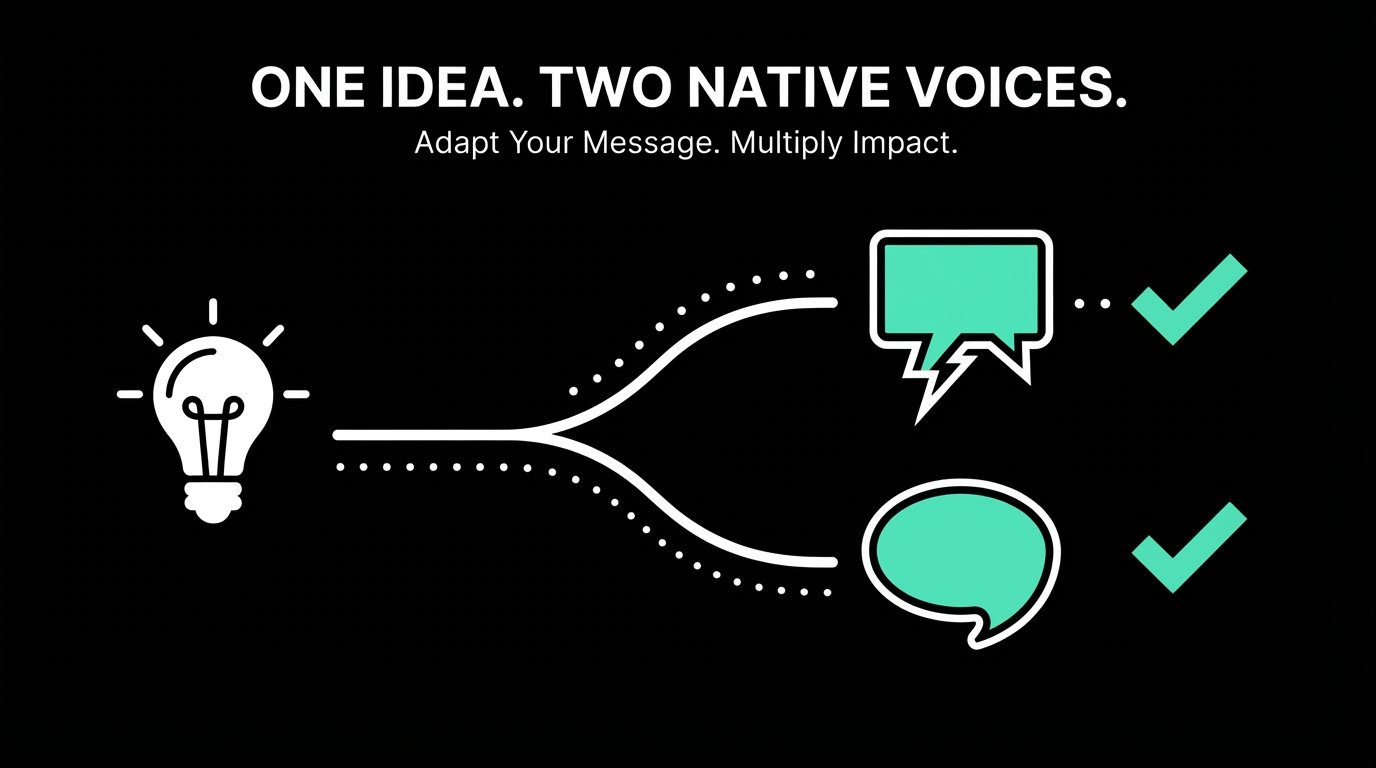
The strongest bilingual advertising systems therefore work from one strategy but allow the creative expression to diverge. English and Arabic can communicate the same promise without sounding like the same sentence.
FAQs
The translation may preserve the meaning but lose the persuasive hook, natural phrasing or cultural context. Compare the underlying proposition and audience motivation rather than only the wording.
For performance campaigns, writing from the commercial idea and audience insight is usually stronger than translating line by line. The Arabic version should preserve the promise while allowing the hook and phrasing to be native.
There is no universal answer. The right register depends on the audience, category, geography and brand. The important test is whether the language feels natural and credible to the people being addressed.
Because grammatical accuracy is not the same as advertising fluency. Literal translation can create wording that is technically correct but does not sound like something the intended audience would naturally read or say.
They can share the same strategic idea, offer and visual identity, but the copy does not need to be identical. Testing different hooks and phrasing can reveal what each audience responds to.
Measure the same meaningful outcomes you use for the wider campaign—such as qualified leads, purchases or revenue—while also monitoring creative-level engagement and conversion signals. Linguistic feedback alone is not enough.
Key Takeaways
- Translation preserves language; localization preserves persuasion.
- Arabic creative should be written around the audience and commercial proposition, not the English sentence.
- Tone, formality, hooks and CTAs can need different treatment across languages.
- Test Arabic creative on performance outcomes, not grammatical accuracy alone.
- One strategy can support two different creative expressions.
Meta Social — Dubai’s #1 Performance Marketing Agency
Meta Social helps UAE and GCC brands build performance creative that adapts to the audience without losing the commercial proposition—combining paid media, creative testing and measurement across markets and languages.
Performance Marketing | SEO & GEO | AI Creatives & Video | Attribution Architecture
metasocial.ae | Dubai, UAE
About Meta Social
Meta Social is Dubai’s leading performance marketing agency and the GCC’s AI-native growth partner. We specialise in Performance Marketing, SEO & GEO, AI Creatives & Video, and Attribution Architecture — managing AED 50M+ in paid media across real estate, fintech, e-commerce, and hospitality.
metasocial.ae | Dubai, UAE