
Your ROAS Might Include Sales That Would Have Happened Without the Ad — Here's How to Find Out
Direct Answer
Platform-reported ROAS credits your ad for every conversion inside its attribution window— including purchases from existing customers or loyal buyers who would have bought anyway. Incrementality testing is the only way to know how much of that number is real.
As a performance marketing agency running Meta Ads UAE accounts, Meta Social builds incrementality testing into account reviews for any client spending enough to justify it — because platform ROAS and true incremental ROAS are frequently two very different numbers.
What Incrementality Actually Measures
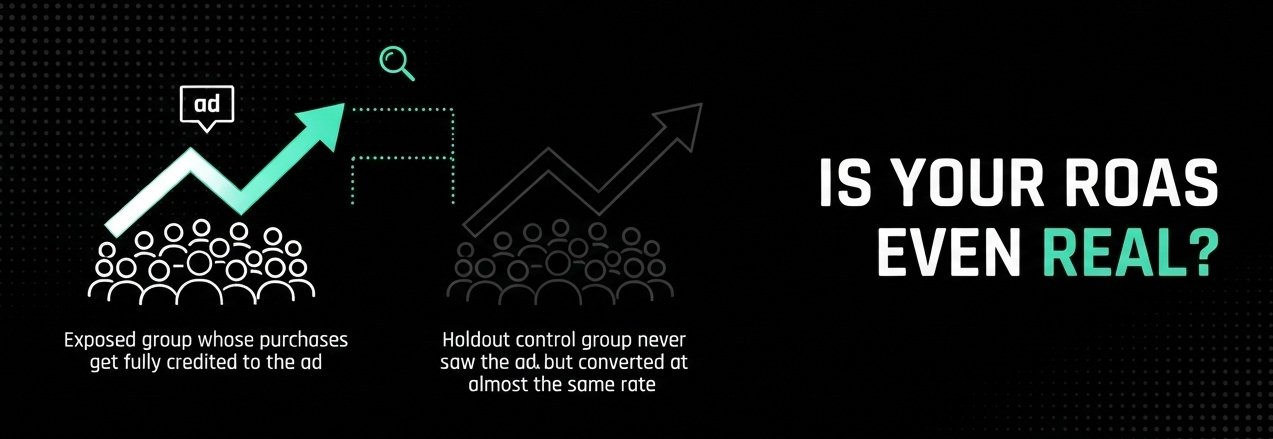
Attribution shows the map — which touchpoints a customer passed through before converting. Incrementality answers a more fundamental question: would this conversion have happened without the ad at all? A repeat customer who already intended to buy gets counted as a win by attribution the moment they click through, even though the ad may have changed nothing about their decision. Incrementality is the only method that separates a genuinely persuaded customer from one the ad simply happened to be standing near.
The Two Ways to Test It
Meta’s Conversion Lift Study, built into Ads Manager, randomly holds back a control group — typically 10 to 20% of the eligible audience — who never see the ad, then compares their conversion rate against the group that did. It’s free to run but needs real volume, generally around 200,000 users, to produce a statistically reliable result. For accounts too small to hit that threshold, a geo-holdout test is the practical alternative: pause the ad in three to five matched markets for about four weeks and compare regional sales against markets where it kept running
— a rougher read, but one that works at far lower spend.
What the Test Usually Reveals
Meta’s newer Conversion Count breakdown, which splits results into first-time versus repeat conversions, has surfaced results where only around 55% of reported conversions were genuinely first-time customers — the rest were repeat buyers a brand likely already owned regardless of the ad. Despite this being one of the highest-leverage checks available, only 52% of US marketers currently run any incrementality testing at all, according to a 2025 eMarketer survey — which means a properly run test is still a real competitive edge, not a routine industry practice.
Why the Real Number Is Usually Smaller Than the Dashboard
Once a test runs, the resulting incremental ROAS is consistently lower than the platform-reported figure — sometimes only modestly, sometimes dramatically. This isn’t platform dishonesty; it’s the structural gap between crediting every conversion inside a window and
proving which of those conversions the ad actually caused. A Meta Partner Agency reporting incremental ROAS and cost per incremental conversion alongside standard platform metrics is giving a founder the number that should actually drive a scaling decision.
What Can Distort a Result
Timing matters more than most tests account for. Running a holdout during Black Friday or a major product launch inflates both groups with deal-seeking or already-motivated buyers, compressing the visible gap between them and understating real lift. A neutral result — test and control performing the same — is a signal to revisit creative or offer, not proof the channel doesn’t work; a weak ad can still be running against an audience with genuine underlying demand.
How to Actually Run One
Smaller accounts should start with a geo-holdout — no minimum spend requirement, no need for Meta’s involvement, just matched markets and a clean four-week read. Larger accounts spending enough to hit the volume threshold should use Meta’s native Conversion Lift tool directly inside Ads Manager. Either way, this isn’t a one-time exercise: a baseline from six months ago is already a stale basis for today’s budget decisions, so quarterly retesting on the highest-spend channels keeps the calibration current as a meta ads agency continues to scale the account. The same discipline is worth applying to organic investment too — a GEO agency claiming its content is driving incremental revenue should be able to point to a comparable test, not just a rising traffic chart.
FAQs
You don’t need formal approval to launch one, but Meta recommends coordinating with an account representative for larger tests, since campaigns with insufficient conversion volume won’t produce a statistically reliable result. Very small or newly launched campaigns are usually better served by a geo-holdout instead.
A neutral result means the specific creative or offer being tested isn’t moving people who wouldn’t have converted anyway — it doesn’t mean the channel itself is worthless. Treat it as a signal to test a different creative angle or offer structure before concluding the channel deserves less budget.
Meta’s native Conversion Lift tool generally needs enough volume to reach roughly 200,000 users across test and control combined, which usually means meaningful monthly spend. A geo-holdout test has no fixed minimum — it trades some precision for accessibility, making it the realistic option for accounts well below that volume threshold.
Quarterly, at minimum, on your highest-spend channels. Audience behavior, competition, and creative all shift over months, so a result from two quarters ago is already an outdated basis for a current budget decision — treat it as a recurring calibration check, not a one-time verdict.
This single fix benefits every AI platform simultaneously and is almost always the actual blocker before protocol-specific integration work is worth pursuing.
Key Takeaways
- Attribution shows which touchpoints a customer passed through — incrementality proves which ones actually caused the conversion.
- Meta’s Conversion Lift Study needs roughly 200,000 users for reliable results; geo-holdout tests work at much lower volumes for smaller accounts.
- Only 52% of US marketers currently run incrementality testing, so a properly executed test remains a genuine competitive advantage rather than standard practice.
- Timing can distort results: testing during Black Friday or a major launch can inflate both groups and understate the true lift.
Meta Social — Dubai’s #1 Performance Marketing Agency
Meta Social builds incrementality testing into every Meta Ads UAE account review — so budget decisions are based on real lift, not platform-reported credit. Get in touch at metasocial.ae
Performance Marketing | SEO & GEO | AI Creatives & Video | Attribution Architecture
metasocial.ae | Dubai, UAE
About Meta Social
Meta Social is Dubai’s leading performance marketing agency and the GCC’s AI-native growth partner. We specialise in Performance Marketing, SEO & GEO, AI Creatives & Video, and Attribution Architecture — managing AED 50M+ in paid media across real estate, fintech, e-commerce, and hospitality.
metasocial.ae | Dubai, UAE