
What Actually Happens in the First 14 Days of a
New
Meta Ad Account
The first 14 days of a new Meta ad account are less about finding the winning campaign and more about finding out what the account can reliably learn. Early results are noisy: delivery is being established, the audience is responding to the offer and creative, conversion volume is building, and the team is still discovering which signals are useful. Treating the first few days as a final performance verdict is one of the fastest ways to overreact.
At Meta Social, we treat a new account as a measurement and learning problem before treating it as a scaling problem. A Meta Partner should be looking for patterns that survive beyond the first spike or dip — while making enough deliberate changes to learn, without constantly resetting the conditions the platform is trying to optimise against.
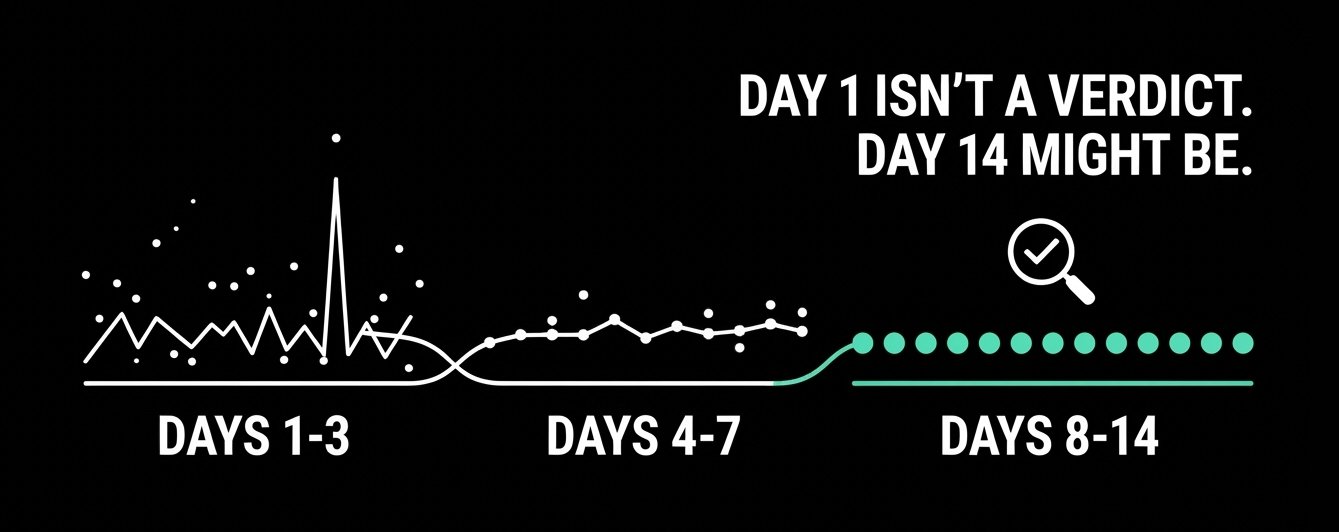
Days 1–3: The Account Is Proving That the Setup Works
The first few days are often the least useful time to make dramatic conclusions. Before worrying about whether the campaign has found its ideal audience, you need to know whether the basic system is functioning.
Are ads delivering? Are the intended events firing? Are landing pages loading properly? Are leads reaching the CRM? Is the offer generating the kind of response the campaign was designed to create?
A Meta ads agency that skips these checks can end up optimising a media problem that is actually a tracking, creative or conversion problem. Cheap clicks do not mean much if the destination experience is broken. A promising CPL does not mean much if the leads cannot be qualified.
Days 4–7: The First Patterns Start Appearing
By the middle of the first week, there is usually more useful information to work with — but still not enough to declare a winner simply because one ad has a better-looking number.
You are looking for directional signals. Which creative is earning attention? Which message is producing stronger intent? Are certain audiences producing more meaningful actions? Is the cost of conversion moving in the right direction, or are you simply seeing normal day-to-day volatility?
This is where a GEO agency mindset can be useful even outside search: look for the context behind the number. A lower CPC may be the result of cheaper attention rather than better demand. A higher CPL may be acceptable if the resulting leads are materially stronger.
The mistake is turning every early difference into a decision. A new account needs enough consistent evidence to distinguish a pattern from noise..
Days 8–14: From Initial Signals to Better Decisions
The second week is where the account should start becoming more interpretable. That does not mean the platform has suddenly revealed a permanent winning formula. It means the team has more evidence to decide what deserves another test, what should be removed and what needs a different commercial answer.
The best question at this stage is not “Which ad won?” It is “What did we learn that changes the next decision?” If one creative repeatedly produces better qualified leads, that is useful. If an audience generates volume but weak downstream quality, that is useful too. If several ads fail for the same reason, the problem may sit in the offer or landing page rather than the media setup.
That is where Performance marketing becomes more than buying impressions. The first two weeks should create a feedback loop between media, creative, conversion data and the actual economics of the business..
The Bigger The Biggest Mistake Is Changing Everything at Once
New accounts create a dangerous temptation: something looks weak, so the team changes the audience, creative, budget and optimisation approach at the same time. A few days later the numbers move, but nobody knows why.
Good testing needs enough control to make the result interpretable. Meta’s own testing guidance emphasises isolating variables when comparing creative or other elements, rather than changing everything simultaneously.
The same principle applies to campaign management. If every disappointing result triggers a complete rebuild, the account never gets a clean opportunity to reveal what is actually working.
The job in the first 14 days is therefore not to make the account look perfect. It is to make the next decision smarter than the previous one.
What Should You Actually Watch?
- Delivery and technical health: are campaigns, events, landing pages and lead flows working as intended?
- Creative response: which hooks, propositions and formats are attracting meaningful attention?
- Conversion quality: are the actions being generated commercially useful, not simply cheap?
- Stability: are patterns repeating across several days or appearing only as short spikes?
- Downstream outcomes: where possible, connect platform results to qualified leads, sales and revenue.
- Test clarity: can you explain what changed and what the change taught you?
A strong first fortnight should leave the team with fewer assumptions and better questions. That is a much more valuable outcome than a dashboard that looks impressive for three days.
FAQs
Usually, not as a final performance verdict. Three days can reveal technical problems or obvious creative issues, but early performance can be volatile. Use the period to identify problems and directional signals rather than declaring a permanent winner.
There is no universal number of days that guarantees reliable learning. The right point depends on campaign objective, conversion volume, budget, sales cycle and data quality. The first 14 days are best treated as a structured learning period, not a fixed platform rule.
The problem may not be the targeting. Check the offer, landing-page experience, tracking, lead form, follow-up process and the quality of the traffic. Cheap clicks can coexist with weak commercial intent.
Not automatically. First check whether the difference is large and consistent enough to be meaningful, whether the ad has received enough opportunity to generate useful data, and whether there is another issue affecting conversion. Remove clear underperformers, but avoid making every early fluctuation a hard decision.
Only when the performance and conversion quality are strong enough to justify the next level of spend. Scaling a short-lived spike can simply make an unstable result more expensive.
Key Takeaways
- The first 14 days are a learning period, not a final performance verdict.
- Fix technical and conversion problems before blaming targeting.
- Look for repeatable patterns rather than reacting to daily fluctuations.
- Change variables deliberately so the account can actually teach you something.
- The best outcome of the first fortnight is a smarter next decision.
Meta Social — Dubai’s #1 Performance Marketing Agency
Meta Social connects performance marketing, product data and AI-led shopping infrastructure to help UAE e-commerce brands turn product discovery into measurable growth.
Performance Marketing | SEO & GEO | AI Creatives & Video | Attribution Architecture
metasocial.ae | Dubai, UAE
About Meta Social
Meta Social is Dubai’s leading performance marketing agency and the GCC’s AI-native growth partner. We specialise in Performance Marketing, SEO & GEO, AI Creatives & Video, and Attribution Architecture — managing AED 50M+ in paid media across real estate, fintech, e-commerce, and hospitality.
metasocial.ae | Dubai, UAE