
Your Last-Click Report Says You Won. Your Business Might Disagree
Last-click attribution is easy to understand because it gives every conversion to the final interaction before purchase. The problem is that the final interaction is not necessarily the interaction that created the demand. A customer may see a Meta ad, search the brand later, visit through Google, return through WhatsApp and finally convert — with the last click receiving all the credit.
At Meta Social, we treat attribution as a measurement system rather than a reporting format. The goal is to understand which channels create demand, which capture existing intent and which assist the conversion — then make budget decisions using the full customer journey instead of rewarding whichever platform happened to get the final click.
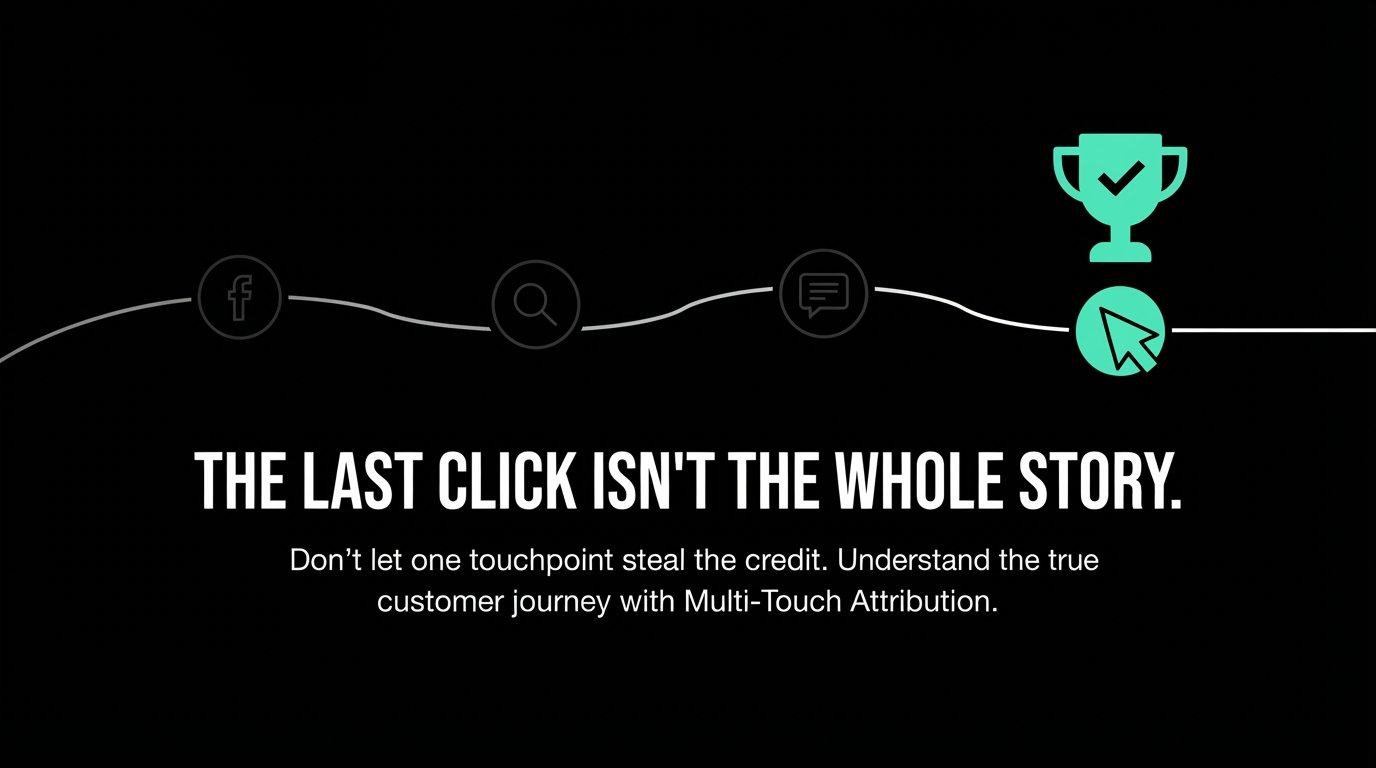
The Last Click Is Often the End of the Story, Not the Beginning
Imagine a Dubai property buyer who first sees a project on Instagram. They do not enquire immediately. A week later, they search the developer’s name, read reviews, watch a YouTube walkthrough and finally submit a lead form after clicking a branded search ad.
A last-click report can make Search look like the hero and Meta look like an expense. But without the earlier exposure, the branded search may never have happened. The model is answering a narrow question — ‘Where did the final conversion come from?’ — while the business is asking a much bigger one: ‘What caused this customer to become interested enough to convert?’
This is why a Meta ads agency should be careful about judging campaigns only by the conversion column inside a platform dashboard. A channel can create demand that another channel later captures, and the final click can hide that relationship.
The Problem Gets Worse When Customers Move Between Channels
Modern customer journeys rarely stay inside one platform. A consumer might discover a restaurant through Instagram, compare it on Google, ask a friend on WhatsApp and book through the website. A B2B buyer might watch a video, visit LinkedIn, search the company and return weeks later through direct traffic.
Every handoff makes the last click look more important than it may actually be. It also creates an incentive to over-invest in channels that are naturally good at capturing existing demand while under-investing in channels that create it.
This is where omnichannel measurement matters. The objective is not to find one perfect attribution model — there isn’t one. It is to compare multiple views of the journey and look for patterns that remain visible when the measurement lens changes.
A Meta Partner should therefore help clients ask different questions of the same data: which channel introduces customers, which one assists, which one closes, and what happens when investment in one channel changes?
What Better Attribution Looks Like
Better attribution does not mean building an unnecessarily complicated dashboard. It means separating the roles channels play and using more than one measurement lens.
- Use platform attribution for optimisation, but do not treat it as the complete business picture
- Compare first-touch, last-touch and multi-touch views where the data supports them
- Track branded search and direct traffic alongside paid-media activity to identify possible demand creation effects
- Connect lead-generation campaigns to downstream CRM outcomes, not just form submissions
- Use experiments or geo-based tests where possible to understand whether increasing spend actually changes total business results
This is where GEO agency thinking can also become relevant to measurement. If AI search, organic search, social and paid media all influence discovery, the brand needs a visibility picture that extends beyond the final website session. The customer may have encountered the brand long before analytics recorded the conversion.
The Metric Your CFO Actually Cares About
A campaign can have an impressive platform ROAS and still fail to create the profit the business expected. Discounts, margins, fulfilment costs, sales-team effort, refunds and repeat purchase behaviour can all change the economics after the platform reports a conversion.
That is why the most useful performance question eventually becomes bigger than ‘Which channel got the sale?’ It becomes ‘Which investment is creating incremental, profitable growth?’
For a Performance marketing team, that means moving from attribution as a credit-allocation exercise to attribution as a decision-making tool. The model does not need to be perfect. It needs to be good enough to stop the business from systematically overfunding the easiest-to-credit channel.
FAQs
No. It is useful for understanding the final conversion interaction and can be practical for reporting and optimisation. The problem comes when it is treated as the only explanation of how demand was created.
There is no universal best model. The right approach depends on the sales cycle, data quality, channel mix and business objective. Comparing multiple views and validating them with experiments is usually more useful than searching for one perfect model.
Platform ROAS is one input, not the complete business result. Compare it with CRM outcomes, revenue quality, margins and broader changes in demand where those measurements are available.
Start by mapping the actual customer journey and identifying where conversions move between channels. Then compare platform, CRM and business-level data before changing large amounts of budget.
Key Takeaways
- Last-click tells you where the conversion happened, not necessarily what created the demand.
- Cross-channel journeys make single-touch attribution increasingly incomplete.
- Use platform attribution for optimisation, but validate major budget decisions with CRM, business and experimental evidence.
- The goal is not perfect attribution; it is better decisions about incremental, profitable growth.
Meta Social — Dubai’s #1 Performance Marketing Agency
Meta Social connects paid media, creative, attribution and business outcomes so UAE brands can make budget decisions on what actually drives growth — not just what gets the final click.
Performance Marketing | SEO & GEO | AI Creatives & Video | Attribution Architecture
metasocial.ae | Dubai, UAE
About Meta Social
Meta Social is Dubai’s leading performance marketing agency and the GCC’s AI-native growth partner. We specialise in Performance Marketing, SEO & GEO, AI Creatives & Video, and Attribution Architecture — managing AED 50M+ in paid media across real estate, fintech, e-commerce, and hospitality.
metasocial.ae | Dubai, UAE