
We Almost Cut a Client's Budget in January Because of a Number That Was Never About Performance —
Here's What We Checked First
Direct Answer
Mid-January, a dashboard showed conversions down 22% week over week, with a budget review scheduled that Friday. The instinct in the room was immediate: cut spend before the number gets worse. It didn’t get cut.
As a performance marketing agency reviewing Meta Ads UAE accounts that same week, the identical 15–30% drop was showing up on unrelated campaigns with nothing in common except the platform they ran on — the pattern that stopped the number from being treated as a performance problem before checking what else had changed.
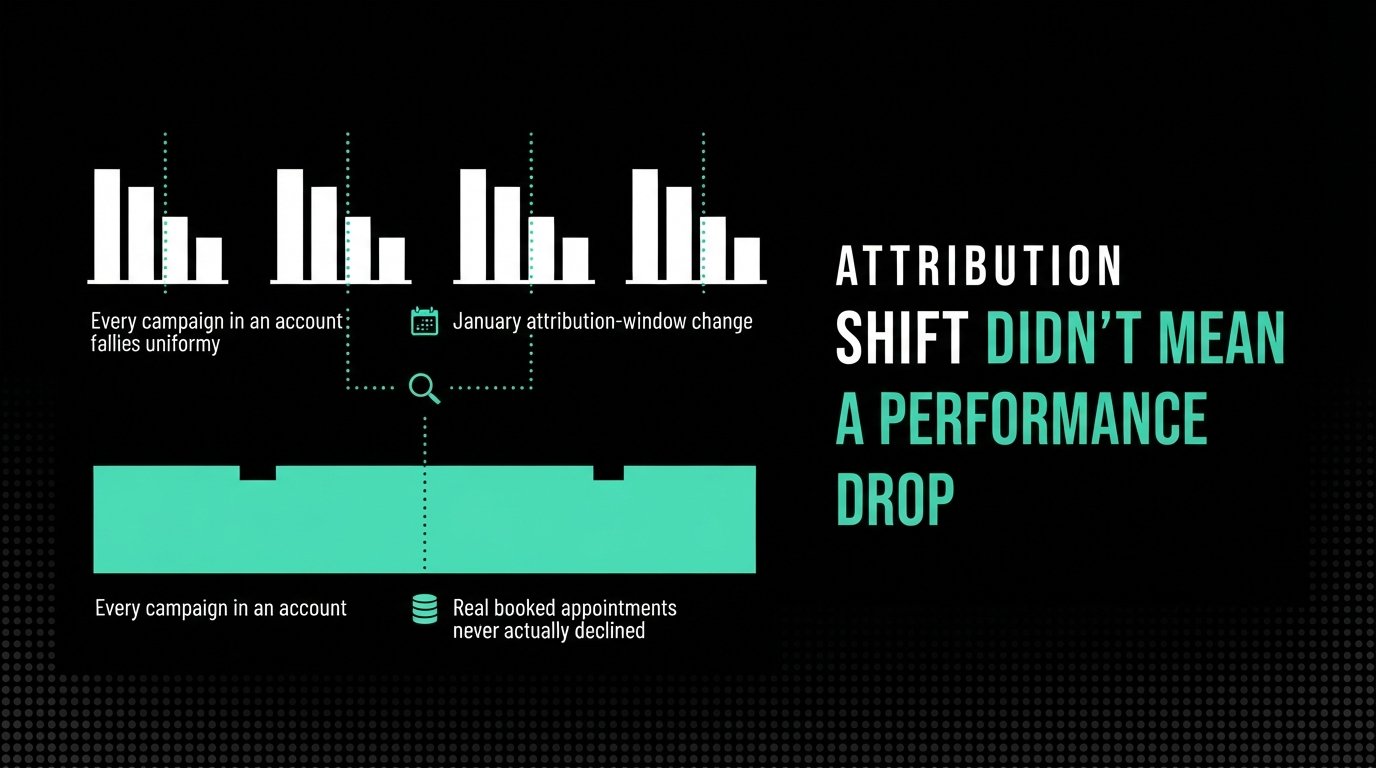
The Number That Triggered the Conversation
The account had been stable for four months — consistent CPA, predictable lead volume, no creative or budget changes in weeks. Then, in the second week of January, reported conversions dropped sharply across every campaign in the account simultaneously. Not one underperforming ad set — every single one, at roughly the same rate, on the same days. That uniformity was the first thing that didn’t fit a normal performance decline.
Why We Didn’t Cut the Budget That Week
A real performance problem — creative fatigue, audience saturation, rising competition — almost never hits every campaign at the exact same moment and magnitude. It shows up unevenly, spreading over days as frequency climbs or a segment burns out. A drop landing on every campaign simultaneously, at a near-identical percentage, is a measurement signature, not a performance one. That distinction is why the budget wasn’t cut that Friday.
What Actually Happened on January 12
Meta deprecated two attribution windows that week — 7-day view and 28-day view — that a meaningful share of accounts had reported under for years. Conversions that would previously have been credited to an ad someone saw but didn’t click, or converted within 28 days of viewing, stopped counting the same way overnight. Nothing about audience behavior changed. The ruler measuring it got shorter, and every account using those windows reported a drop that had nothing to do with actual sales.
We confirmed it by pulling CRM data for the same two-week window. Actual booked appointments — the number that pays the bills — hadn’t moved. The gap was entirely inside Meta’s own measurement, not inside the business.
The Three Checks We Run Before Trusting a Reported Drop
First: is the drop uniform across every campaign, or concentrated in a few? Uniform points to measurement; concentrated points to a real problem worth investigating. Second: does CRM or sales data confirm the same decline, or stay flat while the platform number falls? A gap means
the platform is undercounting, not that performance changed. Third: did the timing line up with a known platform change? A drop landing exactly on a documented change date is rarely a coincidence.
What We Told the Client Instead
We recommended holding the budget for two more weeks, reconciling every reported conversion against CRM bookings on a rolling basis, and re-baselining “normal” under the new attribution windows before any spend decision. A Meta Partner Agency should run this reconciliation as standard practice, not a special request — the platform’s reported number and the business’s actual number are two different things, and only one should ever drive a budget call. The same discipline applies to organic channels: a GEO agency reporting citation or traffic gains should be held to the same CRM-reconciliation standard before those numbers get credited with driving real leads.
What This Changes About How We Read Every Dashboard Now
Every reported swing gets the same first question before second-guessing the campaign itself: is this uniform, and does it line up with something Meta changed. Most performance problems are real and deserve a real response. But the ones that aren’t cost businesses twice — once from the panic cut, again from the weeks spent rebuilding a campaign that never needed fixing. Any meta ads agency that skips this check and reacts to the dashboard alone is making budget decisions without knowing what it’s actually measuring.
FAQs
Check whether the decline hit every campaign at once, at roughly the same rate. A uniform, account-wide drop usually points to a measurement or attribution change. A drop concentrated in one or two campaigns, building gradually, is far more likely to be a genuine performance issue worth investigating on its own terms.
Pull your CRM or actual sales data for the same period the dashboard is reporting on. If bookings, leads, or revenue stayed flat while the platform-reported number dropped, the gap is in measurement, not in the business. Never let a platform dashboard override what your own sales data is telling you.
No — accounts that relied more heavily on view-through conversions (someone saw the ad, didn’t click, converted later) were hit hardest, since the 7-day and 28-day view windows were the ones removed. Click-based conversions were less affected, which is part of why the drop hit some accounts far harder than others.
Give it a full reporting cycle — roughly 30 days — before treating the new numbers as the real baseline. Attribution changes take a few weeks to fully settle as Meta’s models adjust, and reacting to the first one or two weeks of post-change data risks making a decision based on numbers that are still stabilizing.
Key Takeaways
Attribution Window Deprecation: Meta’s January 2026 deprecation of the 7-day and 28-day view attribution windows caused reported conversions to drop 15–30% industry-wide with no actual change in user behavior.
Verifying Real Impact: CRM or actual sales data is the only reliable way to confirm whether a platform-reported drop reflects real business performance.
The Cost of Panic: The cost of a panic budget cut is often paid twice—once immediately, and again in the weeks required to rebuild a campaign that never needed fixing.
- A performance drop that hits every campaign in an account simultaneously, at a near-identical rate, is usually a measurement signature — not a real decline.
Meta Social — Dubai’s #1 Performance Marketing Agency
Meta Social reconciles every Meta Ads UAE dashboard against real CRM data before any budget decision gets made. Get in touch at metasocial.ae
Performance Marketing | SEO & GEO | AI Creatives & Video | Attribution Architecture
metasocial.ae | Dubai, UAE
About Meta Social
Meta Social is Dubai’s leading performance marketing agency and the GCC’s AI-native growth partner. We specialise in Performance Marketing, SEO & GEO, AI Creatives & Video, and Attribution Architecture — managing AED 50M+ in paid media across real estate, fintech, e-commerce, and hospitality.
metasocial.ae | Dubai, UAE