
Why Creative That Used to Last 3 Weeks Now Fatigues in 5–7 Days — And What That Does to Your Monthly Content Budget
Direct Answer
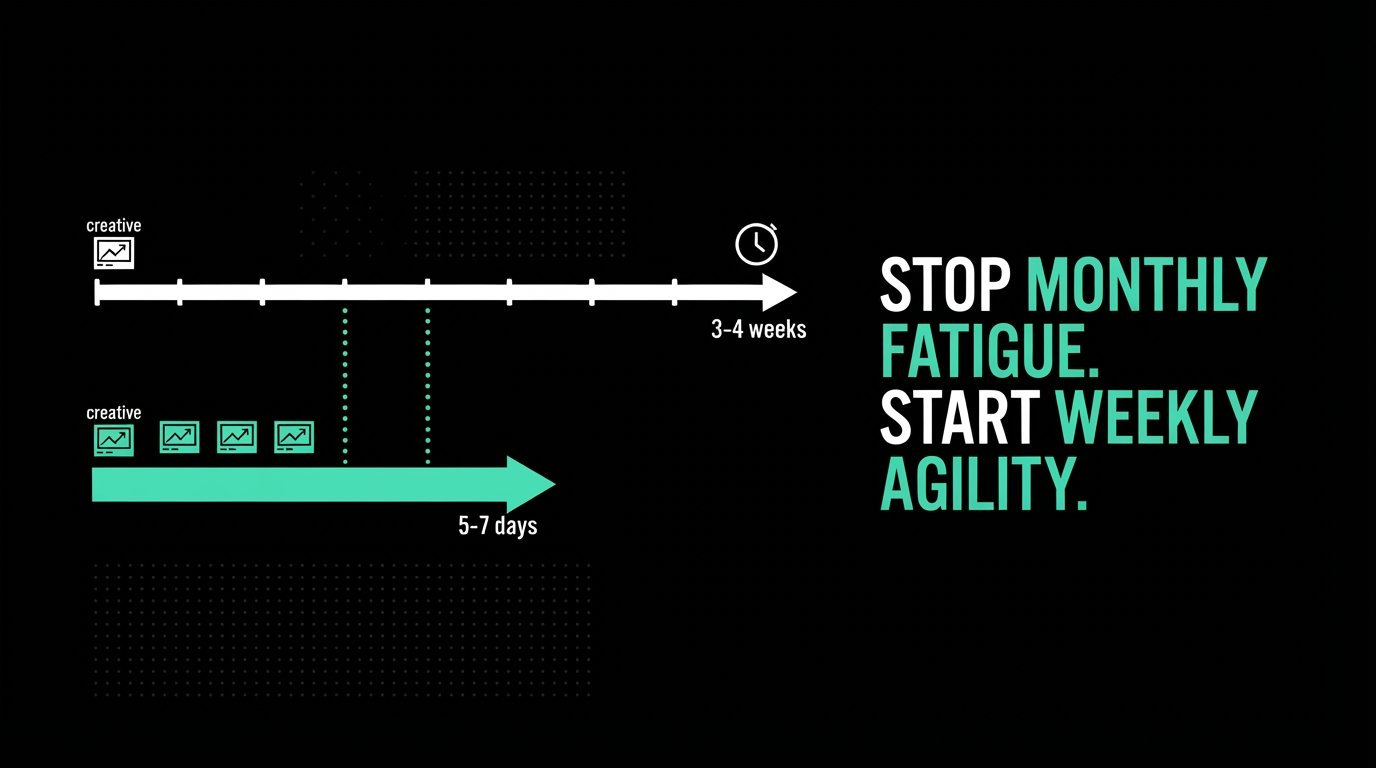
Three years ago, a strong Meta creative could carry a campaign for three to four weeks before performance slid. Today, the same ad often loses efficiency within five to seven days— sometimes less — with no change to offer, audience, or budget.
At Meta Social, we’ve traced this to how Meta’s delivery system works now, not to anything brands are doing wrong. The current ad-serving model exhausts a defined audience roughly three times faster than the one it replaced, compressing a creative’s entire lifecycle from weeks into days. As a performance marketing agency running accounts through this shift, we see the same result every time: a brand still briefing creative monthly ends up underperforming for two to three weeks out of every four.
Why Audiences Exhaust Faster Than They Used To
The old delivery model spread impressions evenly across a broad, loosely-scored audience, giving a creative a wide pool of fresh eyes before frequency became a problem. The newer model concentrates delivery on the narrow slice it scores as highest-intent, finding and re-serving the same high-value users far faster. That’s a deliberate efficiency gain for the platform — and the direct reason creative now runs out of fresh audience in days, not weeks.
When CPA climbs, frequency is the first thing we check — not audience, not offer. In client accounts, a frequency above 3 within a 7-day window is consistently where CTR starts declining, even with an unchanged creative. That’s not audience fatigue in the old sense. It’s the same small pool seeing the same ad for the fourth or fifth time in a week — a pattern any meta ads agency reviewing frequency data should catch immediately.
What Fatigue Looks Like Before CPA Actually Rises
CPA is a lagging indicator — by the time it moves, the decline has usually been building for days. At Meta Social, we track CTR against frequency on a rolling basis instead of waiting for cost per result to confirm a problem: a CTR drop of 15–20% against rising frequency reliably shows up three to five days before CPA visibly worsens. That gap is where a fresh variant, introduced early, prevents the spike a client would otherwise see on a monthly report.
The Monthly Content Budget Problem This Creates
Most creative production is still planned monthly — a brief goes out, a batch comes back, and the account runs on it until the next cycle. That cadence made sense at three to four weeks of useful life. It doesn’t match a five-to-seven-day fatigue window. A monthly batch now needs to survive four to five separate fatigue cycles before the next one arrives, and in practice most don’t — performance degrades in the back half of every month, then resets when new creative lands.
This is a budgeting problem before it’s a creative one. A budget sized for “four to six new ads a month” was calculated against the old timeline. Against the current one, that same budget structurally underfunds what the account needs — not because the creative is worse, but because the math behind it no longer holds.
How This Changes What “Enough Creative” Actually Means
At Meta Social, we’ve moved client accounts from a monthly release schedule to a rolling test queue — fewer new variants entering rotation weekly instead of a larger batch landing once a month. This usually means the same annual spend redistributed into smaller, more frequent runs timed to the account’s actual fatigue signal, not a calendar date. For a performance marketing agency managing multiple accounts, creative planning now sits inside the media strategy conversation, not beside it. Winning variants are also worth a second life outside the ad account: repurposed into organic content, exactly what a GEO agency specialises in, so one winning concept keeps earning attention long after it cycles out of paid rotation.
What Happens If the Budget Doesn’t Adjust
The accounts that struggle most aren’t running bad creative — they’re running good creative two to three weeks past its useful life. Every extra day runs at a quietly elevated CPA that never gets flagged, because nothing dramatic happened; the ad just kept running past the point it stopped being efficient. Over a quarter, that gap often costs more than producing the extra variants would have.
Creative production has become a media-buying decision, not a design task. A Meta Ads UAE account reviewed against last year’s playbook keeps showing the same pattern — strong first week, quiet decline, a CPA number that eventually forces a reaction — for as long as the production calendar and the platform’s real delivery behavior run on two different clocks.
FAQs
No — conversion-optimized campaigns with a narrow custom audience tend to fatigue fastest, often within the shorter end of the five-to-seven-day range, because the algorithm is concentrating delivery on a genuinely small pool. Broader awareness or reach campaigns hold up slightly longer since the eligible audience is larger to begin with, though the underlying frequency mechanic is the same.
Check frequency alongside CTR for the same date range. Rising frequency with declining CTR on an unchanged creative points to fatigue. If frequency is flat but CPA is still climbing, the more likely cause is audience saturation or increased competition in the auction — a different problem with a different fix, usually targeting-related rather than creative-related.
Usually neither in isolation. The fix is redistributing an existing budget into smaller, more frequent production runs rather than adding significant new spend. Some brands do need more total variants across a quarter, but the bigger unlock is usually cadence — producing on a weekly rolling basis instead of stockpiling a month’s worth of creative that ages out before it’s fully used.
It depends on account size and competition, but most active UAE accounts need at least two to three genuinely new concepts entering rotation weekly to stay ahead of a five-to-seven-day fatigue curve — not just resized or recolored versions of the same asset. A Meta Partner Agency reviewing your account should be able to show you exactly how many fresh concepts your specific fatigue rate requires.
Key Takeaways
- Meta’s current delivery model exhausts a defined audience roughly three times faster than the system it replaced — this is a platform mechanic, not a sign anything is being done wrong.
- Frequency and CTR decline three to five days before CPA visibly rises — tracking those two numbers catches the problem before it shows up on a monthly report.
- A creative production calendar built for a three-week fatigue window is structurally underfunded against a five-to-seven-day reality — this is a budgeting problem, not just a creative one.
- Shifting from a monthly release batch to a weekly rolling test queue usually redistributes existing budget rather than requiring a larger one.
Meta Social — Dubai’s #1 Performance Marketing Agency
Meta Social builds creative production calendars around your account’s actual fatigue rate, not a fixed monthly schedule. Get in touch at metasocial.ae
Performance Marketing | SEO & GEO | AI Creatives & Video | Attribution Architecture
metasocial.ae | Dubai, UAE
About Meta Social
Meta Social is Dubai’s leading performance marketing agency and the GCC’s AI-native growth partner. We specialise in Performance Marketing, SEO & GEO, AI Creatives & Video, and Attribution Architecture — managing AED 50M+ in paid media across real estate, fintech, e-commerce, and hospitality.
metasocial.ae | Dubai, UAE