
Why Optimising for "Landing Page Views"
Instead of "Purchases" Can Quietly Inflate Your CPM
Direct Answer
A campaign report lands on a founder’s desk showing CPM down 35% month over month. It looks like a win — until someone checks purchases for the same period and finds they haven’t moved at all. The CPM didn’t drop because the account got more efficient. It dropped because the campaign was quietly optimizing toward Landing Page Views instead of Purchases.
At Meta Social, this is one of the first things we check in any performance marketing agency handoff — not because it’s rare, but because it’s an easy, invisible switch that makes an account look healthier than it is. The optimization event a campaign is set to chase determines who Meta shows the ad to, and a cheaper event will always produce a cheaper, more misleading CPM.
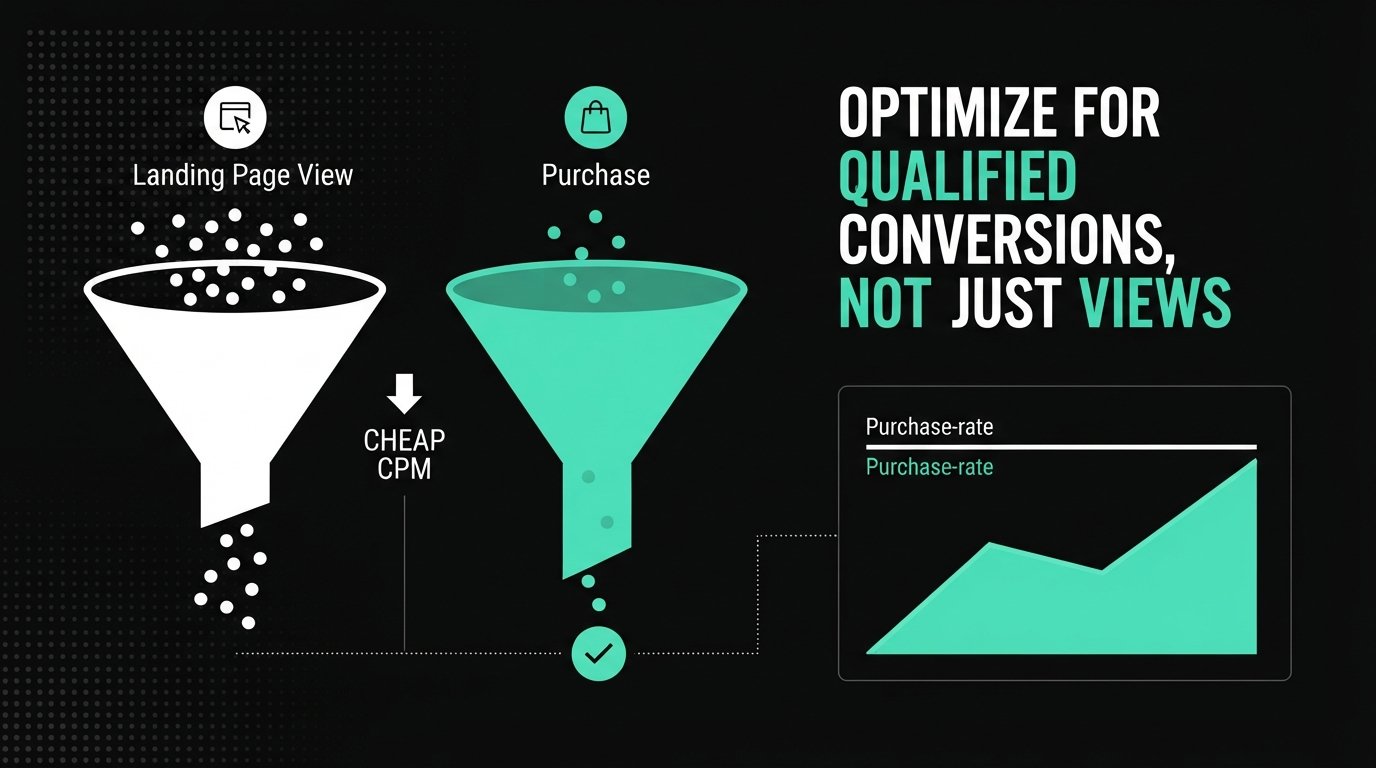
Why the Optimization Event Changes Who Sees Your Ad
Meta’s delivery system doesn’t show an ad to “everyone in your audience” — it predicts, for each person, how likely they are to complete the specific event the campaign is optimizing for, and prioritizes impressions accordingly. A Landing Page View only requires someone to load a page. A Purchase requires them to browse, decide, and check out. The pool likely to do the first thing dwarfs the pool likely to do the second — which is exactly why optimizing toward the easier event buys impressions at a lower CPM. It’s finding cheaper attention, not better customers.
Why This Mistake Is More Common Now Than It Used To Be
CPMs have climbed across most competitive UAE categories over the past year, which pressures anyone reporting monthly numbers to show a stable or improving cost trend. Switching a campaign’s optimization event to something cheaper to hit is one of the fastest ways to produce a better-looking chart without changing anything about the offer, creative, or targeting. It rarely happens as deliberate deception — more often it’s a leftover setting from an early build phase nobody revisited, or a well-intentioned “efficiency” fix that optimized the wrong number.
What a Cheap CPM on the Wrong Event Actually Costs
A lower CPM optimizing for Landing Page Views still spends the full budget — it just spends it reaching people never evaluated on purchase likelihood in the first place. The reported cost-per-thousand looks better, but real cost per purchase, traced through to actual sales, is often significantly higher than an account correctly optimized from the start. Any meta ads agency reporting CPM as a standalone win, without checking the event behind it, is handing a client a number that flatters the media plan and says nothing about revenue.
How We Catch This During an Account Audit
At Meta Social, one of the first things we check on any Meta Ads UAE account we take over is a simple cross-reference: what event is each campaign actually optimizing for, versus what the business actually needs. It’s a two-minute check that gets skipped constantly, since a campaign can run for months producing plausible-looking numbers without anyone opening that setting.
We then compare the CPM trend against the purchase-rate trend for the same period — CPM falling while purchase rate stays flat or worsens is the signal, almost every time.
When Landing Page View Optimization Is Actually the Right Call
This isn’t always a mistake. A brand-new pixel without enough purchase history genuinely can’t give Meta’s algorithm what it needs to learn who’s likely to buy — optimizing toward Purchase too early, before roughly 30–50 purchase events have accumulated, often produces unstable, expensive delivery. A temporary step through Landing Page View or Add to Cart, with a clear plan to shift once volume supports it, is legitimate. The problem isn’t using an easier event during a genuine ramp-up. It’s leaving it there permanently and reporting the resulting CPM as if it reflects purchase-ready performance.
Why This Deserves to Be a Strategic Decision, Not a Default Setting
The optimization event a campaign chases is one of the most consequential settings in the account, and usually the one that gets the least attention after launch. A Meta Partner Agency managing your account should be able to name, for every active campaign, exactly which event it’s optimizing toward and why that’s still right at the account’s current stage — not just what CPM was last month. The same discipline applies on the organic side: a GEO agency reporting traffic growth should be able to name the specific action that traffic is meant to drive.
FAQs
In Ads Manager, open the campaign at the ad set level and look at the “Performance Goal” or “Optimization Event” field under the conversion settings. It will explicitly state Landing Page View, Add to Cart, Purchase, or whichever event was selected — this takes under a minute to check and is worth verifying on every active campaign at least once a month.
Yes — for a genuinely new pixel or account without enough purchase history for Meta’s algorithm to learn from. It becomes a problem only when it’s left as the permanent setting well past the point where enough purchase data exists to optimize toward the real event, or when the resulting CPM is reported as if it reflects purchase performance.
Meta generally recommends at least 30 to 50 purchase events within a 7-day window before an ad set can exit the learning phase reliably on that event. Below that volume, Purchase-optimized delivery tends to be unstable and expensive. Once you’re consistently clearing that threshold, staying on a cheaper proxy event longer than necessary is costing you data, not saving you money.
The direct cost is spend delivered to people who were never evaluated on purchase likelihood— often a meaningfully higher real cost per purchase than the CPM report suggests. The indirect cost is larger: months of campaign data that trained the algorithm on the wrong signal, which then has to be relearned once the event is finally corrected.
Key Takeaways
Optimization Impact on Delivery: Meta’s delivery system shows your ad to people predicted to complete whichever event you optimize for—a cheaper event produces a cheaper, less meaningful CPM.
Warning Signs: A falling CPM alongside a flat or worsening purchase rate is the clearest sign a campaign is optimizing toward the wrong event.
Landing Page View Usage: Landing Page View optimization is legitimate during a genuine low-data ramp-up—the mistake is leaving it there permanently.
Audit Quick Win: Checking the optimization event on every active campaign takes under a minute and is one of the highest-value checks in a routine account audit.
Meta Social — Dubai’s #1 Performance Marketing Agency
Meta Social audits every campaign’s optimization event against what your business actually needs — not just what the CPM report shows. Get in touch at metasocial.ae
Performance Marketing | SEO & GEO | AI Creatives & Video | Attribution Architecture
metasocial.ae | Dubai, UAE
About Meta Social
Meta Social is Dubai’s leading performance marketing agency and the GCC’s AI-native growth partner. We specialise in Performance Marketing, SEO & GEO, AI Creatives & Video, and Attribution Architecture — managing AED 50M+ in paid media across real estate, fintech, e-commerce, and hospitality.
metasocial.ae | Dubai, UAE