
Why UAE Brands with Great Products
Still Lose on Google (The Intent Mismatch Problem)
Direct Answer
Intent mismatch is when your content answers a different question than the one the user is actually asking. It is the single most common reason high-quality content fails to rank, drive traffic, or generate leads — despite genuine investment in production. For UAE brands, intent mismatch is particularly damaging because the buyers researching in Dubai are often internationally sophisticated and precisely specific in their search behaviour. Meta Social diagnoses and fixes intent mismatch as the first step of every SEO and GEO engagement — because the best-written content in the world won’t rank if it’s solving the wrong problem. |
What Search Intent Actually Means
Every search query has an underlying intent that goes beyond the words themselves. Google classifies intent into four types: informational (I want to learn something), navigational (I want to find a specific site), commercial (I am researching before I buy), and transactional (I am ready to buy now). The content format, depth, and structure that ranks for each type is fundamentally different.
A blog post about ‘best areas to invest in Dubai real estate’ serves informational and commercial intent — the reader wants analysis and options, not a booking form. Sending this traffic to a project-specific landing page is an intent mismatch. A geo agency or performance marketing agency that doesn’t map content to intent is optimising production, not performance.
The Three Intent Mismatch Patterns UAE Brands Repeat
Pattern 1: Transactional Pages for Informational Queries
A developer builds a product page optimised for ‘Dubai waterfront apartments’ — which is a commercial/transactional query — and also tries to rank it for ‘is Dubai real estate a good investment’ — which is an informational query. The page can’t serve both intents. Google reads the format, structure, and content of the page and compares it to what users clicking that query actually want to find. A transactional product page for an informational query loses every time.
Pattern 2: Generic Content for Specific Queries
A fintech brand publishes a broad article titled ‘Everything About Business Banking in the UAE’. The article tries to capture 30 different keyword variations and ends up serving none of them well. ‘How to open a business account in Dubai as a foreign national’ is a specific query with a specific user — they want a step-by-step process guide, not a broad overview. Specific queries require specific content.
Pattern 3: Brand-First vs Answer-First Structure
Many UAE brand websites open content with a brand introduction before answering the question the user searched for. Google’s quality assessors — and AI Overview selection — reward content that answers the question in the first paragraph, not the third. A geo agency rewrites content structure to be answer-first: the direct response to the query stated clearly in the opening 60 words, with supporting evidence below.
How to Audit Your Content for Intent Mismatch
- Search your target query in an incognito browser and study the top 3 results — what format are they? What depth? What structure?
- Compare your page to the top results — if they’re listicles and yours is a long-form essay, you have a format mismatch
- Check Google Search Console — high impressions with low CTR often indicates a ranking page that doesn’t match the user’s expectation from the title
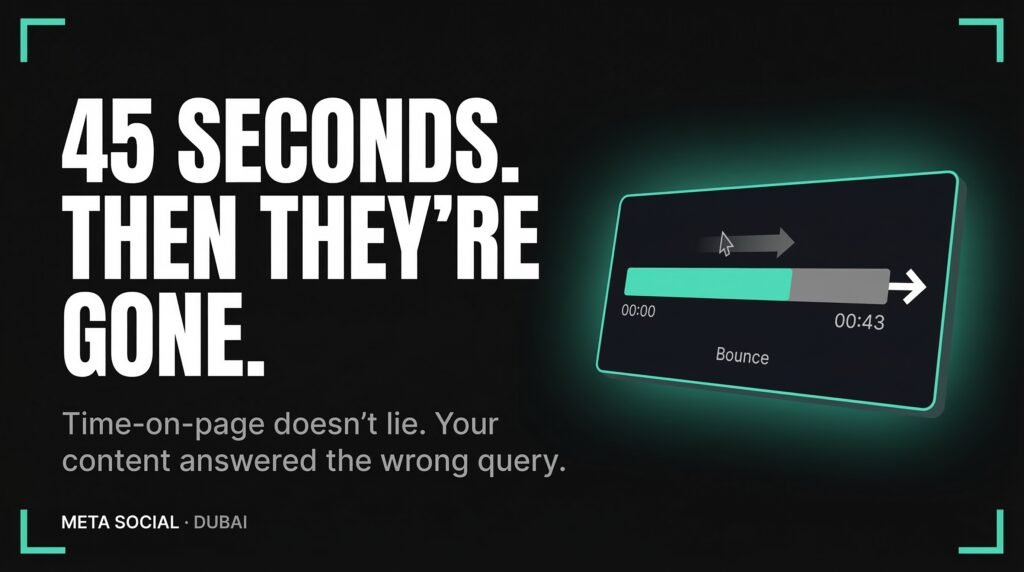
- Check time-on-page — if your ranking pages have under 45 seconds average engagement, users are landing and immediately leaving because the content doesn’t match what they needed
FAQs
Often yes. The most common fix is restructuring — moving the direct answer to the top, reformatting a long-form piece into a more scannable structure, or adding a clear FAQ section at the end. Full rewrites are only necessary when the content’s core angle fundamentally mismatches the query intent.
Directly. AI Overview citations are extremely intent-sensitive — the AI engine is trying to answer a specific question and cites the source that most precisely addresses that question. A broad or mismatched piece is almost never cited in an AI answer, even if it ranks on page 1. Working with a geo agency that understands intent architecture is essential for AI citation success.
For pages already ranking in positions 4–20, intent fixes can move rankings within 2–4 weeks — Google recrawls and reassesses. For pages not yet ranking, intent-corrected content typically takes 6–10 weeks to build authority. CTR improvements from fixing title and meta description intent alignment can show within 1–2 weeks of Google updating its index.
✓ Intent mismatch — content answering the wrong question — is the most common reason strong content fails to rank or convert. |
Meta Social — Dubai’s #1 Performance Marketing Agency Meta Social diagnoses and fixes intent mismatch for UAE brand content — building SEO and GEO-ready pages that match what buyers actually search for. Start at metasocial.ae Performance Marketing | SEO & GEO | AI Creatives & Video | Attribution Architecture metasocial.ae | Dubai, UAE |
About Meta Social Meta Social is Dubai’s leading performance marketing agency and the GCC’s AI-native growth partner. We specialise in Performance Marketing, SEO & GEO, AI Creatives & Video, and Attribution Architecture — managing AED 50M+ in paid media across real estate, fintech, e-commerce, and hospitality. metasocial.ae | Dubai, UAE |