
Meta Ads Retargeting Is Broken for Most UAE Brands.
Here's the Fix.
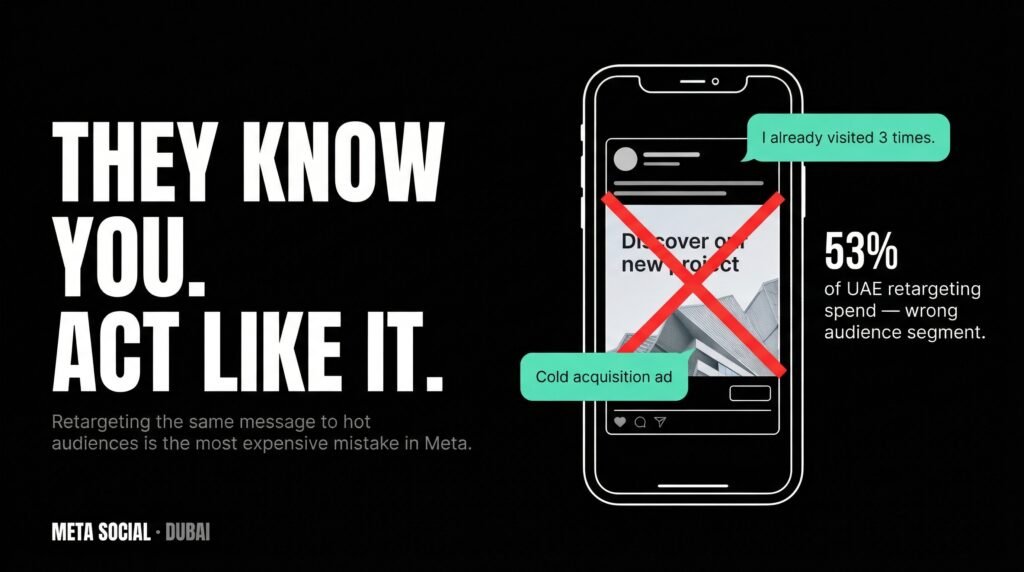
Direct Answer Most UAE retargeting campaigns are built on one flawed assumption: that everyone who visited your website is worth retargeting equally. They are not. Someone who spent six minutes on your pricing page, scrolled to the bottom, and then left to check their WhatsApp is a fundamentally different prospect from someone who bounced in nine seconds after landing on the wrong page from a mismatched search query. Treating both with the same creative, the same bid, and the same message is one of the most expensive mistakes in UAE performance marketing — because you’re paying premium retargeting CPMs to show a conversion ad to someone who was never close to converting. Meta Social rebuilds retargeting architecture for GCC brands from the signal layer up. Here is what the correct structure looks like. |
The Three Retargeting Mistakes UAE Brands Make — Repeatedly
Mistake 1: One Pool, One Message, Every Visitor
The default retargeting structure across UAE accounts is a single Website Visitors audience, 30 or 60-day window, running one creative. This pools your highest-intent visitors — people who reached a specific service page, watched a video, downloaded a brochure — with everyone who arrived, saw nothing relevant, and left. The CPL looks reasonable because the pool is large. The qualified lead rate is terrible because most of the pool had no meaningful intent.
A meta ads agency that doesn’t segment this pool is optimising for the average. And the average, in most UAE website traffic, is a visitor who was not a buyer.
Mistake 2: Showing Acquisition Creative to Warm Audiences
Retargeting audiences already know your brand. They’ve been to your website. They’ve seen your product. Showing them the same creative that introduced your brand to a cold audience — the awareness hook, the broad value proposition — is a wasted impression. It restarts a conversation that was already further along.
We took over a real estate developer’s account in Q3 last year. Their retargeting campaign was running the same brand-introduction video they’d been using for cold traffic — the developer story, the vision, the project overview. The audience had already seen this. They needed to hear something different: specific unit availability, pricing clarity, the answer to whatever objection had stopped them converting the first time. When we changed the creative — same audience, same budget, different message — qualified lead rate went from 6% to 19% in four weeks.
Mistake 3: No Exclusions for People Who Already Bought
Showing conversion ads to customers who have already converted is a brand experience problem, not just a budget waste problem. A buyer who completed a purchase or signed a reservation form and then sees an urgent ‘Limited units remaining’ retargeting ad is being told, implicitly, that the brand doesn’t know who they are. In the UAE’s high-trust, high-relationship purchase categories — real estate, financial services, luxury retail — this matters.
The Three-Tier Architecture That Fixes It
Segment your retargeting audiences by intent signal, and match creative to each tier:
- Tier 1 — Hot (7–14 day window): Pricing page visitors, checkout initiators, WhatsApp conversation starters, 75%+ video viewers. These people were close. The creative should address the specific objection that stopped them. Highest bid, highest frequency allowance.
- Tier 2 — Warm (15–30 day window): Product or service page visitors, 25–75% video viewers, lead form openers who didn’t submit. These people were interested but not decided. The creative should deepen the case — social proof, specific outcomes, reasons to act.
- Tier 3 — Cool (31–60 day window): Homepage visitors, blog readers, social engagers. These people showed curiosity, not intent. The creative should build familiarity and give them a reason to come back — not push them to convert immediately.
A performance marketing agency running this architecture is not just managing three audiences — it is running three genuinely different conversations with three different stages of buyer. The result is a retargeting system that converts the hot pool efficiently, develops the warm pool deliberately, and filters the cool pool for the visitors worth investing in.
Why This Starts With Your Event Tracking
You cannot build tier-based retargeting without granular event tracking. A Pixel that only fires PageView events sees every visitor as identical. To separate your pricing page visitors from your homepage bouncers, you need ViewContent events on key pages, video watch percentage events on product videos, and InitiateCheckout or LeadFormOpen events for high-intent actions. An ai agency dubai implementing this architecture starts with an event taxonomy audit before touching campaign structure — because without the signals, the tiers don’t exist.
FAQs
Meta requires 1,000 matched users minimum for delivery. In practice, Tier 1 audiences for most UAE brands will be small — 2,000 to 8,000 people depending on traffic volume. At this size, frequency accumulates fast. Scale budget proportionally to audience size: a Tier 1 audience of 3,000 people should not be carrying more than AED 1,500–2,000 per week, or you’ll be in the frequency damage zone within days.
No. Mixing them in one campaign creates a budget conflict — the algorithm will favour whichever audience converts faster in the short term, which is usually retargeting. This makes acquisition look inefficient (because retargeting is stealing its conversions) and makes retargeting look like the engine of growth (because it is claiming credit for conversions that were already warm). Separate campaigns give you real visibility into what each is actually doing.
Suppress retargeting ads for a randomly selected 10–15% holdout of your retargeting audience. Measure their conversion rate over 4 weeks against the exposed group. If the holdout converts at 80% of the rate of the exposed group, retargeting is driving 20% incremental conversion — real value. If the holdout converts at 95% of the rate of the exposed group, your retargeting campaign is mostly claiming credit for conversions that would have happened anyway. This is the test a serious meta partner agency runs before recommending any retargeting budget increase.
Key Takeaways ✓ Single-pool retargeting averaging across all visitors mixes a 6-minute pricing-page reader with a 9-second bouncer — and prices both at the same premium retargeting CPM. |
Meta Social — Dubai’s #1 Performance Marketing Agency Meta Social is Dubai’s leading performance marketing agency and the GCC’s AI-native growth partner. We specialise in Performance Marketing, SEO & GEO, AI Creatives & Video, and Attribution Architecture — managing AED 50M+ in paid media across real estate, fintech, e-commerce, and hospitality. metasocial.ae | Dubai, UAE |