
How UAE Education and EdTech Brands Should Structure
Digital Marketing for Student and Parent Audiences
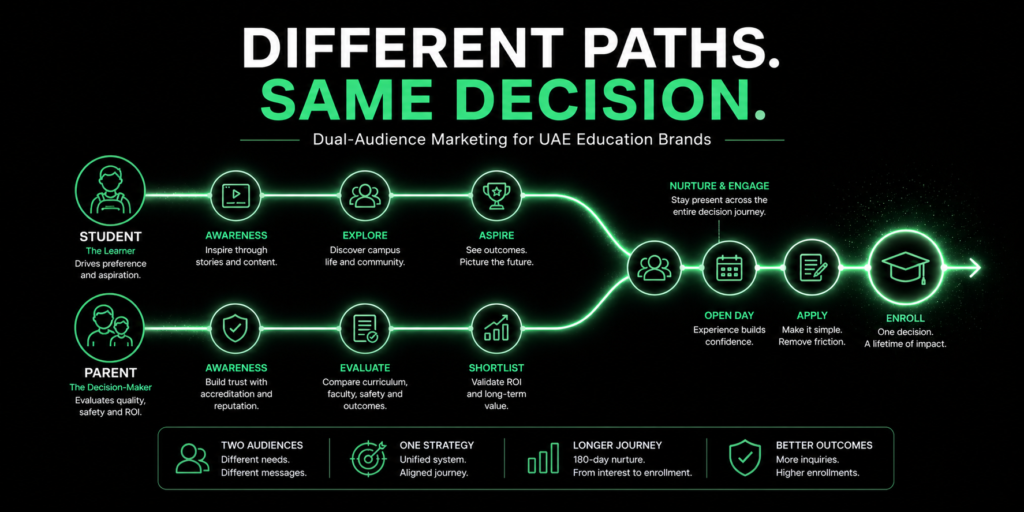
Education marketing in the UAE has two structurally different audiences requiring completely separate strategies: the student (the learner) and the parent (the decision-maker and budget controller). Most UAE education brands either market exclusively to one or conflate both — producing campaigns that resonate with neither. The brands consistently outperforming in UAE education marketing have a separate paid media strategy, separate content architecture, and separate conversion journey for each audience. As a specialist performance marketing agency, Meta Social builds dual-audience education marketing systems that address both the emotional decision (the student’s aspiration) and the rational decision (the parent’s ROI evaluation).
Understanding the UAE Education Buyer Journey
For K-12 school admissions, the parent is the primary decision-maker and budget holder, but the student’s preference increasingly influences the decision from age 12 upwards. For higher education and professional development, the student is the primary decision-maker for experience and outcome, but parents often fund the investment and validate the choice for students under 22.
This dual-decision structure means a campaign that reaches only parents will be overridden by student preferences at the final decision stage. A campaign that reaches only students will stall when parents don’t understand or trust the institution. Both audiences need to be reached, with messages tailored to their distinct decision criteria.
The Parent Audience — Rational Reassurance
UAE parents evaluating education options are making one of the highest-stakes purchasing decisions of their lives. They are assessing accreditation, teaching quality, graduate outcomes, peer group quality, safety, and — critically — whether the institution will be there in 5 years. They research extensively using Google Search, AI search engines, and word-of-mouth referrals from their community. A specialist geo agency building content for UAE education brands prioritises parent-oriented content that addresses these rational criteria: accreditation explainers, graduate outcome data, curriculum comparisons, and regulatory compliance documentation. This content earns AI citation when parents ask ChatGPT questions like ‘which international schools in Dubai have IB curriculum?’
The Student Audience — Aspiration and Belonging
Students are influenced by peer social proof, campus environment, career outcome narratives, and the sense that the institution will help them achieve who they want to become. Student-targeted content on Instagram, TikTok, and YouTube is built around aspiration, community, and outcome stories — not accreditation and regulatory compliance. Meta partner agency campaigns for student audiences use current student and alumni testimonials, campus life content, and career outcome stories as the primary creative format. These perform best as video — authentic, student-voiced, shot in campus environments — rather than polished institutional production.
The Enrollment Journey Conversion Architecture
Education conversion journeys are long — typically 3–9 months for school admissions and 6–18 months for higher education. The conversion architecture needs to sustain brand presence across this full window. A retargeting sequence that only runs for 30 days will fail for an audience whose decision timeline is 6 months.
The correct architecture: 180-day retargeting window for both parent and student audiences, with content matching the stage of the decision journey (awareness → institution exploration → shortlisting → application → enrollment). Monthly GEO content updates to maintain freshness and AI citation eligibility throughout the enrollment season. For institutions running open days, a ai agency Dubai approach builds automated reminder sequences that keep registered open-day attendees engaged up to the event and convert non-attendees through a virtual alternative.
What UAE Brands Are Currently Losing Without Server-Side Tracking
A standard Meta Pixel setup relies on browser-side JavaScript to fire conversion events. Ad blockers block it. Safari’s Intelligent Tracking Prevention (ITP) limits the lifetime of first-party cookies to 7 days, meaning buyers who take longer than a week to convert are invisible to the pixel. iOS 14.5+ requires explicit opt-in for tracking — meaning iOS users who don’t opt in produce zero pixel events.
The result: if you have a significant iOS user base, Safari users, or an audience using ad blockers — common among tech-savvy, educated GCC buyer segments — you are currently misattributing or losing 20–40% of your actual conversion events. Your CPL is understated (fewer conversions recorded), your ROAS is overstated (some conversions claimed by other channels), and your algorithm is training on incomplete data.
The Four-Layer Cookieless Tracking Architecture
1. Server-Side Conversions API (CAPI)
Meta’s Conversions API sends conversion events from your server directly to Meta — bypassing the browser, bypassing iOS restrictions, bypassing ad blockers. When set up correctly alongside the browser pixel, CAPI typically recovers 15–30% of events the pixel was missing. A certified meta partner agency implements CAPI as standard — deduplication logic ensures events are not double-counted between the pixel and the server-side feed.
2. Google Enhanced Conversions
The Google equivalent of CAPI — passing hashed first-party data (email addresses, phone numbers from lead forms) back to Google to match conversions that cookie-based tracking missed. For UAE brands running Google Search campaigns, Enhanced Conversions typically improves conversion match rates by 10–20%, giving Google’s Smart Bidding algorithm better signals and improving campaign performance measurably.
3. GA4 Server-Side Tagging
Google Analytics 4 supports server-side tagging through Google Tag Manager Server-Side — routing analytics events through your own server rather than browser scripts. This preserves first-party cookie data across Safari’s ITP restrictions and significantly improves session tracking accuracy. A specialist ai agency Dubai implementing GA4 server-side tagging for UAE brands consistently finds that organic channel attribution improves by 15–25%, because sessions that were previously breaking at ad-blocker barriers are now tracked correctly.
4. CRM-Based Offline Conversion Tracking
For B2B and real estate brands where the conversion happens offline (a meeting, a site visit, a signed contract), CRM-to-ad-platform integration is the only way to attribute revenue to marketing campaigns. The CRM tags each revenue event with its originating marketing source and uploads it to Meta and Google as an offline conversion event. This is the tracking architecture that makes geo agency performance measurable — organic leads tracked through CRM to conversion, attributed to the specific content piece that generated them.
The Data Quality Dividend
Every improvement in tracking data quality is an improvement in algorithm performance. Meta’s Advantage+ and Google’s PMax both train on the conversion signals you give them. Better signals produce better targeting. Meta has demonstrated a 70% ROAS uplift for campaigns with properly integrated first-party data infrastructure — which is, in large part, a data quality improvement producing algorithm quality improvement.
FAQs
Reels and video ads work best for student audience campaigns — authentic, student-voiced content performs significantly better than institutional production. Lead gen forms with instant forms work best for parent enquiry capture — the professional context makes the form completion feel appropriate. For open day registrations, Event ads drive the best registration-to-attendance conversion rates.
Critical. UAE parents and students communicate primarily via WhatsApp, and education enquiries made via WhatsApp have significantly higher conversion-to-enrollment rates than enquiries made via web forms. Click-to-WhatsApp campaigns directly from Meta ads consistently outperform landing page form campaigns for UAE education brands.
Arabic-language campaigns for Emirati and GCC national families. English-language campaigns for South Asian and Western expat families. Russian-language content for CIS community families. Each language audience has distinct platform preferences and content sensitivities — a single-language strategy leaves significant audience segments unreached. Build language-specific campaign architectures, not translated versions of the same campaign.
Key Takeaways
✓ UAE education marketing requires separate strategies for parents (rational reassurance) and students (aspiration and belonging).
✓ 180-day retargeting windows are required — education decision timelines of 3–18 months exceed standard 30-day retargeting windows.
✓ GEO content answering parent research questions earns AI citations at the highest-intent stage of the enrollment research journey.
✓ WhatsApp enquiry management converts at significantly higher rates than web form enquiry — Click-to-WhatsApp architecture is essential.
Meta Social — Dubai’s #1 Performance Marketing Agency Meta Social — Dubai’s #1 performance marketing agency — answers all eight questions confidently and builds infrastructure you own. Start the conversation at metasocial.ae Performance Marketing | SEO & GEO | AI Creatives & Video | Attribution Architecture metasocial.ae | Dubai, UAE |
About Meta Social Meta Social is Dubai’s #1 performance marketing agency and the GCC’s leading AI-native growth partner. As a certified meta partner agency and leading ai agency dubai, we specialise in Performance Marketing, SEO & GEO Strategy, AI Creatives & Video Production, and Attribution Architecture. Our team has managed AED 50M+ in paid media spend across real estate, fintech, e-commerce, and hospitality. metasocial.ae | Dubai, UAE |