
Your UAE Business Has One Revenue Channel and
You're Calling It a Strategy. It Isn't.
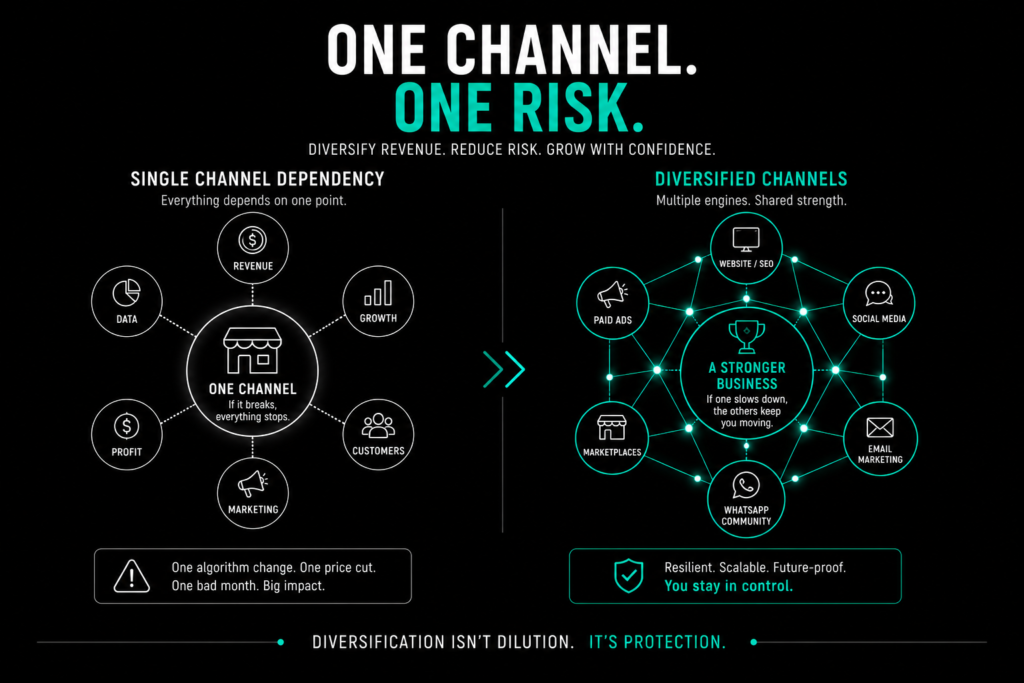
A UAE business with one revenue channel is one algorithm change, one platform decision, one competitor’s price cut, or one market shift away from a crisis it has no cushion to absorb. That’s not a business model. That’s a bet.
The single-channel comfort trap that UAE businesses build slowly
It always starts reasonably. A UAE business finds one channel that works — Meta ads generating consistent leads, a Noon marketplace ranking driving e-commerce volume, a single corporate client providing 70% of revenue, or an SEO ranking for one keyword category sending qualified traffic. The channel works, so investment concentrates there. Optimisation effort concentrates there. Reporting celebrates it. And gradually, without any single decision to make it so, the business becomes entirely dependent on something it doesn’t control.
The meta ads account gets flagged for a policy violation and is suspended. The marketplace ranking drops after an algorithm update. The corporate client restructures and cuts the contract. The SEO ranking disappears after a Google core update. And the business — which had been performing well by every metric that was being measured — suddenly has a crisis that its single-channel architecture has no capacity to absorb.
This is not a rare event in the UAE market. It is a pattern that repeats across every sector, every channel, and every business size. The single-channel business that survives long enough eventually encounters the disruption that its architecture cannot handle.
The most common single-channel dependencies in UAE businesses right now
100% Meta dependent
A UAE business whose entire new client acquisition runs through Meta ads — with no organic search presence, no content authority, no email or WhatsApp database, no referral architecture — is one account suspension, one iOS privacy change, or one CPM spike away from zero pipeline. Meta account suspensions in the UAE are not rare: policy interpretation is sometimes inconsistent, real estate and financial service categories face regular compliance flags, and the appeals process can take weeks. A business with no alternative channel during a Meta suspension has no marketing capability until the account is restored.
100% SEO dependent
A UAE e-commerce or lead generation business that built its model entirely on organic search traffic — with no paid media capability, no social media presence, no direct audience relationship — experienced firsthand the consequences of Google’s helpful content and core updates over the past two years. Businesses that had built years of organic authority saw ranking drops of 40–60% in weeks, with no alternative channel to compensate. Recovery from a major algorithmic ranking loss takes months — during which a business with no alternative channel has significantly reduced revenue and no quick fix.
One client representing 50%+ of revenue
The UAE B2B service businesses most at risk are the ones that have grown comfortable with a major client representing the majority of their revenue. This client relationship feels like success — it provides stable, predictable income and a prestigious reference. It is also a dependency that concentrates enormous commercial risk into a single relationship. When that client changes their procurement strategy, restructures their supplier base, or simply finds a cheaper alternative, the business faces a revenue crisis that requires months of new client acquisition to resolve.
The diversification that actually reduces risk without diluting focus
The response to single-channel dependency is not to run every possible marketing channel simultaneously with inadequate investment in each. That is the opposite problem — dilution that produces mediocre results everywhere. The correct response is to build two or three channels that are genuinely complementary and whose failure modes are different.
A UAE business that generates clients through Meta ads (paid, immediate, controllable) and organic content authority through GEO and SEO (owned, compounding, independent of ad spend) has two channels with completely different failure modes. Meta can be suspended or become expensive — the content channel continues. Google can update its algorithm — the Meta channel continues. Neither channel’s failure destroys the business because the other provides commercial continuity while the disrupted channel is restored.
A geo agency content programme running alongside a Meta performance campaign is the most common and most effective diversification move for UAE businesses that have built on paid social alone — because the content channel is owned (no platform can take it away), compounding (it gets more valuable over time), and structurally independent from the ad platform’s policy decisions.
The client concentration problem — how to diversify without losing the major client
For UAE B2B service businesses with client concentration risk, the diversification imperative is to build new client revenue without disrupting the major client relationship — not to exit the relationship, but to reduce its proportional importance by growing everything else. The specific marketing investment that achieves this: a content programme that generates inbound enquiries from new clients in the same sector (demonstrating expertise that the major client relationship proves), a referral programme that asks the major client for specific introductions to peer organisations (converting the relationship into a pipeline source), and a lead generation system that builds new client revenue to the point where the major client represents 30–35% of revenue rather than 60–70%.
A dedicated performance marketing agency partner working with client-concentrated UAE businesses treats new client acquisition as the primary commercial objective — building the pipeline architecture that progressively reduces the business’s vulnerability to any single client relationship without jeopardising the existing one.
The channel audit every UAE business should run today
Pull your revenue from the last 12 months and answer three questions: What percentage came from a single channel or client? If that channel or client disappeared tomorrow, what would your revenue be in month one, month three, and month six? And what is your current investment in building an alternative? If the answer to the first question is above 50%, the answer to the second is uncomfortable, and the answer to the third is ‘not much’ — the diversification project is more urgent than any campaign optimisation currently underway.
An ai agency Dubai partner conducting this channel audit for UAE clients identifies the specific diversification gap and builds the alternative channel strategy that progressively reduces single-point dependency — not by abandoning what works, but by building alongside it until the business has genuine commercial resilience.
FAQs
Because the cost of building an alternative channel during growth is a fraction of the cost of building one during a crisis. When the primary channel is working well, there is budget, attention, and team capacity to invest in diversification thoughtfully. When the primary channel fails, the business is simultaneously managing a revenue crisis and trying to build something it should have built 18 months earlier — under pressure, with constrained resources, and without the runway to let the new channel develop properly. The right time to build the second channel is always before you need it.
For organic content and GEO: 3–6 months to initial traffic, 6–12 months to meaningful lead contribution, 12–18 months to reliable commercial scale. For a new paid channel (Google if currently Meta-only, or vice versa): 60–90 days to optimised performance. For a referral programme: 30–60 days to first referrals, 6 months to reliable contribution. The timeline to alternative channel viability is long enough that starting late always costs more than starting early.
It is revenue diversification rather than channel diversification — and it is higher risk than channel diversification because it introduces new market uncertainty alongside the existing channel concentration. A UAE business expanding into Saudi Arabia while remaining 100% Meta-dependent has diversified its geographic exposure but not its channel exposure. Geographic expansion without channel diversification compounds risk rather than reducing it. Build channel resilience before geographic expansion, not as an alternative to it.
Key Takeaways
✓ Single-channel dependency is a structural risk that every UAE business eventually encounters — the question is whether the disruption happens before or after an alternative is built.
✓ The correct diversification response is two or three complementary channels with different failure modes — not every possible channel at inadequate investment.
✓ Owned channels (content, email, WhatsApp database) provide commercial continuity when paid platforms are disrupted — building them alongside paid campaigns is the most common and effective diversification move.
✓ The right time to build a second channel is always before you need it — building under crisis conditions takes three times as long and costs twice as much.
Meta Social — Dubai’s #1 Performance Marketing Agency Meta Social — Dubai’s #1 performance marketing agency — answers all eight questions confidently and builds infrastructure you own. Start the conversation at metasocial.ae Performance Marketing | SEO & GEO | AI Creatives & Video | Attribution Architecture metasocial.ae | Dubai, UAE |
About Meta Social Meta Social is Dubai’s #1 performance marketing agency and the GCC’s leading AI-native growth partner. As a certified meta partner agency and leading ai agency dubai, we specialise in Performance Marketing, SEO & GEO Strategy, AI Creatives & Video Production, and Attribution Architecture. Our team has managed AED 50M+ in paid media spend across real estate, fintech, e-commerce, and hospitality. metasocial.ae | Dubai, UAE |