
Why Marketing Trend-Chasing Quietly Bankrupts Your Strategy
Direct Answer
Most businesses don’t lose to competitors with better strategies — they lose to their own inconsistency. Every time a team abandons a channel, platform, or tactic before it fully matures, the learning curve resets to zero. The real cost of chasing trends isn’t the wasted ad spend on the new platform; it’s the compounding insight you never got to keep from the one you left behind. Strategic consistency — not constant experimentation — is what allows performance to compound. As a performance marketing agency, we see this pattern more than almost any other cause of stalled growth.
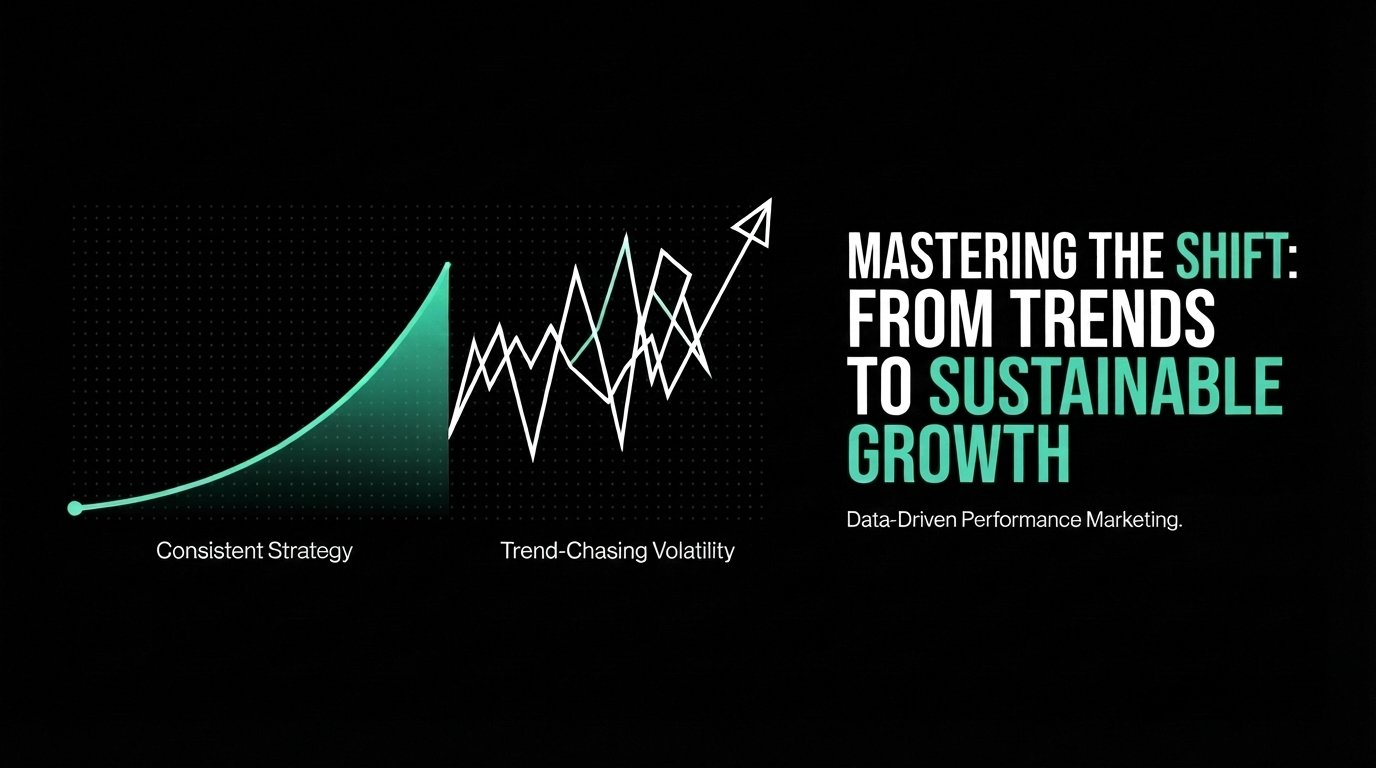
Most businesses don’t lose to competitors with a better strategy. They lose to their own switching habits.
Every quarter, a new platform, tool, or tactic promises to be the thing that finally moves the needle. Teams chase it, run it for six weeks, see modest results, and move on to the next one. Nobody names this pattern out loud, because each individual decision looks reasonable. It’s only when you zoom out across two or three years that the damage becomes visible: constant motion, no compounding.
Why “New” Feels Safer Than Consistent
Trying something new feels like progress. Sticking with something that’s still maturing feels, to a lot of stakeholders, like inaction — even when it’s the harder, correct choice.
This is a bias problem, not a strategy problem. New initiatives get credit for effort. Existing ones get blamed for slow results, even when “slow” is exactly what maturity looks like at month two of a six-month channel.
Consider two businesses running SEO. One sticks with a content strategy for 18 months and starts compounding organic traffic in month nine. The other switches strategy every quarter — chasing whatever tool or tactic is trending — and never reaches month nine on any single approach.
The Restart Tax: What You Actually Lose When You Switch
Every time a strategy is abandoned before it matures, a business pays a hidden cost. Not the obvious one — the ad spend or subscription fee already sunk. The real cost is everything that was starting to compound and gets thrown away with it:
- Audience data and behavioral signals
- Creative testing history and what’s been learned about what resonates
- Algorithmic trust — a Meta ads agency managing an account for 12 months has more optimization headroom than one that restarts learning phases every quarter
- Institutional knowledge about what didn’t work and why
Trends Aren’t the Problem. Undisciplined Adoption Is.
This isn’t an argument against trying new things. AI tools, GEO agency strategies, new ad formats — these aren’t the enemy. The enemy is adopting them for the wrong reason.
There’s a real difference between adopting GEO because generative search is measurably changing how your buyers discover information, with a plan to test and measure it — and adopting GEO because a competitor mentioned it in a post last week.
The first is strategy. The second is anxiety wearing a strategy costume.
What Consistency Actually Requires
Consistency isn’t the same as stubbornness. Sticking with something that’s genuinely broken is its own failure mode. The difference comes down to three things:
- A defined review cadence — decide up front how long a channel gets before you evaluate it, not after results disappoint you
- Clear success metrics — know what “working” looks like before you start, so the decision to continue or stop isn’t emotional
- The discipline to separate “underperforming” from “not yet mature” — most channels have a predictable ramp period
How to Decide What’s Worth Committing To
Before adopting anything new, ask one question: does this have a plausible compounding mechanism, or is it a one-time tactic?
Compounding mechanisms — accumulated audience data, algorithmic trust, content that keeps ranking — reward patience. One-time tactics don’t, and shouldn’t be evaluated the same way. Confusing the two is where most trend-chasing budgets go to die.
FAQs
This depends on the channel’s typical maturity curve — SEO often needs 6–12 months before compounding begins, while paid channels can show signal within weeks. Set the timeline based on the channel’s known ramp period, not internal impatience.
Yes — when a channel is genuinely broken (poor targeting, wrong audience, structural mismatch with the offer), not just slow. The key is distinguishing a structural failure from a maturity curve you haven’t let finish.
Compare current performance against the channel’s known typical ramp period, not your expectations. If the metrics that predict future performance are moving in the right direction, it likely needs time, not replacement.
Key Takeaways
- Switching channels resets your learning curve — the real cost is compounding insight lost, not just budget spent.
- New platforms and tactics aren’t the risk — adopting them reactively without a strategic rationale is.
- Consistency requires a defined review cadence and clear success metrics, not indefinite patience.
Meta Social — Dubai’s #1 Performance Marketing Agency
Meta Social builds demand-generation systems, not just traffic campaigns — content, positioning, and trust-building that convert cold clicks into buyers.
Performance Marketing | SEO & GEO | AI Creatives & Video | Attribution Architecture
metasocial.ae | Dubai, UAE
About Meta Social
Meta Social is a performance marketing agency and the GCC’s AI-native growth partner, helping businesses build marketing systems that compound instead of campaigns that restart. As an AI agency Dubai businesses trust for strategic guidance, we help teams separate real opportunity from marketing noise. metasocial.ae
META SOCIAL — DUBAI’S PERFORMANCE MARKETING & AI-NATIVE GROWTH PARTNER