
Why Sales and Marketing Stay Misaligned Even
When Everyone Agrees They Shouldn't Be
Direct Answer
Sales and marketing alignment initiatives usually fail for a reason no one names directly: the two teams are incentivized around different time horizons. Sales is rewarded for revenue closed this quarter. Marketing is rewarded for pipeline volume, brand awareness, or long-term demand — outcomes that take longer to materialize. No amount of joint meetings fixes that fork, because the underlying incentives still pull each team in a different direction. As a Meta Partner Agency, we’ve found real alignment means redesigning shared KPIs around revenue outcomes both teams can actually influence together.
Almost every company agrees sales and marketing should be aligned. Alignment workshops get scheduled. Shared Slack channels get created. And within a quarter, the same complaints return: marketing says sales isn’t following up on leads, sales says marketing isn’t sending qualified ones.
If everyone agrees alignment matters, why does it keep failing? The honest answer isn’t about communication. It’s about what each team is actually paid to do.
The Alignment Myth: Why More Meetings Don’t Work
Communication-based fixes treat a structural problem as if it were an interpersonal one. More check-ins, more shared dashboards, more “let’s get on the same page” meetings — these can improve rapport, but they don’t touch the underlying issue: the two teams are still being measured, and paid, on different definitions of success.
You can have excellent communication between two teams pulling in different directions. It won’t fix the direction problem.
The KPI Fork: Where the Real Disconnect Starts
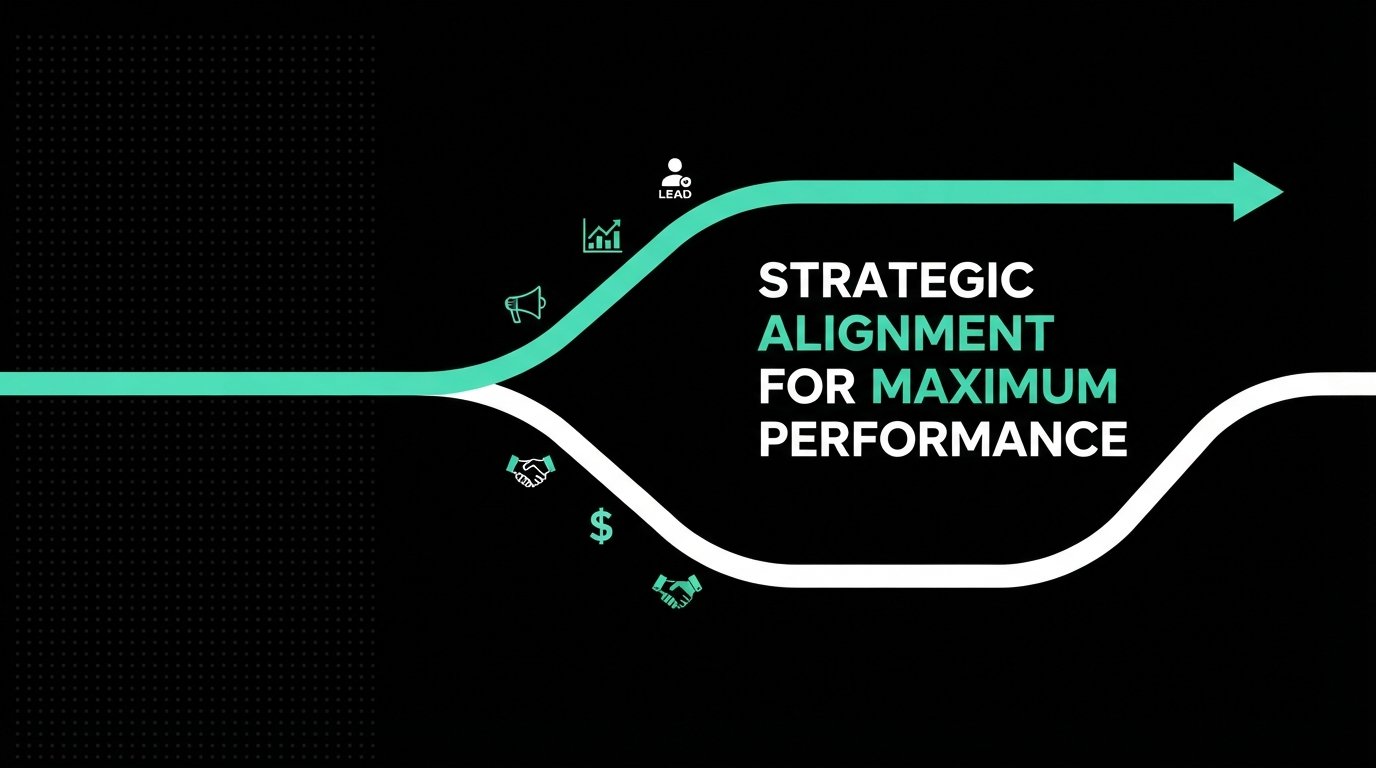
Picture a sales cycle as a timeline. At the start, marketing generates a lead and reports a win — an MQL, a form fill, a booked demo. Marketing’s incentive is satisfied here, near the beginning of the timeline.
Sales’ incentive doesn’t activate until much later — a closed deal, often weeks or months down that same timeline. Between those two points, the lead has to survive qualification, objection handling, and a buying committee. If it doesn’t convert, both teams can point to their own numbers and claim they did their job.
This is the KPI Fork: two incentive structures diverging from a single starting point. A marketing team hitting every MQL target while a sales team reports declining lead quality isn’t a contradiction — it’s two teams correctly following two different scoreboards.
What Shared KPIs Actually Look Like
Fixing the fork means moving both teams onto metrics that only make sense together:
Sales-accepted lead rate — not just how many leads marketing sends, but how many sales actually wants to work
- Pipeline velocity — how quickly leads move through stages, which both teams influence
- Revenue-stage conversion — tracking a lead all the way to closed revenue, not stopping the count at MQL
Closing the Feedback Loop with CRM and AI Data
Shared KPIs only work if both teams can see the same data in near real time. CRM insights and AI-driven lead scoring create that shared visibility — surfacing which lead sources actually convert to revenue, not just which ones generate volume.
This also closes the loop in the other direction: feedback from sales about which Meta ads agency–sourced leads actually close should inform how marketing adjusts targeting and creative — not sit in a CRM field nobody reviews.
What Changes When the Fork Is Fixed
When incentives point the same direction, the conversation changes. Marketing stops optimizing purely for lead volume. Sales stops treating every lead as marketing’s sole responsibility. Both teams start making decisions based on what actually closes, not what each team’s individual scoreboard rewards.
FAQs
Because they address communication without addressing incentives. If sales and marketing are still measured on different, sometimes competing, metrics, better communication only makes the disagreement more polite — not more aligned.
Metrics that require both teams’ input to move, such as sales-accepted lead rate, pipeline velocity, and revenue-stage conversion — as opposed to top-of-funnel-only metrics like MQL volume.
By making lead-source and conversion data visible to both teams in real time, so marketing can see which leads actually close and adjust targeting accordingly, instead of relying on anecdotal feedback.
Key Takeaways
- Sales/marketing misalignment is usually an incentive design problem, not a communication problem.
- Sales optimizes for short-horizon revenue; marketing optimizes for longer-horizon pipeline — these naturally diverge without shared KPIs.
- Real alignment requires shared, revenue-stage metrics — not more meetings.
Meta Social — Dubai’s #1 Performance Marketing Agency
Meta Social builds demand-generation systems, not just traffic campaigns — content, positioning, and trust-building that convert cold clicks into buyers.
Performance Marketing | SEO & GEO | AI Creatives & Video | Attribution Architecture
metasocial.ae | Dubai, UAE
About Meta Social
Meta Social is a performance marketing agency and AI agency Dubai brands trust to build revenue systems, not isolated campaigns — helping sales and marketing teams align around shared, measurable outcomes. metasocial.ae
META SOCIAL — DUBAI’S PERFORMANCE MARKETING & AI-NATIVE GROWTH PARTNER