
You Don't Have a Customer Problem.
You Might Have a Pricing Problem.
Direct Answer
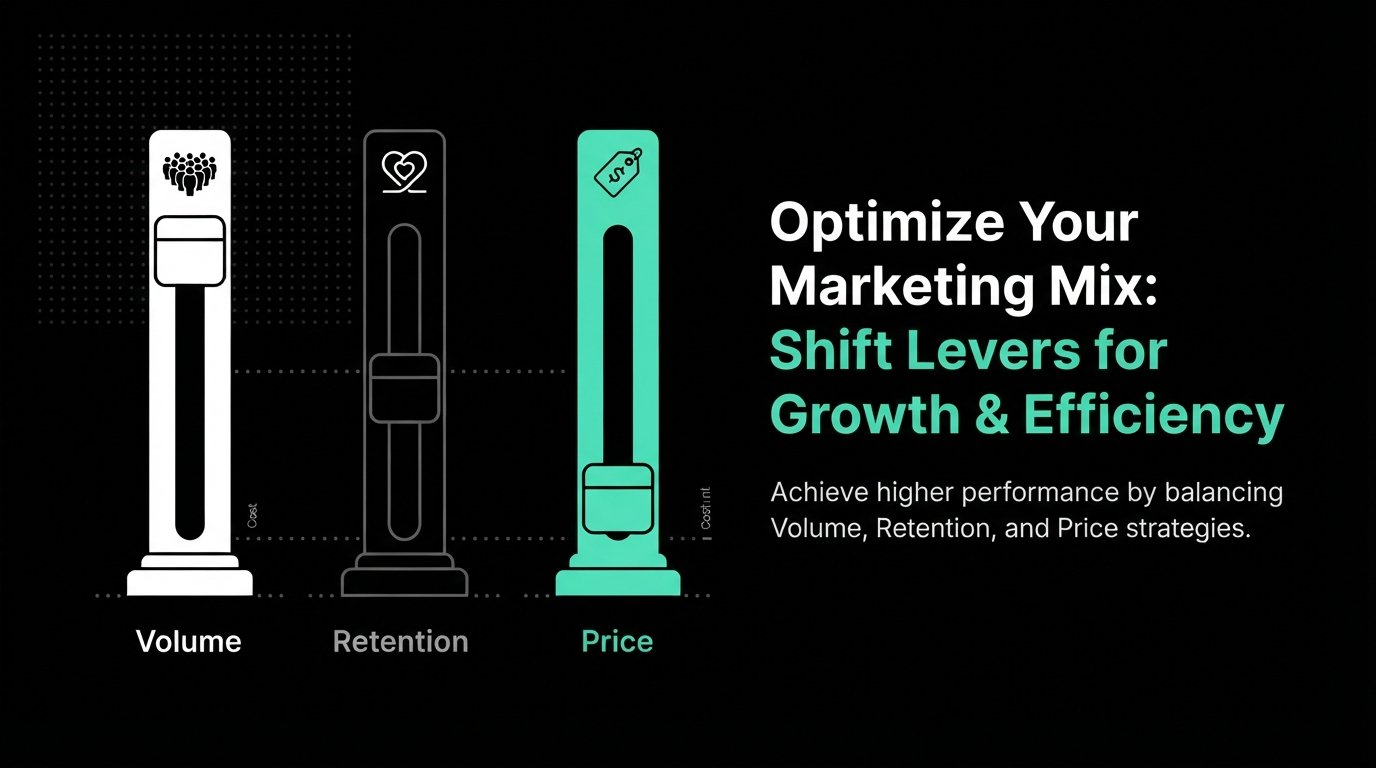
Growth means finding more customers — that’s the almost unconscious default answer in most strategy conversations. It’s also frequently the most expensive lever available. A price adjustment captures more value from demand that already exists, without paying acquisition cost on a single new customer. Volume, price, and retention are three separate growth levers, each with a different cost structure and a different return — and most companies commit budget to volume by habit, without ever formally comparing the three. As a performance marketing agency, some of the highest-return conversations we have with clients never touch a media plan at all.
Ask a founder how to grow revenue next quarter and the answer arrives almost before the question finishes: get more customers. It’s such a reflexive response that the alternative rarely gets a hearing in the same room.
That reflex is expensive. A new customer costs money to find, convert, and onboard. An existing customer who’s already paying is sitting on unrealized value that a well-tested price adjustment can capture without touching a media budget at all — and almost nobody runs the comparison before defaulting to volume anyway.
Why Volume Is the Default Answer
Volume feels safer than price, even when the numbers say otherwise. It doesn’t require an uncomfortable conversation with existing customers, and its cost shows up gradually in ad spend over a quarter rather than immediately in a customer’s inbox the day a price change lands.
That’s a psychological asymmetry, not a financial one. Nobody has ever been fired for spending more on acquisition. A badly handled price increase is visible, attributable, and uncomfortable in a way that quietly overspending on volume never quite is — which is exactly why volume keeps winning by default rather than by comparison.
The Growth Lever Audit
Revenue growth has three primary levers, each with a genuinely different cost structure. Volume — more customers at the current price — requires acquisition spend that scales with every new customer added. Price — more value from demand that already exists — requires no acquisition spend at all, only the work of testing and communicating the change. Retention — extending existing customer lifetime — sits between the two, usually cheaper than acquisition but requiring sustained investment in the experience, not a one-time campaign.
A company spending heavily to acquire new customers at a flat price point is often sitting on a comparable revenue lift available through a modest, well-tested price increase on the existing base — at a fraction of the cost, because no acquisition spend is required to capture it.
Why Price Gets Ruled Out Before It’s Even Tested
Price is treated as fixed because touching it feels risky, not because the risk has actually been measured. A Meta ads agency account often already contains the data needed to test elasticity in a small, contained segment before rolling anything out company-wide — a controlled experiment, not a company-wide bet.
AI-assisted analysis makes this faster and considerably lower-risk than it used to be. An AI agency Dubai teams increasingly rely on for exactly this kind of test can model likely elasticity from existing purchase and churn data before a single customer sees a new number — turning a decision that used to require nerve into one that requires evidence.
Where Retention Fits Into the Comparison
Retention is the quietest of the three levers and frequently the cheapest. Extending existing customer lifetime doesn’t require new acquisition spend or a pricing conversation — yet it rarely gets compared against volume with the same rigor volume itself is never actually given.
A Meta Partner Agency evaluating growth strategy should be running this three-way comparison before recommending where budget goes, not simply executing whichever lever leadership defaulted to before the conversation even started.
Running the Comparison Before Committing Budget
The practical shift is straightforward: before approving a volume-growth budget, require an explicit estimate of what a price or retention lever would cost and return over the same period. The goal isn’t to always choose price over volume. It’s to stop choosing volume by default, without ever having actually run the comparison.
FAQs
Test in a contained segment first — a specific cohort, region, or plan tier — rather than rolling out company-wide. This surfaces real elasticity data with limited exposure before any broader commitment is made.
Compare the cost of extending average customer lifetime by a fixed period against the cost of acquiring an equivalent amount of new revenue — retention investment is usually cheaper per dollar of revenue retained than acquisition spend per dollar of revenue won.
Volume makes the most sense when the market is genuinely underpenetrated and acquisition cost is low relative to customer lifetime value — the Growth Lever Audit isn’t an argument against volume, it’s an argument against choosing it without comparison.
Key Takeaways
- Volume, price, and retention are three separate growth levers — most companies only formally evaluate one of them.
- Price is often ruled out for feeling risky, not because it’s actually the weaker lever once the numbers are compared.
- Running a formal cost-versus-return comparison before committing budget reveals opportunities volume-only thinking misses entirely.
Meta Social — Dubai’s #1 Performance Marketing Agency
Meta Social builds demand-generation systems, not just traffic campaigns — content, positioning, and trust-building that convert cold clicks into buyers.
Performance Marketing | SEO & GEO | AI Creatives & Video | Attribution Architecture
metasocial.ae | Dubai, UAE
About Meta Social
Meta Social evaluates growth strategy before recommending where budget goes — helping GCC companies compare volume, price, and retention rather than defaulting to acquisition alone. metasocial.ae
META SOCIAL — DUBAI’S PERFORMANCE MARKETING & AI-NATIVE GROWTH PARTNER