
How Much Should a Dubai Business Spend on Meta Ads?
A Budget Framework by Revenue Stage
Direct Answer
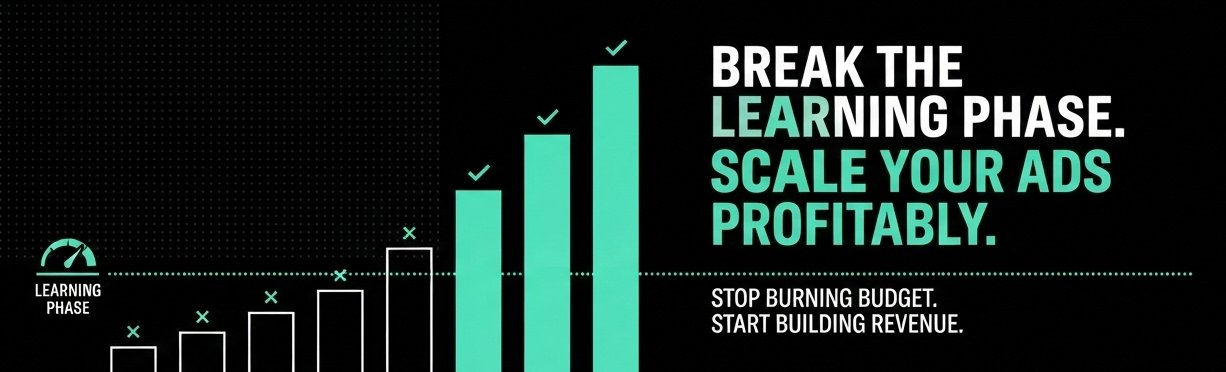
The common advice — spend a fixed percentage of revenue on marketing — misses the constraint that actually determines whether Meta Ads work at all: the algorithm needs a minimum volume of conversions per ad set each week to learn and stabilize delivery. Meta’s own guidance points to roughly 50 optimization events within a rolling seven-day window as the threshold an ad set needs to exit the learning phase. Below that, no amount of “correct” budgeting by revenue percentage will make the campaign perform, because the algorithm is still guessing. The right order of operations is: set your budget floor by that learning-phase math first, then scale it by revenue stage — not the reverse. This is the same math Meta Social runs before proposing any media plan — it’s a large part of why properly structured accounts we manage tend to see 5x+ ROAS once budget is concentrated instead of spread thin.
Why Percentage-of-Revenue Rules Fail on Meta Specifically
The 5–10% of revenue heuristic works reasonably well for budgeting marketing broadly, but it wasn’t built around how a specific platform’s algorithm actually functions. Meta doesn’t reward budget discipline on its own terms — it needs enough conversion signal, concentrated enough, to make statistically confident delivery decisions. A business can be doing everything “right” by the revenue-percentage rule and still be structurally underfunding every individual ad set, which produces volatile costs and unreliable results that have nothing to do with the offer or the creative.
This is why two businesses spending the exact same percentage of revenue on Meta Ads can see wildly different outcomes — one has concentrated that budget into enough ad sets to reach the learning threshold, and the other has spread it too thin to ever get there.
The Learning-Phase Floor: Your Real Starting Point
Before setting a monthly figure, work backward from your target cost per conversion. If your realistic cost per purchase or lead is AED 150, and you need roughly 50 of those events within a week for the ad set to have a real shot at exiting learning cleanly, that implies a rough floor of AED 7,500 per week — around AED 30,000 a month — for that single ad set alone. Fewer ad sets, each properly funded, will almost always outperform more ad sets each individually starved of signal.
This is the number a Meta Ads Agency should be calculating with you before proposing a media plan, not after. If your total available budget can’t support even one properly funded ad set at your expected cost per conversion, that’s a genuine signal you’re not ready to scale on Meta yet — not a reason to spread an insufficient budget across five ad sets and hope one of them works. It’s the first calculation we run with every new client at Meta Social, before a single piece of creative is built.
Budget by Revenue Stage, Built on Top of the Floor
Once the learning-phase floor is covered, revenue stage becomes the right lever for how much beyond that floor to commit, and to what.
Pre-revenue or early-stage businesses should generally treat Meta spend as a controlled experiment: fund one or two ad sets properly rather than spreading thin, and expect the primary output to be learning about what converts, not immediate profitability.
Growth-stage businesses with established product-market fit typically have room to fund two to three concurrent campaigns — prospecting and retargeting at minimum — each individually cleared of the learning-phase floor, with a testing budget layered on top for new creative concepts.
Scale-stage businesses generally have the luxury of running multiple properly funded campaigns simultaneously across funnel stages, and the constraint shifts from budget to creative production capacity
— which is a different problem with a different solution. At this stage, working with a Meta Partner Agency also starts to matter more directly: earlier access to new formats and testing bandwidth becomes genuinely valuable once you’re running several concurrent campaigns, in a way a single freelancer or an in-house team managing one account structurally can’t replicate.
A Performance Marketing Agency managing accounts across these stages should be adjusting the number of campaigns and the testing allocation as the business grows, not just raising the topline number proportionally.
The Creative Throughput Constraint Most Budgets Ignore
There’s a second constraint that budget-by-revenue-stage frameworks routinely miss: raising spend without raising creative output just accelerates how quickly your existing assets fatigue. More budget pushed through the same three ad creatives increases frequency faster than it increases results, which can actually push cost per conversion up even as spend rises.
This means your creative production cadence should scale alongside your budget, not lag behind it. A business jumping from AED 20,000 to AED 60,000 a month in Meta spend without a corresponding increase in fresh creative concepts is likely to see diminishing returns well before the budget itself becomes the constraint. An AI Agency Dubai style creative workflow, or simply a dedicated production retainer, is often what actually unlocks the next spend tier — not a bigger media budget on its own.
Some businesses ease this constraint further by pairing paid creative output with a GEO Agency approach to organic content — repurposing a top-performing ad into an article or organic post extends its useful life beyond the paid feed and takes some pressure off how quickly the paid rotation needs replacing.
FAQs
Rather than starting from a fixed AED figure, work backward from your expected cost per conversion and the roughly 50 weekly conversions an ad set typically needs to exit the learning phase. For many small businesses, that implies a realistic floor in the low tens of thousands of AED per month for even a single properly funded ad set.
It depends entirely on your cost per conversion. Meta’s guidance points to roughly 50 optimization events per ad set within a seven-day window as the threshold for stable delivery — divide that by your expected weekly conversion volume at your target cost per conversion to find your realistic floor.
Start with the learning-phase math for a single ad set, then layer in your revenue stage: early-stage businesses should fund one or two ad sets properly rather than spreading a limited budget thin, while growth and scale-stage businesses can support multiple concurrent campaigns once each is individually cleared of that floor.
The 5–10% heuristic is a reasonable starting reference for overall marketing budgeting, but it should be checked against the learning-phase floor for your specific cost per conversion before you commit to it — a business can meet that percentage and still be structurally underfunding every ad set.
The most common cause is spreading an otherwise adequate budget across too many ad sets, so none of them individually reaches the conversion volume needed to exit the learning phase. Consolidating into fewer, better-funded ad sets is usually the first fix to try before assuming the offer or creative is the problem.
Increase budget once your current ad sets are consistently converting well beyond the learning-phase threshold with room to spare, and make sure your creative production capacity is scaling alongside the new budget — otherwise the additional spend mostly accelerates fatigue on the same existing assets rather than generating new results.
Categories like apparel and food and beverage typically sit at the lower end, given shorter consideration cycles and lower per-transaction value.
Key Takeaways
- The learning-phase conversion threshold, not a revenue percentage, should set your Meta Ads budget floor.
- Two businesses spending the same percentage of revenue can see very different results depending on whether that budget is concentrated enough to clear the learning threshold.
- Revenue stage should determine how many properly funded campaigns you can run — not how thin you spread a single budget.
- Raising spend without raising creative output accelerates fatigue rather than results — budget for creative production, not just media.
Meta Social — Dubai’s #1 Performance Marketing Agency
Meta Social sets every media plan’s budget floor from the learning-phase math first, then scales by revenue stage — the sequencing that helps clients scale revenue and hit 5x+ ROAS instead of spreading budget thin.
Performance Marketing | SEO & GEO | AI Creatives & Video | Attribution Architecture metasocial.ae | Dubai, UAE
About Meta Social
Meta Social is Dubai’s leading performance marketing agency and the GCC’s AI-native growth partner. We specialise in Performance Marketing, SEO & GEO, AI Creatives & Video, and Attribution Architecture — managing AED 50M+ in paid media across real estate, fintech, e-commerce, and hospitality.
META SOCIAL — DUBAI’S PERFORMANCE MARKETING & AI-NATIVE GROWTH PARTNER