
The Meta Ads Account Structure Mistake That Quietly Inflates
Your CPA: Consolidation vs Fragmentation
A fragmented Meta Ads account can quietly increase acquisition costs when too many campaigns or ad sets divide the same budget and conversion signals. The issue is not simply the number of ad sets; it is whether each one has enough meaningful data to optimise effectively and whether multiple structures are competing for essentially the same opportunity. Consolidating unnecessary structures can give Meta stronger signals while making budget allocation and performance analysis cleaner.
Meta Social approaches account restructuring by auditing conversion volume, audience overlap, budget distribution and the purpose of each campaign before deciding what should stay separate and what should be consolidated. The goal is not to make an account look simpler — it is to build a structure the available data can actually support.
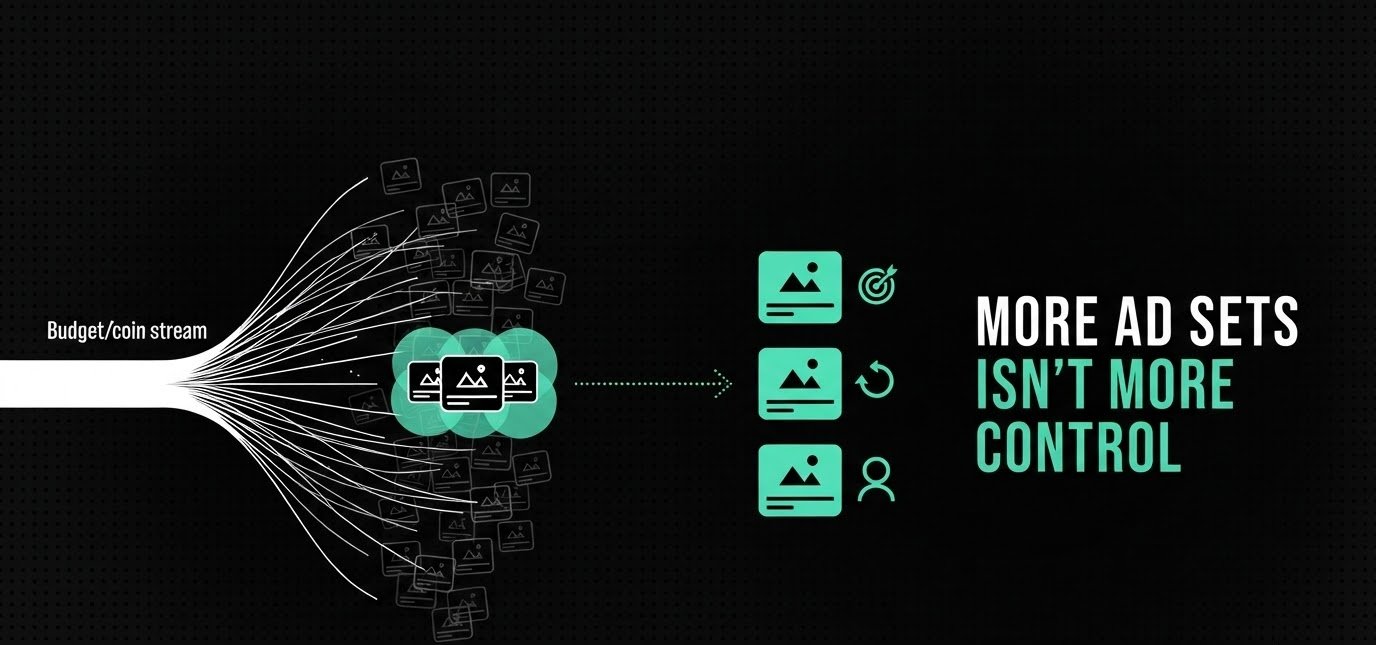
More Ad Sets Do Not Automatically Mean More Control
For years, advertisers were taught to build increasingly detailed account structures: one campaign for one audience, another for another audience, separate ad sets for interests, lookalikes, demographics, placements and funnel stages.
The logic sounds sensible. More segments appear to mean more control.
But control is only valuable when the account has enough volume to support it.
Imagine a business has a fixed monthly budget and 10 ad sets competing for a relatively small pool of conversions. Each ad set now receives only a fraction of the available signal. Instead of one strong pool of data informing optimisation, the account has several smaller pools trying to learn independently.
That is where fragmentation becomes expensive.
A meta ads agency should therefore ask a more useful question than “How many ad sets should we have?” The question is: how much conversion signal can this budget realistically support?
There is no universal number of campaigns or ad sets that works for every advertiser. A high-volume e-commerce account can support a more complex structure than a lead-generation business producing a handful of qualified conversions each week.
Structure should follow signal — not the other way around.
When Audience Overlap Becomes an Account Problem
Fragmentation becomes even more problematic when separate ad sets are chasing substantially the same people.
Consider an account with three prospecting ad sets:
- Broad UAE audience
- Interest-based audience
- Lookalike audience
If those audiences substantially overlap, the distinction may exist inside Ads Manager without representing a meaningful distinction in the real market.
The bigger issue is not that Meta will blindly charge the advertiser three times for the same impression. Meta’s auction and delivery systems contain mechanisms for deciding which ad gets delivered. The more important concern is that the advertiser has divided its learning and budget across structures that may be competing for the same opportunity.
That makes performance harder to interpret.
Was one audience genuinely better? Did it simply receive more favourable delivery? Did another ad set fail because it had insufficient volume? Or did the account create several versions of essentially the same prospecting strategy?
This is where a meta partner should challenge the structure rather than simply optimise within it.
Consolidation can allow the system to make more of the allocation decisions itself, while the marketing team focuses its control where it matters: the offer, creative, conversion event, landing experience and business-quality signal.
Consolidation Does Not Mean Putting Everything Into One Campaign
This is where the consolidation argument is often misunderstood.
The answer is not to take every campaign in an account and merge it into one giant campaign.
Some distinctions are commercially meaningful.
A prospecting campaign and a customer-retention campaign may have completely different purposes. A separate campaign may be justified for a genuinely different market, offer, objective or measurement requirement. A controlled test may also require temporary separation so its results can be interpreted properly.
The test is simple: Does this separation represent a real business or measurement distinction — or did someone create another ad set because it seemed like a good way to organise the account?
That distinction matters.
A geo agency looking at a multi-market business, for example, may need genuine geographic separation because the markets have different languages, offers, economics or compliance requirements. That is very different from splitting Dubai audiences into multiple ad sets simply because each one sounds more specific.
The same principle applies to an AI agency Dubai business running lead generation: if the actual conversion volume is limited, creating separate ad sets for every possible audience hypothesis can create more complexity than useful information.
Consolidation is therefore not a rule. It is a response to insufficient signal, unnecessary overlap and structural complexity.
What UAE Brands Should Fix First
Before rebuilding a Meta Ads account, look for these four warning signs:
- Too many active ad sets for the available conversion volume. If every ad set is receiving only a small number of optimisation events, ask whether the budget is being spread too thinly.
- Multiple ad sets targeting essentially the same prospect. If the distinction exists mainly inside Ads Manager rather than in the customer’s actual buying journey, consolidation may make more sense.
- Campaigns created for organisational convenience. “Brand,” “audience,” “placement” and “creative” are not automatically reasons to create separate campaigns. Each structural layer should have a job.
- Testing structures that became permanent. A structure created to answer a specific question can make sense during a test. It does not necessarily deserve to remain in the account forever.
This is also where performance marketing needs to move beyond looking at CPA alone. A lower CPA from a fragmented ad set does not automatically make that structure better if it produces fewer qualified customers, unstable delivery or misleading attribution.
The objective is not the smallest possible number of campaigns.
The objective is the simplest structure that gives the platform enough useful signal while preserving the distinctions the business genuinely needs.
The Best Account Structure Is the One the Data Can Support
Meta advertising has moved further toward automated delivery, which makes account structure increasingly important for a different reason: advertisers are no longer expected to manually control every possible audience decision.
The better question is no longer, “How can we create more segments?”
It is: “Which decisions actually need to be made by us?”
That shift can turn consolidation from a cosmetic account clean-up into a genuine performance improvement.
For Meta Social, that is the standard we use when reviewing account architecture: less complexity where complexity adds no value, more separation where the business genuinely needs it, and enough signal for the system to make useful optimisation decisions.
FAQs
Not automatically. The problem is usually the combination of fragmented conversion signals, limited budget and unnecessary audience overlap. An account with high conversion volume can support more segmentation than a low-volume account.
No. Consolidation should follow the account’s conversion volume and business requirements. Different objectives, markets, funnel stages or commercial offers can justify separate structures.
Look at how much conversion volume each ad set receives, whether multiple ad sets target essentially the same people, and whether every structural separation has a clear business or testing purpose
Neither exists in isolation. A strong creative cannot completely compensate for a structure that prevents the system from receiving useful signals, while a clean account cannot rescue weak creative or an uncompetitive offer.
Key Takeaways
- More ad sets do not automatically create more control.
- Fragmentation becomes expensive when budget and conversion signal are spread too thinly.
- Audience overlap is a reason to investigate structure, not a reason to blindly delete campaigns.
- Consolidate where distinctions are artificial; separate where the business genuinely requires it.
Meta Social — Dubai’s #1 Performance Marketing Agency
Meta Social helps UAE brands simplify Meta Ads account structures around real conversion signals — identifying unnecessary fragmentation, audience overlap and inefficient campaign separation before rebuilding what the data actually supports. Get in touch at metasocial.ae
Performance Marketing | SEO & GEO | AI Creatives & Video | Attribution Architecture
metasocial.ae | Dubai, UAE
About Meta Social
Meta Social is Dubai’s leading performance marketing agency and the GCC’s AI-native growth partner. We specialise in Performance Marketing, SEO & GEO, AI Creatives & Video, and Attribution Architecture — managing AED 50M+ in paid media across real estate, fintech, e-commerce, and hospitality.
metasocial.ae | Dubai, UAE