
Why Catalog Sales Campaigns Need a Different Setup From Standard
Conversion Campaigns
Catalog sales campaigns need a different setup because Meta uses both product information and conversion signals to decide what to show and to whom. Feed quality, product sets, availability and tracking therefore matter alongside the usual creative, audience and budget decisions.
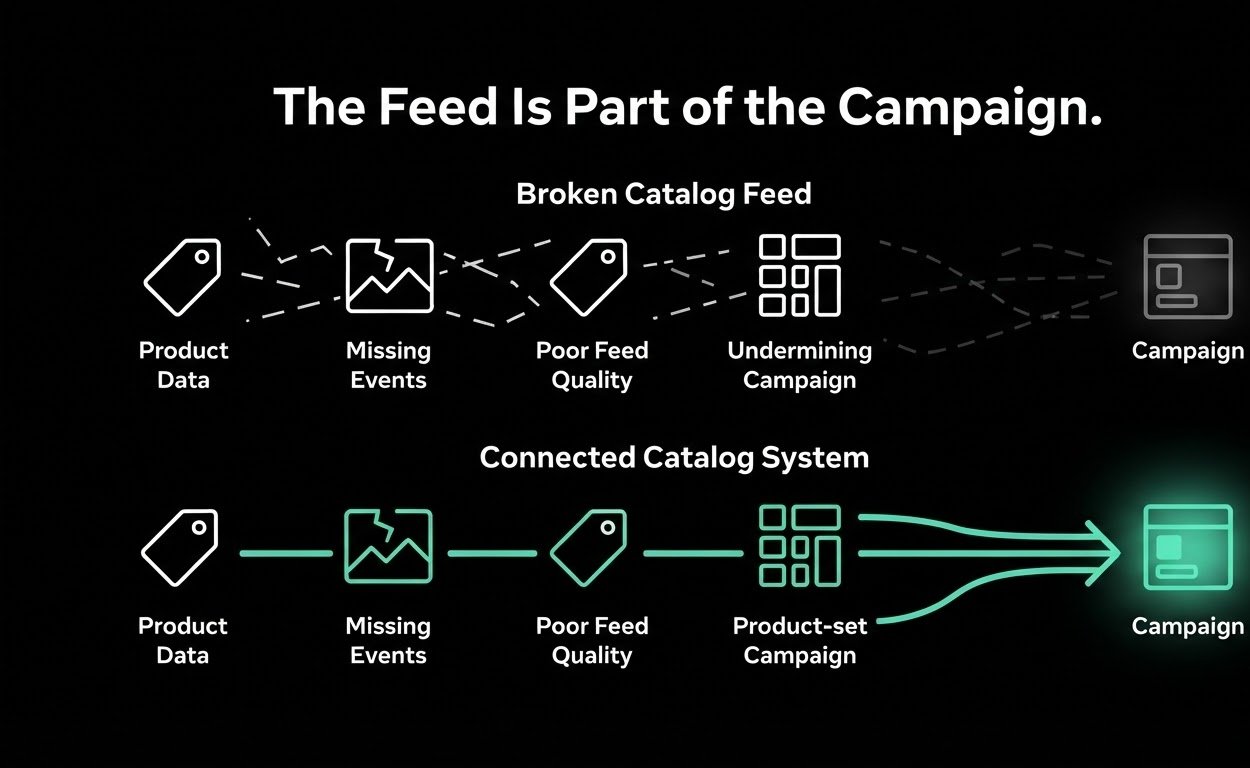
Meta Social builds catalog campaigns as a connected system — aligning product feeds, events and campaign structure so Meta has cleaner signals to optimise against and the business has better control over what it is selling.
A Catalog Is More Than a Product List
A standard conversion campaign is usually built around a relatively straightforward question: which people are most likely to take the desired action after seeing this message?
Catalog campaigns add another layer to that decision. Meta can work with structured information about the products themselves — what they are, how they are grouped, what they cost and whether they are available — and use that information as part of the delivery system.
That changes the source of potential performance problems.
If a standard campaign is underperforming, the first investigation might focus on the audience, creative, offer, landing page or conversion event. With a catalog campaign, the investigation also has to ask whether the product information being supplied to the system is complete, accurate and usable.
A product title that is vague, a broken product URL, an outdated price, missing imagery or an unavailable product can create friction that no amount of campaign-level optimisation can fully solve.
This is why a meta ads agency working on e-commerce should not treat the catalog as a background technical asset. It is part of the advertising input.
The Campaign Can Be Correct While the Catalog Is Wrong
One of the easiest mistakes is to diagnose every catalog problem inside Ads Manager.
Imagine an online retailer has a well-structured campaign, a sensible budget and strong creative. The ads are delivering, but product-level performance is inconsistent. Some products generate purchases while others receive impressions without meaningful downstream action.
The first instinct may be to change the campaign.
But the more useful question is whether the products being presented to Meta are actually organised around the way customers shop.
Product sets are especially important here. A retailer may have hundreds or thousands of SKUs, but not every product should necessarily be treated as one undifferentiated inventory pool. Commercial categories, price ranges, margins, availability, seasonality and customer intent can all create legitimate reasons to organise products differently.
That does not mean creating a separate campaign for every category. The lesson from the account-structure problem we discussed earlier applies here too: separation should exist for a reason.
A meta partner should therefore be able to look beyond campaign settings and ask whether the catalog itself reflects the business.
For a Dubai retailer, for example, a product group built around high-value products may require a different commercial strategy from a group built around fast-moving entry-level products. The catalog should make those distinctions usable without turning the account into dozens of isolated campaigns.
This is also where performance marketing becomes more than media buying. The campaign is only one part of the system; the quality of the information entering the system matters too.
The Right Setup Connects Feed, Events, Creative and Commercial Logic
A strong catalog campaign is built around four connected layers.
- Product information Titles, descriptions, images, prices, availability, URLs and other catalog fields need to accurately represent what the customer will find after the click.
- Product organisation Product sets should reflect meaningful commercial groupings rather than arbitrary divisions created only to make Ads Manager look organised.
- Conversion signals The system needs reliable signals from the customer journey. If product views, carts and purchases are poorly tracked or inconsistently mapped, optimisation becomes less trustworthy.
- Creative and offer The product may be technically eligible to appear, but the creative still has to communicate why the item matters. Catalog automation does not remove the need for strong offers, useful messaging and appropriate creative assets.
The important point is that these layers should not be optimised independently.
If the catalog contains the right products but the event signals are weak, the system may struggle to understand which products are actually driving value. If the signals are strong but the product groups are poorly structured, commercial differences can become harder to manage. If everything is technically correct but the creative and offer are weak, better product matching will not solve the underlying demand problem.
An AI agency Dubai brands work with may use automation to accelerate product descriptions, creative variations or merchandising analysis, but automation should not become an excuse to stop checking whether the underlying commercial data is correct.
The objective is a connected system where product information, customer behaviour and advertising decisions reinforce one another.
What UAE E-commerce Brands Should Fix First
Before changing a catalog campaign, check these five areas in order:
- Catalog accuracy. Check whether prices, availability, images, titles and landing-page URLs match what customers actually see.
- Product-set logic. Ask whether products are grouped around real commercial differences such as category, price, margin, availability or customer intent.
- Event quality. Review whether the important customer actions are being captured consistently enough to support optimisation.
- Campaign complexity. Do not create separate campaigns for every product group unless there is a clear commercial or measurement reason. Use the simplest structure that preserves meaningful control.
- Downstream business value. Do not judge the catalog only by clicks or low-cost purchases. Compare product-level performance against margin, repeat value, lead quality or whatever business metric actually matters.
For businesses with large or changing inventories, this review should become part of the operating process rather than a one-time campaign setup.
A catalog can change without the media team realising it. Products go out of stock, prices change, new collections launch and commercial priorities shift. If the advertising structure does not reflect those changes, yesterday’s setup can become today’s constraint.
A geo agency supporting a multi-market e-commerce brand may also need to account for differences in availability, language, pricing or product relevance across locations. The more markets and products involved, the more important it becomes to keep the underlying structure coherent.
The goal is not to make catalog advertising more complicated. It is to make sure the system is receiving the right information and that the campaign structure matches the way the business actually sells.
The Feed Is Part of the Campaign
The biggest mindset shift is simple: a catalog campaign does not begin when you click “Create campaign.”
It begins with the information Meta is given about the products, the events it receives from the customer journey and the commercial logic behind the inventory.
That is why catalog performance should be diagnosed across the whole system rather than judged from campaign settings alone.
For e-commerce brands, the strongest setup is the one where the catalog, tracking, creative and campaign structure all tell the same commercial story.
FAQs
Not automatically. They are designed around different inputs. Catalog campaigns can use structured product information and product-level signals, so performance depends on more than the campaign objective alone.
No. Separate structures should have a clear commercial or measurement purpose. Product sets can often provide useful organisation without creating unnecessary campaign fragmentation.
Incorrect prices, availability, images, titles or URLs can undermine the customer experience and reduce the usefulness of the information available to the advertising system. Feed quality should be treated as part of campaign readiness.
Look at the business outcome that matters: qualified purchases, margin, repeat value, contribution profit or another meaningful downstream metric. A low-cost conversion is not automatically a valuable conversion.
Key Takeaways
- A catalog is an advertising input, not just a product database.
- Catalog accuracy and event quality can matter as much as campaign settings.
- Product sets should reflect meaningful commercial differences, not arbitrary segmentation.
- The strongest setup connects catalog, events, creative and campaign structure.
Meta Social — Dubai’s #1 Performance Marketing Agency
Meta Social helps e-commerce brands connect catalog, product-set, event and campaign architecture so Meta can make better use of the signals available across the product journey. Visit metasocial.ae
Performance Marketing | SEO & GEO | AI Creatives & Video | Attribution Architecture
metasocial.ae | Dubai, UAE
About Meta Social
Meta Social is Dubai’s leading performance marketing agency and the GCC’s AI-native growth partner. We specialise in Performance Marketing, SEO & GEO, AI Creatives & Video, and Attribution Architecture — managing AED 50M+ in paid media across real estate, fintech, e-commerce, and hospitality.
metasocial.ae | Dubai, UAE