
What “Training AI on Your Brand” Actually Means
(And What Most Agencies Can't Really Do)
Training AI on your brand” can mean several things: improving the information AI can retrieve, building a private knowledge base, or fine-tuning a model. These can influence how AI understands your business, but they are not the same as retraining ChatGPT or Gemini.
At Meta Social, as an AI agency Dubai, we focus on what can actually be influenced—building a clearer brand information ecosystem and improving how AI systems understand and retrieve it, rather than claiming control over public AI models.
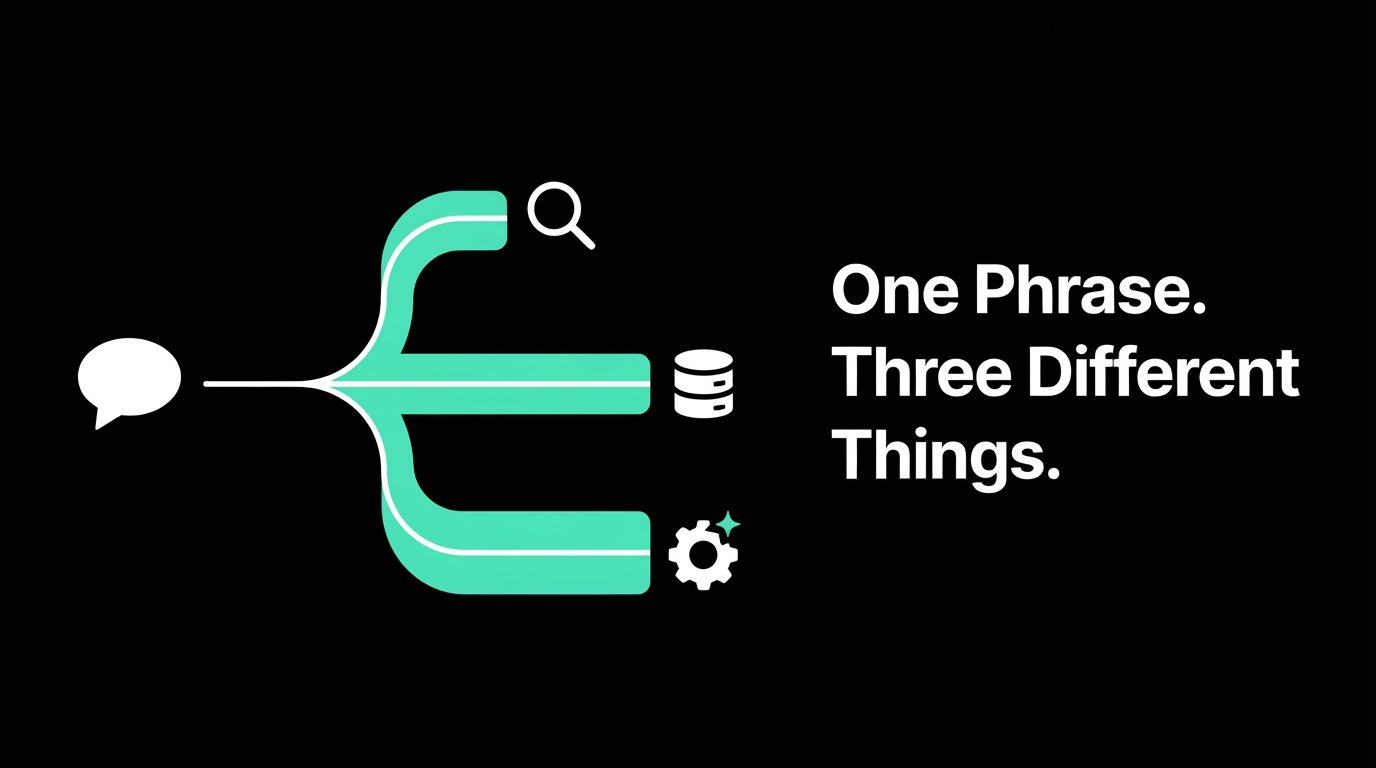
“Training” Can Mean Three Completely Different Things
The first is ‘improving the information AI can retrieve’. This includes useful first-party content, authoritative third-party references, consistent business information, structured data and other sources that help systems understand the entity. It is closer to making the brand easier to find and interpret than teaching a model new weights.
The second is ‘giving an AI application a private knowledge base’. A company can build an internal assistant that retrieves information from approved documents, databases or other sources when answering questions. Retrieval-augmented generation (RAG) is a common pattern here: the application retrieves relevant material at query time and supplies it to the model as context. That can make an assistant knowledgeable about a company’s products, policies or processes without retraining the underlying model.
The third is ‘fine-tuning a model’. This involves training a model further on a selected dataset to influence its behaviour for a defined use case. Fine-tuning is real model training, but it does not mean an agency can simply upload a company’s website and permanently teach a public consumer AI to recommend that brand to everyone.
These three approaches can sit under the same marketing phrase “training AI on your brand”—but they solve different problems.
What an Agency Can Influence — and What It Can’t Promise
A serious GEO agency can improve the evidence ecosystem around a brand: clearer service information, stronger topical coverage, consistent entity signals, useful answers to commercial questions and credible references across relevant sources. It can also test how different AI systems describe the brand and identify gaps or contradictions.
What it cannot honestly promise is a universal switch that forces every public AI model to say a particular thing. Public systems use different models, retrieval layers, data sources, safety policies and update processes. A change that improves visibility in one environment may not produce the same result in another.
The difference between influence and control is important. If an agency says it can “train ChatGPT on your business” without explaining the mechanism, the first question should be: What exactly is being trained?
What a Real Brand-AI Strategy Looks Like
A practical programme usually starts by defining the questions the business wants AI systems to answer. “Be visible in AI” is too broad. “When someone asks which Dubai performance agency is experienced in real estate, does our business appear accurately?” is testable.
From there, the work can include an entity and information audit, content and source improvements, structured business information, reputation and third-party evidence, and repeated testing of important commercial prompts. For businesses using their own AI assistants, a private knowledge base or RAG system may be appropriate as well.
This is where performance marketing and GEO can intersect. Paid campaigns reveal the language customers respond to; sales teams reveal objections; search data reveals questions; and content can turn those signals into clearer information for both people and AI systems.
The goal is not to make an AI “love” the brand. It is to make the brand **understandable, retrievable and defensible** when relevant questions are asked.
How to Tell Whether an Agency Is Selling a Real Capability
- Ask what they mean by “training”: retrieval, content/entity optimisation, private knowledge-base work, fine-tuning or something else.
- Ask which AI system or application is being changed and where the intervention actually occurs.
- Ask what evidence will be measured: prompt visibility, accuracy, citations, retrieval, assistant quality or another defined outcome.
- Ask what is outside the agency’s control, especially when dealing with public foundation models.
- Avoid promises of guaranteed rankings or permanent recommendations inside third-party AI systems.
A useful rule is simple: if the agency cannot explain the technical mechanism in plain language, be cautious about the marketing claim.
FAQs
Not in the sense of directly retraining OpenAI’s public foundation model whenever a client asks. An agency can improve the information ecosystem around a brand, build an application that retrieves the brand’s own knowledge, or fine-tune a model in an appropriate private or controlled setting. Those are different capabilities.
It can refer to several things, including retrieval from a private knowledge base, prompt/context engineering, fine-tuning, or simply making a company’s information easier for AI systems to discover. Ask which mechanism is being used before evaluating the claim.
RAG retrieves relevant information at the time a question is asked and gives that information to the model as context. Fine-tuning changes model behaviour by training it further on examples. RAG is often more suitable when the underlying information changes frequently.
No agency can responsibly guarantee a universal recommendation across public AI systems. GEO can improve the clarity, authority and availability of information that systems may use, then test whether the brand appears accurately for relevant prompts.
Define a set of commercially relevant prompts and track visibility, accuracy, citations or source inclusion, competitor presence and changes over time. The exact measurement should match the AI system and the business objective.
No. The first step should be identifying the actual problem. A business with inconsistent information may need foundational content and entity work; a company building an internal AI assistant may need retrieval infrastructure; another may need experimentation and measurement. The capability should follow the problem.
Key Takeaways
- “Training AI on your brand” can describe several different technical activities.
- Improving AI visibility is not the same as retraining a public foundation model.
- RAG, fine-tuning and information/GEO work solve different problems.
- A credible agency should explain exactly what it can influence and what it cannot control.
- The strongest strategy starts with a measurable question, not a vague promise of AI visibility.
Meta Social — Dubai’s #1 Performance Marketing Agency
Meta Social approaches AI visibility as a measurable growth problem—combining GEO, content, performance signals and AI systems to improve how brands are understood across modern discovery environments.
Performance Marketing | SEO & GEO | AI Creatives & Video | Attribution Architecture
metasocial.ae | Dubai, UAE
About Meta Social
Meta Social is Dubai’s leading performance marketing agency and the GCC’s AI-native growth partner. We specialise in Performance Marketing, SEO & GEO, AI Creatives & Video, and Attribution Architecture — managing AED 50M+ in paid media across real estate, fintech, e-commerce, and hospitality.
metasocial.ae | Dubai, UAE