
You Rank #1 on Google. Why Aren't AI Assistants Recommending You?
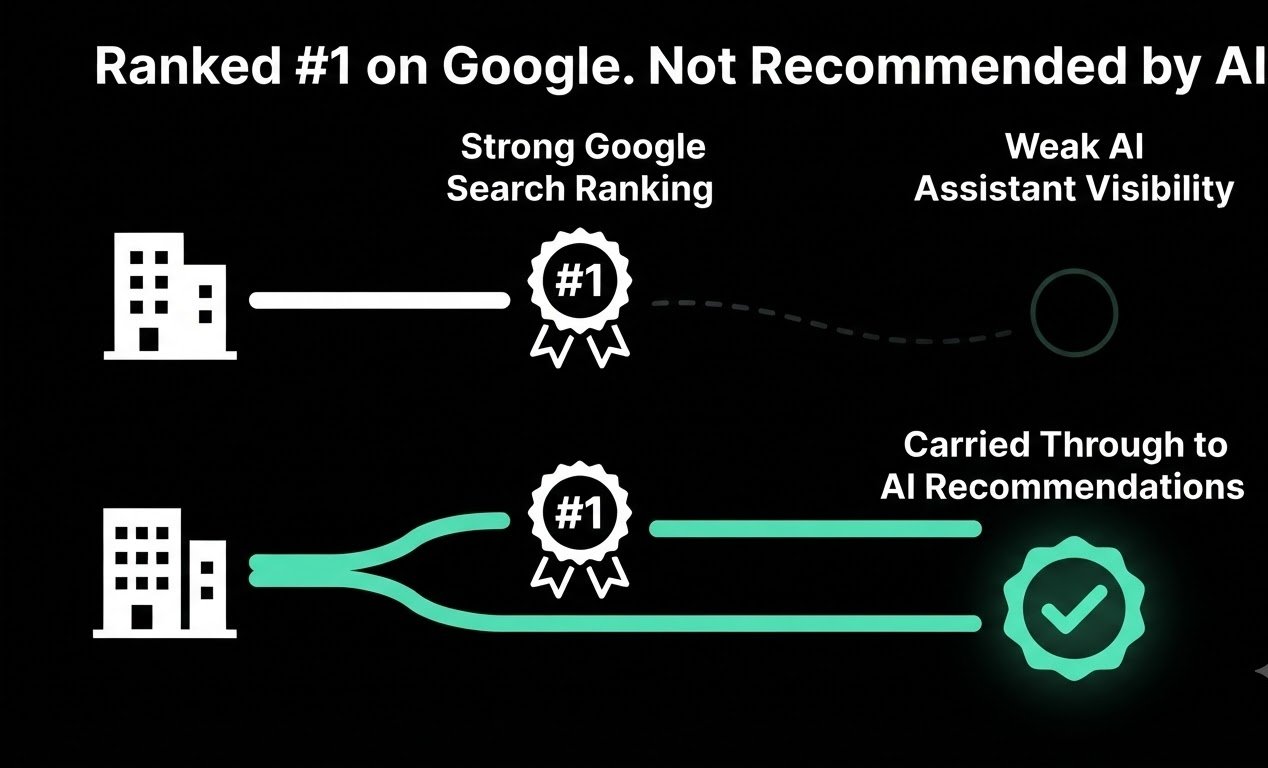
Ranking #1 on Google is still valuable, but it does not guarantee that an AI assistant will recommend your business. AI systems can use different sources, signals and retrieval processes when generating answers, so a brand can have strong traditional search visibility while appearing rarely—or not at all—when customers ask AI tools for a recommendation.
Meta Social would treat the gap as a GEO visibility problem rather than assuming the SEO strategy has failed. We would compare the queries where the business ranks strongly with the questions where AI assistants recommend competitors, then audit the information, authority and entity signals surrounding the brand. For a geo agency, the goal is not to replace SEO; it is to make strong search visibility carry further into the AI discovery layer.
Google Rankings and AI Recommendations Are Different Jobs
Google and AI assistants can both help a customer discover a business, but the experience is different. A Google result gives the user a set of pages or listings to evaluate. An AI assistant may instead produce a shortlist, explain why certain businesses fit the request, and present a recommendation directly.
That means a business can win the traditional ranking battle without winning the recommendation battle.
A #1 position tells you that a page is highly visible for a particular search. It does not tell you that an AI system will select that business when the customer asks a broader question such as “Which agency should I use?” or “Who are the best providers in Dubai for this service?”
This distinction is becoming important for any performance marketing strategy that depends on customers discovering the brand through digital channels.
The AI Answer Can Draw From a Wider Information Footprint
An AI recommendation is not necessarily based on the same page that ranks first on Google. The system may rely on multiple sources to understand a company, its services, locations, reputation and relevance to the customer’s request.
That creates an information-footprint problem. A business might have excellent service pages but weak or inconsistent information across directories, reviews, industry publications, partner websites or other third-party sources.
The issue is not that every third-party mention automatically improves AI visibility. The more useful question is whether the important facts about the business are clear, consistent and supported across the places an AI system may encounter them.
This is where GEO becomes an extension of search strategy. The work shifts from optimising one ranking page to improving how the business can be understood as an entity across its wider information environment.
Being Visible Is Not the Same as Being Chosen
Even when a business appears in an AI answer, that does not automatically mean the visibility is commercially meaningful. It may be mentioned as one of many options, described inaccurately, or positioned below a competitor that better matches the customer’s stated need.
A stronger AI visibility audit therefore asks four separate questions: Are we present? Are we described correctly? Are we recommended for the right use cases? And what information appears to support that recommendation?
These questions also expose a common reporting mistake. Teams can celebrate an increase in AI mentions without checking whether the brand is actually appearing in high-intent questions where customers are choosing between providers.
For an AI agency Dubai team, this is why AI visibility needs to be monitored alongside traditional search rather than reported as a completely separate vanity metric.
The Fix Is Not to Abandon SEO
The answer to weak AI visibility is not to stop investing in Google. Strong technical SEO, useful content, authoritative pages and clear business information remain important foundations.
The change is in how the foundation is evaluated. Instead of asking only whether a page ranks, the team should also ask whether the information is easy for AI systems to retrieve, interpret and corroborate.
That can mean clarifying service and location information, strengthening important entity relationships, improving first-party content, addressing inconsistent business information, and developing credible third-party references where they genuinely help customers understand the business.
The result should be a stronger information ecosystem—not content created simply because it contains words an AI model might recognise.
How Meta Social Would Approach It
- Find the ranking-to-recommendation gap
Identify important queries where the business ranks strongly on Google, then test equivalent customer-intent questions across relevant AI systems. - Compare the businesses being recommended
Look beyond whether the brand appears. Record which competitors are recommended, how they are positioned, and what makes them appear relevant to the question. - Audit the information footprint
Review the brand’s key pages, business information, reviews and credible third-party references to identify gaps or inconsistencies that could affect how the business is understood. - Strengthen the missing signals
Prioritise improvements to the pages and information sources that address the clearest gaps instead of producing large volumes of generic AI-focused content. - Retest the same questions
Repeat the fixed prompt set over time. The objective is to see whether the brand becomes more consistently visible and accurately positioned for commercially important questions.
FAQs
AI systems can use different information sources and retrieval processes. A competitor may have a stronger or clearer information footprint for the particular question being asked.
No. GEO should build on strong SEO and clear business information. The objective is to extend discoverability into AI-generated answers, not abandon traditional search.
It is better to build accurate, well-supported information that can be understood across multiple AI systems. Platform-specific testing is useful, but the underlying information quality should remain the priority.
Compare important Google rankings with AI presence, positioning and recommendations for equivalent customer-intent questions. Track the same test set over time rather than relying on isolated prompts.
Key Takeaways
- #1 on Google does not guarantee AI recommendation.
- AI systems can draw on a wider information footprint than one ranking page.
- Track presence, positioning and recommendation separately.
- GEO should extend strong SEO—not replace it.
Meta Social — Dubai’s #1 Performance Marketing Agency
Meta Social connects traditional search performance with AI-search visibility by testing where strong Google rankings do—and do not—translate into AI recommendations. We use those gaps to prioritise practical SEO and GEO improvements around the information customers and AI systems need to understand the brand. Speak to our team at metasocial.ae
Performance Marketing | SEO & GEO | AI Creatives & Video | Attribution Architecture
metasocial.ae | Dubai, UAE
About Meta Social
Meta Social is Dubai’s leading performance marketing agency and the GCC’s AI-native growth partner. We specialise in Performance Marketing, SEO & GEO, AI Creatives & Video, and Attribution Architecture — managing AED 50M+ in paid media across real estate, fintech, e-commerce, and hospitality.
metasocial.ae | Dubai, UAE