
Why Your Best-Case Study Might Be Invisible to AI Search Engines
A case study can contain strong evidence and still be difficult for AI search systems to use if the important facts are buried inside long narrative, unclear headings or vague claims. AI systems need to identify what happened, what was changed, what evidence supports the result and which business produced that evidence.
Meta Social would structure case studies as evidence, not just stories — making the problem, intervention, methodology and outcome easy to identify while keeping the surrounding context useful to human readers. That gives an AI agency Dubai a stronger foundation for improving how a brand’s expertise and proof are represented in AI search.
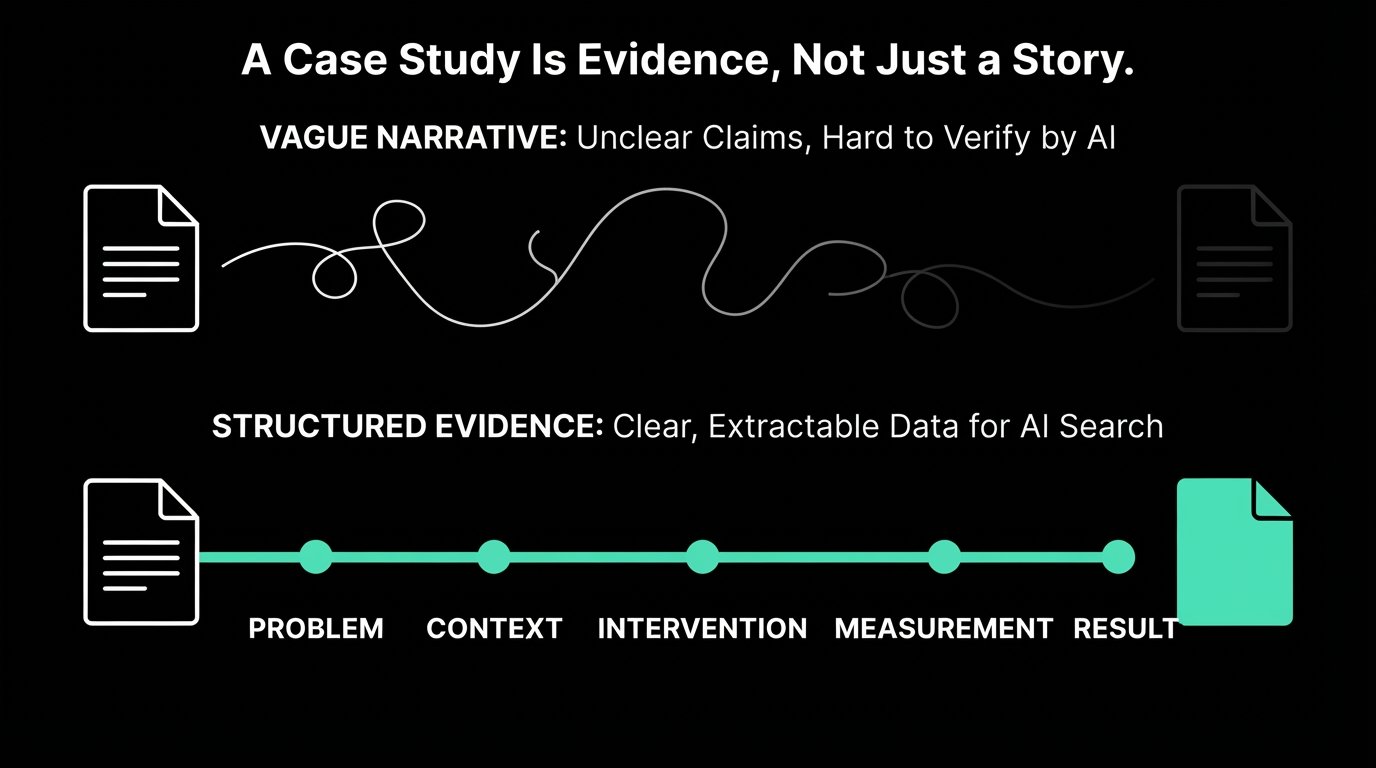
The Problem With Narrative-Heavy Case Studies
Most case studies are written to persuade a prospective client, so they often prioritise storytelling over information architecture. A polished introduction may describe the client and challenge for several paragraphs before the actual intervention appears. Results can then be presented as a broad statement such as “significant growth” without clearly defining the baseline, timeframe or metric.
That format can still work for a human reader, but it makes evidence harder to extract. If a reader — human or machine — cannot quickly distinguish the problem, action and result, the case study becomes less useful as a source of verifiable information.
This matters for a geo agency, for example, when a case study involves local visibility. “We improved local presence” is far less useful than clearly stating which locations were affected, what was changed and which measurable indicators were used.
Turn the Case Study Into Evidence
The strongest case studies make their evidence explicit. Start with the business problem, define the relevant baseline, explain the intervention, identify the measurement period and state the outcome with enough context to understand what changed.
A useful structure is simple: Problem → Context → Intervention → Measurement → Result → What the result means. This does not mean stripping the case study of its narrative. It means making the narrative sit around clearly labelled evidence.
For a Meta ads agency, that could mean separating campaign structure, audience strategy, creative changes, conversion signals and business outcomes instead of describing the work as one undifferentiated “campaign optimisation” exercise. The same principle applies to SEO, GEO and performance marketing case studies.
Make Claims Specific Enough to Be Useful
Specificity matters more than impressive wording. “Traffic increased substantially” tells a reader very little. A stronger case study identifies the metric, comparison period, business context and intervention that preceded the change.
The goal is not to publish every internal detail. It is to provide enough information for the claim to be understood and evaluated. If a result depends on seasonality, a promotional period, a change in tracking or another major factor, that context should not be hidden.
This also protects the case study from becoming generic marketing copy. A Meta partner should be able to explain not only what improved, but why the change was expected to influence the business outcome being measured.
Build Case Studies That Can Be Reused as Sources
A strong case study should not end as a page that is read once and forgotten. Its clearest claims can become source material for service pages, articles, sales material and future AI-search visibility work.
That means keeping the core facts consistent wherever they are reused. The business name, service, challenge, methodology and results should not change from one asset to another. Third-party references can also reinforce the context when the underlying claims are independently discussed or cited.
This is where case-study quality connects with GEO. The objective is not to “write for an AI” or insert keywords into every paragraph. It is to create authoritative, accessible evidence that search systems can understand and people can verify.
How Meta Social Would Approach It
Meta Social would not treat a case study as a long-form sales story. We would build it around the evidence a prospective customer, search engine or AI system needs to understand what actually happened.
- Define the claim: State the specific business problem and the outcome the case study is intended to prove.
- Document the intervention: Separate the actions taken — campaign, content, technical or strategic changes — so the cause-and-effect story is clear.
- Show the evidence: Give the metric, comparison period and relevant context instead of relying on vague performance language.
- Create reusable proof: Keep the core facts consistent so the case study can support service pages, content and future AI-search visibility work.
This is where an AI agency Dubai can add value beyond formatting. The aim is to turn client experience into structured, credible evidence that supports both human decision-making and machine-readable understanding.
FAQs
Yes, but the clearer the claims, methodology, metrics and context are, the easier it is for systems to identify and use the evidence.
Exact numbers are useful when they can be shared responsibly. When they cannot, the case study should still define the metric, timeframe and nature of the improvement clearly.
Not by itself. Clear evidence, authoritative context and consistent information are more useful than forcing target keywords into the copy.
Yes. A well-structured case study can provide original evidence about a brand’s expertise, especially when its claims are clear, accessible and consistently represented.
Key Takeaways
- A case study is evidence, not just a sales story.
- Clear claims and methodology make proof easier to understand.
- Metrics need context: baseline, timeframe and what changed.
- Good case studies can become reusable evidence across SEO, GEO and sales content.
Meta Social — Dubai’s #1 Performance Marketing Agency
Meta Social treats case studies as part of a brand’s evidence layer, connecting client results with the content and search systems that need to understand them. We focus on making the proof specific, consistent and useful rather than simply making the case study sound impressive Visit metasocial.ae
Performance Marketing | SEO & GEO | AI Creatives & Video | Attribution Architecture
metasocial.ae | Dubai, UAE
About Meta Social
Meta Social is Dubai’s leading performance marketing agency and the GCC’s AI-native growth partner. We specialise in Performance Marketing, SEO & GEO, AI Creatives & Video, and Attribution Architecture — managing AED 50M+ in paid media across real estate, fintech, e-commerce, and hospitality.
metasocial.ae | Dubai, UAE