
Testing Arabic AI Search: How Dubai Businesses Show Up
Differently in Arabic-Language Queries
Arabic and English AI searches can surface different answers because the wording, entities, sources and context used to interpret a query can change. For Dubai businesses, that means visibility should not be assumed from an English-language result alone — especially when the brand serves Arabic-speaking customers.
Meta Social treats Arabic AI visibility as something to test rather than assume, comparing equivalent Arabic and English queries, the entities and sources surfaced, and how consistently a brand is represented across both.
Arabic Search Is Not Just English Translated
One of the easiest mistakes in AI search is assuming that an Arabic prompt is simply an English prompt written in another language.
The intent may be similar, but the language can change which words are interpreted as important, which entities are connected to the question and which sources appear useful. Arabic also allows different phrasing, regional terminology and levels of formality.
For a Dubai business, that matters because the audience itself can be multilingual. A customer asking for a service in Arabic may express the need differently from a customer asking the same question in English.
That creates a visibility question traditional rank tracking cannot answer on its own: does the brand remain recognisable when the language of the query changes?
The Difference Shows Up in the Sources
AI search does not simply return a list of blue links. It synthesises information from sources and presents an answer around the user’s question. If the sources associated with a brand are stronger in English than Arabic, the resulting answer can differ.
That difference is worth measuring directly. Run equivalent queries in Arabic and English and record more than whether the brand is mentioned.
Look at which businesses appear, which descriptions are used, which websites and third-party sources are referenced, and whether the same core facts about the business survive the language change.
This is where a geo agency needs to think beyond rankings. AI visibility is partly about the information environment around the entity: how the business is described, where that information exists and whether the sources are credible and consistent.
A Simple Arabic-vs-English AI Visibility Test
A useful test does not need a large research budget. Start with a controlled set of queries:
- Use equivalent intent. Write an Arabic query and its closest natural English equivalent rather than translating word-for-word.
Test commercial and informational intent. Ask who the relevant providers are, what a service does, and which businesses are suitable for a specific need.
Record the full result. Capture brand mentions, competitors, cited or referenced sources, descriptions and any factual differences.
Repeat the test. Run the same prompts across the AI systems your customers are likely to use and compare the pattern rather than relying on one answer.
The goal is not to prove that Arabic is always better or worse. The goal is to identify where the brand’s information footprint changes.
For example, an AI agency Dubai may be strongly associated with English-language technology publications but have a thinner Arabic information footprint. A customer asking in Arabic could therefore encounter different competitors or a less complete description of the same company.
The same exercise can reveal gaps that an SEO report may not surface: a business may rank well for its core English terms while being poorly represented when the user expresses the same need in Arabic.
What to Fix When the Results Diverge
If Arabic and English results are materially different, do not start by adding Arabic keywords everywhere. First identify what changed:
- Entity recognition. Is the brand consistently identified by its name, services, locations and other important attributes?
Source coverage. Are credible Arabic-language or bilingual sources describing the business and its expertise?
Content depth. Does the website answer the underlying customer questions in natural Arabic where Arabic-language demand exists?
Third-party consistency. Do reputable external profiles and publications reinforce the same business information?
This is not an argument for translating an entire website without evidence. The right investment depends on where the business has Arabic-speaking demand and where the AI visibility gap is commercially meaningful.
A meta partner or performance marketing team can also use the findings to understand whether landing pages, offers and audience messaging need to reflect different language preferences. AI visibility should connect back to the customer journey rather than becoming a separate reporting exercise.
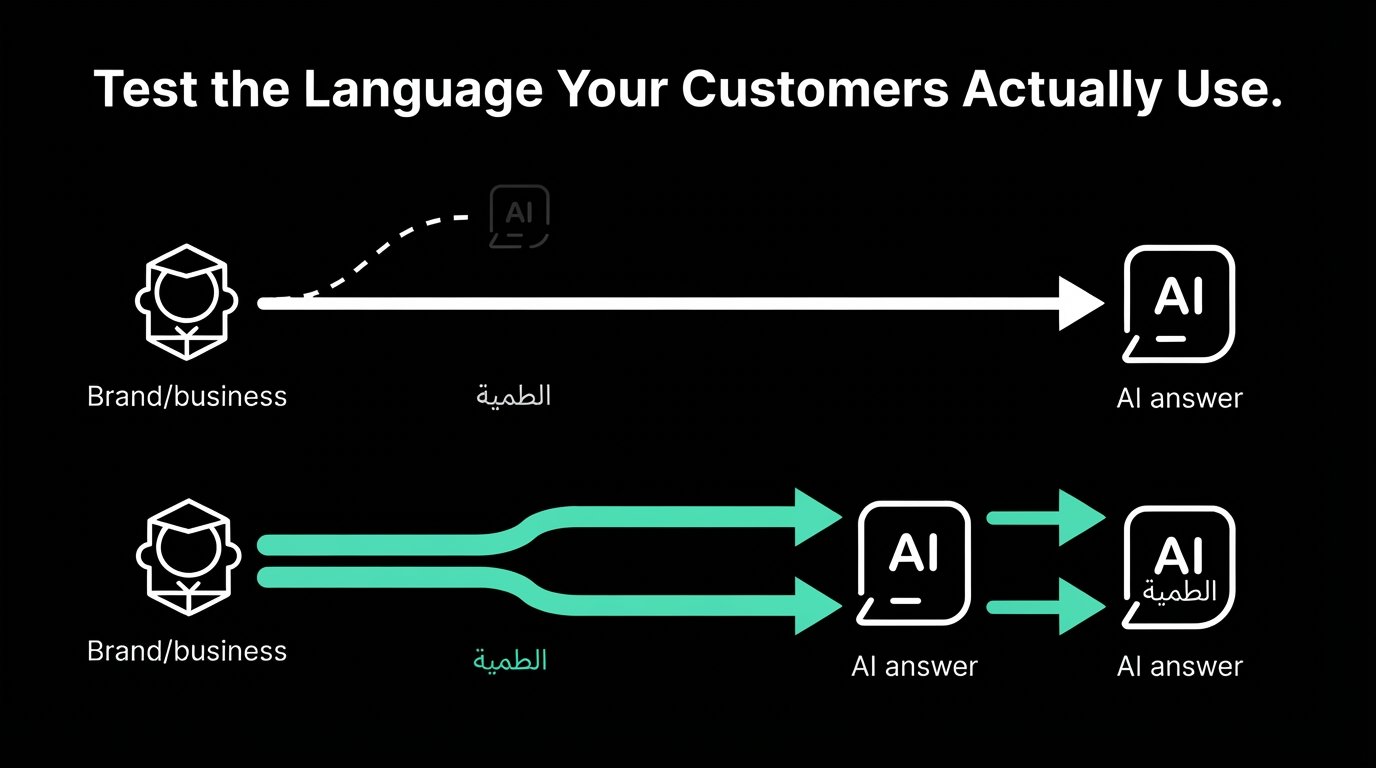
Test the Language Your Customers Actually Use
Arabic AI search deserves to be tested because language can change the context in which a business is discovered and described.
For Dubai brands, the important question is not whether Arabic search is universally different. It is whether your brand, category and location are represented consistently when the customer changes the language of the query.
That makes Arabic AI visibility measurable: run controlled queries, compare the sources and entities surfaced, identify the gaps and improve the information footprint where the evidence shows a real opportunity.
How Meta Social Helped Improve Arabic AI Visibility
A Dubai-based business was appearing reasonably well in English-language AI searches, but equivalent Arabic queries were producing weaker results. The brand was mentioned less often, and some answers relied on third-party sources that did not clearly represent the business.
Meta Social tested comparable Arabic and English queries to identify where the visibility gap was coming from. The team reviewed how the brand, services and key business information were represented across its website and external sources, then strengthened the areas where Arabic-language context was missing.
The result was a more consistent representation of the brand across Arabic AI-search queries and a clearer understanding of which content and external signals needed further improvement.
FAQs
No. The underlying information may overlap, but different language queries can produce different interpretations, sources and competitors. Test both languages instead of assuming equivalence.
Not automatically. Prioritise Arabic content where there is real audience demand and where testing shows a meaningful visibility or information gap.
Use equivalent Arabic and English queries with the same intent, test across relevant AI systems, and record brand mentions, competitors, sources and factual differences.
Yes. GEO focuses on how brands are represented and surfaced in AI-generated answers. Language-specific testing can reveal visibility gaps that a single-language review misses.
Key Takeaways
- Arabic and English queries can produce different AI search results.
- Compare equivalent intent, not literal translations.
- Track entities, sources, competitors and descriptions — not just brand mentions.
- Use testing to decide where Arabic content and information coverage are commercially worthwhile.
Meta Social — Dubai’s #1 Performance Marketing Agency
Meta Social tests AI visibility across the languages UAE customers actually use — comparing Arabic and English queries, source patterns and entity representation before recommending content or GEO changes. Start at metasocial.ae
Performance Marketing | SEO & GEO | AI Creatives & Video | Attribution Architecture
metasocial.ae | Dubai, UAE
About Meta Social
Meta Social is Dubai’s leading performance marketing agency and the GCC’s AI-native growth partner. We specialise in Performance Marketing, SEO & GEO, AI Creatives & Video, and Attribution Architecture — managing AED 50M+ in paid media across real estate, fintech, e-commerce, and hospitality.
metasocial.ae | Dubai, UAE