
Every New Product Line Asks Your Customer to
Hold Two Ideas About You at Once
Direct Answer
A strong brand is assumed to support unlimited product line expansion — brand equity transfers wherever the company decides to point it next. It doesn’t work that way. A brand holds a specific, finite set of associations in customer memory, not an unlimited reservoir of goodwill. Every new product line either reinforces that core association or forces the customer to reconcile two different ideas about what the brand actually is. That reconciliation cost is often invisible until the brand has already blurred and conversion rates across the whole portfolio start declining. As a Meta Partner Agency, we test extension decisions against brand meaning before they reach a launch date.
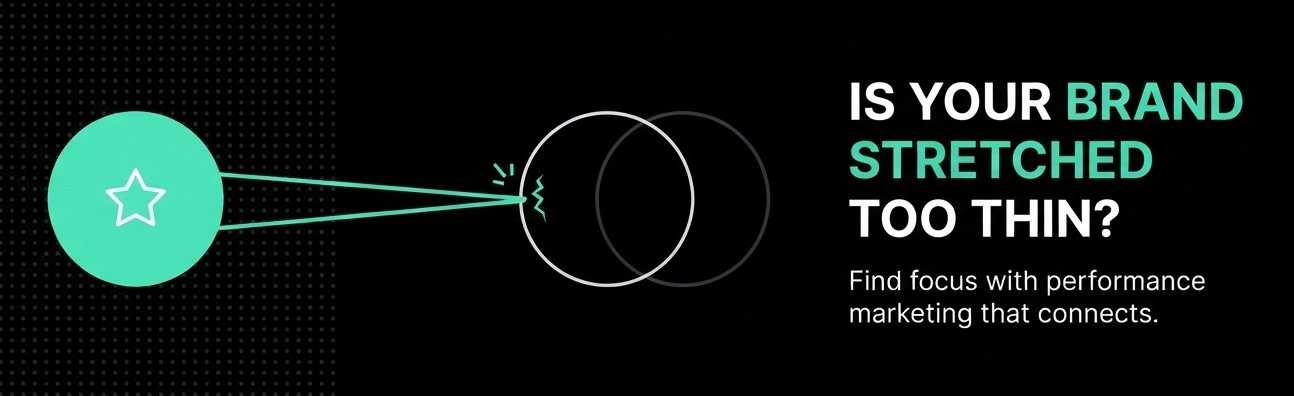
A well-loved brand launches an adjacent product line to capture more revenue from its existing customer base. Eighteen months later, both the original product and the new one are converting worse than either did independently — and nobody on the team connects the decline back to the launch that seemed, at the time, like an obvious way to grow.
The connection is usually real. It’s just invisible from inside the company, because brand dilution doesn’t announce itself the way a failed campaign does. It shows up as a slow, distributed decline across everything the brand touches.
Brand Equity Isn’t a Reservoir. It’s a Specific Set of Associations.
Customers don’t hold vague, unlimited goodwill toward a brand. They hold a specific, compact idea of what it’s for
— and that idea has real edges, even if nobody at the company has ever tried to define them explicitly. Ask a customer what the brand does, and they’ll usually give a short, confident answer. That answer is the boundary a line extension is testing against, whether the company realizes it or not.
The Meaning Elasticity Test
Three questions applied before any line extension reveal whether it’s safe. Does this reinforce the brand’s core association, or stretch it in a genuinely new direction? Would a customer need to hold two different ideas about the brand simultaneously to make sense of both products? Would this extension make sense to someone encountering the brand for the first time through it, with no context from the rest of the portfolio?
A brand known specifically for one clear thing launching an adjacent product that requires an entirely different customer mental model to make sense of fails all three questions at once — and the failure predicts exactly the kind of slow, distributed decline that shows up later without an obvious single cause.
Why the Damage Shows Up Everywhere, Not Just in the New Line
A diluted brand doesn’t only hurt the new product’s performance. A performance marketing agency running paid campaigns for the original product often sees conversion rates on the flagship offering decline too, because
messaging now has to work harder to hold two competing ideas together inside a single ad — and ads that try to do too much convert worse than ads with one clean idea, regardless of how good the creative execution is.
How AI-Generated Descriptions Reveal Dilution Early
A GEO agency evaluating how AI search engines currently summarize and describe a brand can surface dilution before internal teams notice it themselves. When an AI-generated answer struggles to describe what a company actually does in one clean sentence, that’s often the clearest, earliest signal the brand’s core meaning has already blurred — well before it shows up in a quarterly conversion report.
Testing Extensions Before They Reach a Launch Date
The practical application is running every proposed extension through the Meaning Elasticity Test before committing budget or a launch timeline. An AI agency Dubai teams increasingly use for this kind of analysis can process current customer language at scale — reviews, support tickets, social mentions — to check whether a proposed extension actually fits the brand’s existing associations, or is quietly asking customers to hold two different ideas at once.
FAQs
Ask a sample of customers to describe what the brand does in one sentence — if the answers are inconsistent or hedge between two unrelated ideas, that’s a clear sign dilution has already happened.
It can usually be repaired by narrowing focus again — sunsetting or clearly separating the extension that caused the confusion — but the repair takes real time, since customer associations reset slowly, not immediately.
Healthy evolution deepens or extends the existing core association; harmful dilution introduces a genuinely separate one that forces customers to hold two unrelated ideas about the brand at the same time — the Meaning Elasticity Test is designed to catch that distinction before launch.
Key Takeaways
- Brand equity is a specific, finite set of associations — not an unlimited reservoir that transfers automatically to every new product.
- Line extensions that fail the Meaning Elasticity Test can quietly hurt the original product’s performance, not just the new one.
- AI-generated brand descriptions can reveal dilution earlier than internal teams typically notice it on their own.
Meta Social — Dubai’s #1 Performance Marketing Agency
Meta Social builds demand-generation systems, not just traffic campaigns — content, positioning, and trust-building that convert cold clicks into buyers.
Performance Marketing | SEO & GEO | AI Creatives & Video | Attribution Architecture
metasocial.ae | Dubai, UAE
About Meta Social
Meta Social tests brand extension decisions before they reach a launch date — helping GCC companies grow revenue without quietly diluting what their brand actually stands for. metasocial.ae
META SOCIAL — DUBAI’S PERFORMANCE MARKETING & AI-NATIVE GROWTH PARTNER