
AI Agents Are Now Shopping on Behalf of Customers — Is Your Brand Visible to Them?
The next shift in online shopping is not simply that people are asking AI what to buy. AI systems are increasingly helping with the work that comes after the question: comparing products, checking information, building carts and, in some cases, completing purchases. Google is building agentic shopping into Search and Gemini, while OpenAI has already introduced shopping experiences that let users move from product discovery toward checkout inside ChatGPT.
For brands, that creates a new visibility problem. An AI agency Dubai strategy can no longer stop at getting a human to click a page. If an AI agent is helping decide which products or businesses deserve consideration, the information that agent can understand, compare and trust becomes part of the buying journey. The question is increasingly simple: if a machine is doing the shortlist, is your brand giving it enough reasons to include you?
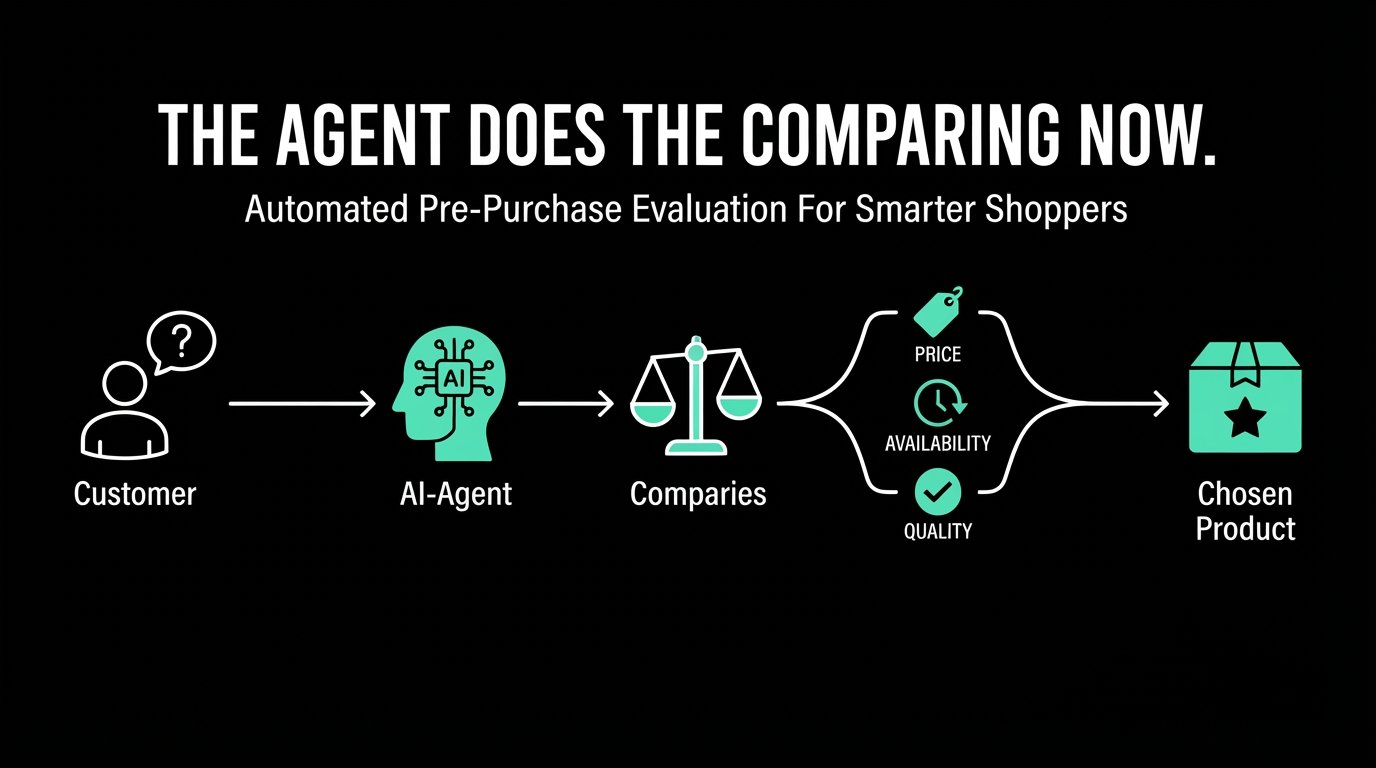
The Buyer May Not Be Doing the Comparison Anymore
Traditional ecommerce assumes the customer does the work. Search for a product, open several tabs, compare prices, read reviews, check delivery and finally decide.
Agentic shopping changes where that work happens. Google describes its Universal Cart as an intelligent shopping layer that can work across Search, Gemini, YouTube and Gmail, while newer commerce protocols are designed to let AI systems interact with merchant information, carts and payments.
OpenAI is moving in a similar direction. Its shopping experience is designed to help users discover products in conversation, with Agentic Commerce Protocol providing a way for AI agents, people and businesses to interact during a purchase.
The important change is therefore not “AI will replace ecommerce.” It is that part of the comparison layer may move from the shopper’s browser into the AI interface.
An Agent Needs Different Information Than a Human Does
A human can tolerate a messy website. They can open a product page, scroll through images, read reviews and work out what matters. An agent has to interpret structured information and make a decision from what it can access.
That makes basic product and business information much more commercially important. Price, availability, specifications, delivery terms, variants, policies, reviews and other attributes need to be accurate enough for systems to compare them.
Google’s Universal Commerce Protocol is explicitly designed to help agents access real-time product information such as pricing and inventory, while its broader merchant tools are aimed at improving discovery in conversational commerce.
This is where a GEO agency perspective becomes useful. GEO is not only about getting a brand mentioned in an answer. It is about making the information around the brand clear enough to be retrieved, interpreted and used when the question becomes commercial.
Being Recommended Is Not the Same as Being Chosen
There is another layer that brands should not overlook. Even if an AI agent finds your product, it still has to decide whether the product fits the request.
Imagine a customer asks for running shoes under a certain budget, available quickly and suitable for long-distance use. The agent is not looking for the brand with the cleverest slogan. It needs evidence about price, suitability, availability and other constraints.
That means brand visibility increasingly depends on the quality of the information surrounding the offer. A performance marketing campaign can create demand, but the agentic layer may influence what happens when the customer asks AI to narrow the options.
The implication is uncomfortable for marketers: attention alone may not be enough. A brand can win the ad impression and still lose the comparison if the information available to the buying system is incomplete, inconsistent or unconvincing.
This Is Not Just an Ecommerce Problem
The most obvious examples today involve products, but the underlying idea is broader. Any purchase that involves research, comparison, qualification or scheduling can potentially become more conversational and agent-assisted.
A customer might ask which hotel best fits a trip, which service provider fits a budget, which software is suitable for a team or which agency has experience in a particular industry. The agent does not need to complete the entire transaction to change the marketing funnel. If it changes the shortlist, it has already changed discovery.
That is why the next generation of Meta ads agency strategy cannot be completely separated from AI discovery. Paid media can create the initial demand, while AI-led research can influence what the customer considers next. The channels may remain different, but the buyer does not experience them as separate systems
. What Brands Should Prepare Before the Agents Arrive
- Make product or service information precise, current and easy for systems to interpret.
- Keep pricing, availability, specifications, locations and policies consistent across important sources.
- Build genuine evidence around the brand: reviews, case studies, expert content and credible third-party references.
- Test how AI systems describe and compare your brand against competitors.
- Identify the questions an agent would need to answer before recommending your offer.
- Connect marketing measurement to the outcomes that happen after discovery, not just the initial click.
The goal is not to “optimise for agents” by stuffing more information onto a website. It is to remove ambiguity. If a customer asks an AI system whether your business fits a specific need, the answer should be supported by clear, consistent evidence.
FAQs
Yes, agentic shopping is already moving beyond recommendations. Google is rolling out agentic commerce capabilities across Search and Gemini, while OpenAI has introduced shopping and checkout infrastructure that allows AI agents to help users move from product discovery toward purchase. Availability and capabilities vary by market and merchant.
Start with accurate, accessible product information: pricing, availability, specifications, variants, policies and other details an agent may need to compare your offer. Then strengthen the broader brand signals around that information, including reviews and credible third-party references.
Yes. AI systems still need information to discover and evaluate products and businesses. Traditional search visibility, technical accessibility, useful content and authoritative sources remain part of the information layer that AI can draw from.
Yes. AI shopping and conversational search can use different sources and decision criteria from a traditional ranking page. A competitor may have clearer product data, stronger reviews, better availability, more relevant attributes or stronger integration with the shopping ecosystem.
It depends on the purchase, but common requirements include product or service details, price, availability, variants, delivery or fulfilment information, policies and evidence of relevance or quality. For higher-consideration purchases, reviews, expertise and third-party information can also matter.
No. Ecommerce is the clearest early use case, but the same discovery pattern can apply to hotels, travel, software, services and other categories where customers research and compare before buying.
Key Takeaways
- AI agents are moving from answering shopping questions toward helping execute the shopping journey.
- The shortlist may become machine-generated before a customer ever visits a brand website.
- Accurate product and business information becomes a competitive asset when agents compare options.
- GEO is increasingly about being understandable and useful to AI systems, not just being mentioned.
- Brands should prepare for AI-assisted discovery before agents become the default buying interface.
Meta Social — Dubai’s #1 Performance Marketing Agency
Meta Social helps UAE brands connect paid acquisition with the next layer of discovery—building performance campaigns, AI visibility and measurement systems that reflect how customers increasingly research, compare and buy.
Performance Marketing | SEO & GEO | AI Creatives & Video | Attribution Architecture
metasocial.ae | Dubai, UAE
About Meta Social
Meta Social is Dubai’s leading performance marketing agency and the GCC’s AI-native growth partner. We specialise in Performance Marketing, SEO & GEO, AI Creatives & Video, and Attribution Architecture — managing AED 50M+ in paid media across real estate, fintech, e-commerce, and hospitality.
metasocial.ae | Dubai, UAE