
Why UAE Brands With Big Ad Budgets Are Still Getting Poor Results — The Infrastructure Problem Nobody Talks About
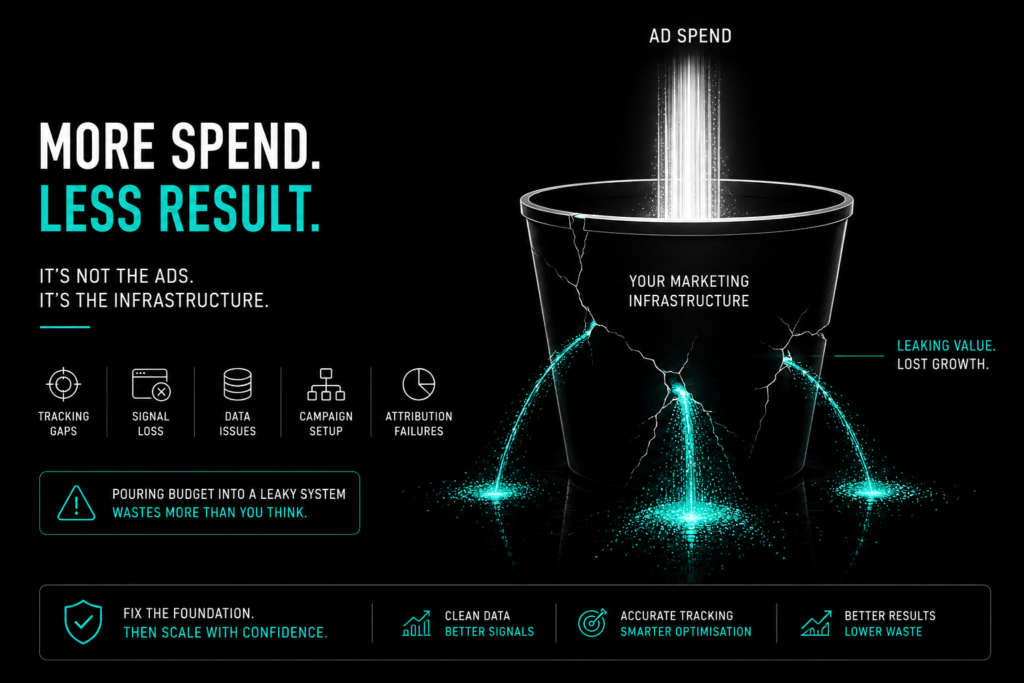
Increasing your ad budget without fixing the infrastructure underneath it is like pouring water into a leaking bucket. Yet across the UAE, brands continue to scale spend while the real problem — broken tracking, misaligned account structures, and poor signal quality — quietly drains every dirham. Partnering with an experienced performance marketing agency can help identify and resolve these foundational issues before they compound further.
This article breaks down the root infrastructure causes behind underperforming campaigns, and what UAE brands need to fix before they invest another fils in paid media.
Why Performance Marketing Infrastructure Fails in UAE
Most UAE brands diagnose performance problems as creative fatigue, audience saturation, or seasonality. While these are real factors, they are rarely the root cause of campaigns that never reach their potential — not even in their first few weeks.
The infrastructure problem is more fundamental: the technical and strategic foundation on which a campaign is built. When that foundation is cracked, no amount of budget will hold the structure up. Working with a reputable digital marketing agency with deep UAE market knowledge is often the most direct path to diagnosing these gaps.
The four most common infrastructure failures seen in UAE campaigns are poor pixel and conversion tracking, misaligned campaign objectives, no first-party data strategy, and account structures that prevent the algorithm from learning.
Broken Tracking Is Costing You More Than You Think
Meta and Google’s algorithms optimise toward the signals you give them. If your pixel is misconfigured, firing duplicate events, or not capturing purchases accurately, you are teaching the algorithm to target the wrong people.
A UAE e-commerce brand spending AED 50,000 a month with a 30% tracking discrepancy is effectively working with a 30% smaller dataset. The algorithm cannot find your best customers if it cannot see who they are. A qualified Meta ads agency will audit pixel health as one of the first steps in any onboarding process.
Audit your Meta Pixel and Google Tag Manager setup before reviewing any other performance lever. Check for duplicate events, verify that your purchase and lead events are firing on confirmation pages — not product pages — and confirm that your conversion window aligns with your actual sales cycle.
Campaign Objectives Drive Everything Downstream
Choosing the wrong campaign objective is one of the most expensive mistakes a UAE brand can make. A brand running Traffic campaigns when they want conversions is telling Meta’s algorithm to find people who click — not people who buy.
This single misconfiguration can inflate CPCs, destroy ROAS, and leave teams confused about why performance is not improving despite creative refreshes and audience changes.
Always align your objective to your actual business outcome. If you want leads, run Lead Generation or Conversions campaigns optimised for leads. If you want purchases, run Advantage+ Shopping or Conversions campaigns with purchase as the goal. Traffic and Reach campaigns have their place in brand building but are not performance tools.
The Account Structure Problem
Fragmented account structures are an endemic problem in UAE markets. Brands often run dozens of ad sets targeting narrow audience segments, believing that more granularity gives more control. In reality, it starves each ad set of the data volume needed for the algorithm to exit the learning phase.
Meta’s algorithm needs approximately 50 conversion events per ad set per week to optimise properly. If you have ten ad sets each generating five conversions a week, none of them are learning — they are all stuck in the learning phase indefinitely. Leveraging an AI agency Dubai can bring smarter account architecture informed by machine learning insights.
Consolidating campaigns, reducing ad set fragmentation, and letting Advantage+ audience tools do the targeting work is the structural shift most UAE brands need to make in 2026.
First-Party Data: The Foundation You Cannot Buy
UAE brands that have not built a first-party data strategy are structurally disadvantaged. Without CRM data, customer lists, and website behavioural data flowing into their ad platforms, they are relying entirely on third-party interest targeting — which becomes weaker with every iOS update and every privacy regulation.
Building a first-party data infrastructure means capturing email addresses and phone numbers at every touchpoint, integrating your CRM with Meta’s Conversions API, and uploading customer match lists regularly.
This is not a quick fix — it takes months to build meaningful first-party audiences — but it is the most defensible competitive advantage a UAE brand can develop in paid media.
What Good Infrastructure Looks Like
A well-built performance marketing infrastructure for a UAE brand in 2026 includes: clean conversion tracking through both pixel and server-side Conversions API; campaign objectives precisely matched to business outcomes; consolidated account structures with sufficient conversion volume per ad set; a functioning first-party data loop from CRM to ad platform; and a creative testing framework that generates learning, not just impressions.
When all five elements are in place, scaling budget actually works. Without them, increasing spend simply amplifies the existing inefficiencies.
FAQs
The most common cause is infrastructure failure rather than creative or audience issues. Broken tracking, wrong campaign objectives, fragmented account structures, and no first-party data strategy all prevent algorithms from optimising effectively — regardless of budget.
Use Meta’s Events Manager to audit pixel health. Check for duplicate events, confirm that purchase and lead events fire on confirmation pages, and verify event match quality scores above 7.0. Also implement server-side tracking via the Conversions API to supplement browser-side data.
Consolidate campaigns to ensure each ad set receives at least 50 conversion events per week. Reduce audience fragmentation, use broad or Advantage+ audiences, and let the algorithm optimise within a well-structured framework rather than trying to micromanage targeting manually.
Extremely important. As third-party cookies disappear and iOS privacy changes reduce signal quality, first-party data from CRM lists, purchase history, and website behaviour becomes the primary fuel for accurate targeting and lookalike audience creation.