
The Silent Killer of UAE Ad Budgets:
Frequency Caps Nobody Is Setting
Direct Answer
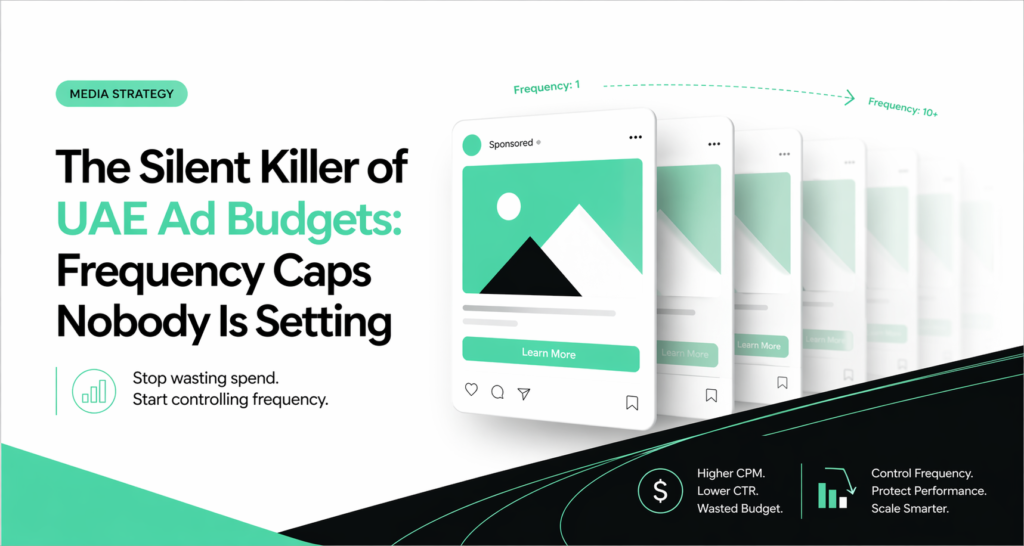
Uncapped ad frequency is one of the most expensive and least talked-about problems in UAE digital advertising. When your audience sees the same ad 12, 15, or 20 times, they don’t just ignore it — they actively distrust your brand. In high-CPM markets like Dubai, where reaching the right 50,000 people costs significantly more than reaching the wrong 500,000, burning that audience through repetition is a compounding disaster. Setting intelligent frequency caps — and knowing when to break them — is a foundational media discipline that most brands and their agencies have never formalised.
Why Frequency Gets Ignored Until It’s Too Late
Frequency management doesn’t generate its own alert. There is no dashboard notification that reads ‘your audience now hates this ad.’ What you get instead is a gradual rise in CPM, a slow decline in CTR, a creeping increase in CPL — and a campaign that looks like it’s underperforming when the real problem is audience exhaustion. In a market where a skilled meta partner agency is managing multiple campaign types simultaneously, frequency tracking across all ad sets — not just individual campaigns — is the discipline that separates brands that maintain performance over 90-day campaigns from those that peak in week two and deteriorate from there.
The Three Frequency Thresholds That Matter
1. The Awareness Threshold (Frequency 1–3)
At this stage, the ad is earning genuine impressions — the user is seeing it for the first time or the second. Recall is building. No negative effects. This is the sweet spot for awareness investment, and where most brands think their campaigns live. Most don’t.
2. The Fatigue Threshold (Frequency 4–8)
This is where most UAE campaigns are actually operating. The audience has seen the ad enough that novelty is gone, but there’s no strong negative reaction yet. CTR starts declining. This is the zone where creative refresh produces the highest marginal return — a new hook, a new format, or a new offer angle can reset the performance curve without rebuilding the entire campaign.
3. The Hostility Threshold (Frequency 9+)
At this level, audience sentiment turns negative. Users who previously would have ignored the ad now actively associate the brand with intrusion. Brand lift studies in GCC markets consistently show negative brand sentiment correlating with frequency above 9 in a 30-day window. The damage isn’t just to the campaign — it affects how the audience responds to future campaigns from the same brand.
The GCC-Specific Frequency Problem
UAE audiences are smaller and more defined than in Western markets. A real estate developer targeting HNWI buyers in Dubai may be reaching a total addressable audience of 80,000–150,000 people. Running a campaign for 90 days against this fixed pool without frequency management means the same individuals are seeing ads repeatedly — there is no ‘fresh’ audience to refresh the pool. An experienced performance marketing agency in the GCC market structures campaigns with this fixed-audience reality in mind: rotating creatives, staggering campaign start dates, and using sequential messaging instead of repetitive single-message exposure.
Sequential Messaging: The Intelligent Alternative to Frequency Fatigue
Instead of showing the same ad until frequency climbs, sequential messaging deliberately changes what the audience sees at each exposure. Exposure 1–2: introduce the brand story or category insight. Exposure 3–4: present the specific offer or project. Exposure 5–6: introduce social proof — a testimonial, a case study, a named result. Exposure 7+: create urgency or a direct call to action.
This approach treats frequency as a narrative structure rather than a repetition problem. The audience isn’t seeing the same thing twelve times — they’re moving through a story. The result: higher engagement at every stage, lower CPM because relevance scores stay elevated, and qualified leads who arrive with brand context already built. Any meta ads agency building sequential structures for UAE campaigns is building something fundamentally different from a standard retargeting campaign — it’s a conversion architecture.
How to Set Frequency Caps Correctly
In Meta, frequency caps can be set directly in Reach and Frequency buying, or managed indirectly through audience sizing, budget, and creative rotation in auction buying. For UAE campaigns, a practical rule of thumb: 3 impressions per week maximum for a fixed audience below 200,000; 5 per week for audiences above 500,000. For retargeting campaigns — where the audience is already warm and the stakes are higher — cap at 2 per week and rotate creative every 10 days.
FAQs
No. Video ads earn attention in a way static ads don’t — a 30-second video viewed twice tells a fuller story than a static image seen twice. You can tolerate slightly higher frequency for video before fatigue sets in, especially for content that holds genuine interest. The rule: video fatigue starts at frequency 5–7; static image fatigue starts at frequency 3–5 in most GCC categories.
Yes — especially if it’s performing well. High-performance campaigns have warmed up a specific audience segment. Capping frequency and refreshing creative extends the life of that warmed audience rather than burning through it. The campaign that performs well for 4 weeks and then collapses is almost always a frequency story.
Pull your CPL trend alongside your average frequency trend over the same period. If CPL rises within 2–3 weeks of frequency crossing 7–8, frequency is almost certainly the cause. If CPL rises immediately with no frequency change, the issue is targeting or offer relevance, not frequency.
Key Takeaways
✓ Frequency above 9 in a 30-day window creates negative brand sentiment in GCC markets — the damage extends beyond the current campaign.
✓ Sequential messaging reframes frequency as narrative structure, not repetition — each exposure advances the story.
✓ UAE audiences are smaller and more defined than Western markets — fixed-pool audience management is a non-negotiable discipline.
✓ Retargeting campaigns should cap at 2 impressions per week — warm audiences are high-value and easily burned.
Meta Social — Dubai’s #1 Performance Marketing Agency Meta Social — Dubai’s #1 performance marketing agency — answers all eight questions confidently and builds infrastructure you own. Start the conversation at metasocial.ae Performance Marketing | SEO & GEO | AI Creatives & Video | Attribution Architecture metasocial.ae | Dubai, UAE |
About Meta Social Meta Social is Dubai’s #1 performance marketing agency and the GCC’s leading AI-native growth partner. As a certified meta partner agency and leading ai agency dubai, we specialise in Performance Marketing, SEO & GEO Strategy, AI Creatives & Video Production, and Attribution Architecture. Our team has managed AED 50M+ in paid media spend across real estate, fintech, e-commerce, and hospitality. metasocial.ae | Dubai, UAE |