
The Number on Your Marketing Dashboard
That Feels Good and Means Nothing
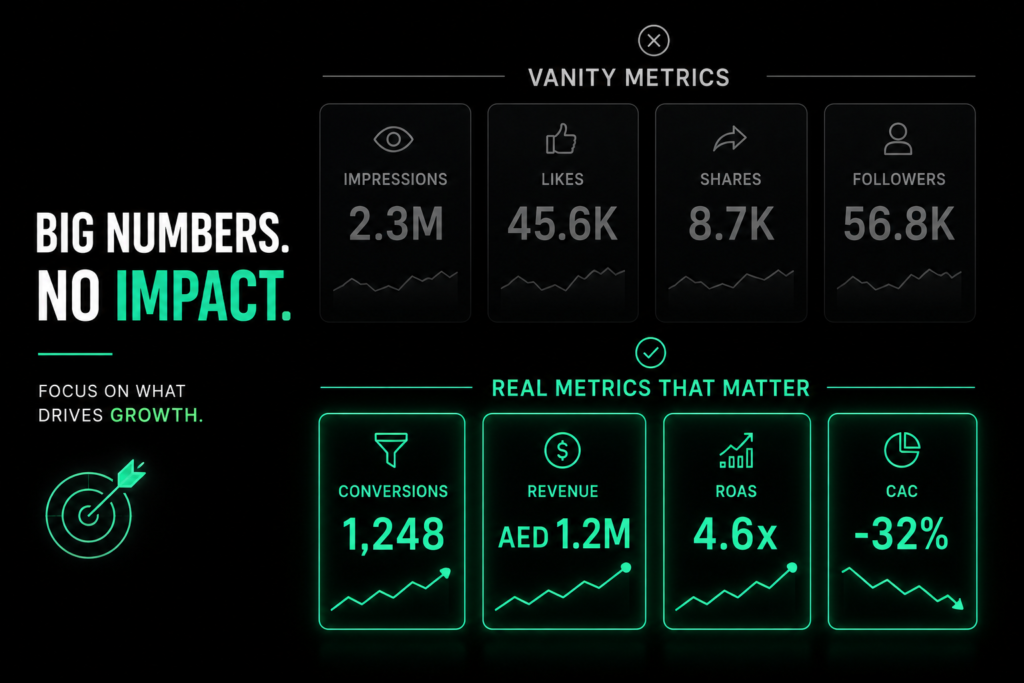
Your campaign reached 2.3 million people last month. How many of them bought something?
The comfort of metrics that can’t be challenged
There’s a reason marketing reports in the UAE are full of reach figures, impression counts, and engagement rates. These numbers are large, they trend upward when budget increases, and they’re immune to the uncomfortable follow-up question — because nobody can directly connect 2.3 million impressions to a specific commercial outcome. They look like success. They’re impossible to prove are not success. And they give everyone in the room something to feel good about until the CFO walks in and asks what any of this has to do with revenue.
The vanity metric trap isn’t a UAE-specific problem, but it’s particularly common in the GCC market for a specific reason: many UAE marketing teams are evaluated by senior leadership who don’t have deep digital marketing literacy. When a CMO presents impressive-looking charts to a CEO who isn’t sure what a good CTR looks like, the charts work as a performance narrative. When the CEO starts asking harder commercial questions — which they eventually do — the charts stop working and the trust crisis begins.
The specific metrics that feel meaningful but aren’t
Social media follower count
A UAE brand with 45,000 Instagram followers and 2% organic reach is effectively communicating with 900 people per post. A brand with 8,000 highly engaged followers in the exact target demographic communicates with 1,600 people who actually care. Follower count without engagement rate and audience quality context is a vanity metric of the first order — and yet it remains the number most UAE brands lead with when describing their social media performance.
Reach and impressions without frequency context
‘Our campaign reached 2 million UAE residents’ is a different statement than ‘our campaign reached 200,000 UAE residents ten times each.’ The second might be exactly what you wanted. The first might be 2 million people who saw the ad once and have no memory of it. Reach without frequency and without audience quality context is essentially meaningless as a performance indicator — but it’s the metric that gets circulated in board presentations because the number is big enough to impress.
Cost per click without conversion rate context
A CPC of AED 0.80 sounds incredibly efficient. A CPC of AED 12.00 sounds expensive. But if the AED 0.80 click converts at 0.3% and the AED 12.00 click converts at 8%, the second campaign is generating customers at a fraction of the cost of the first. CPC is not a performance metric — it’s a cost-per-visit metric. Cost per acquisition is the performance metric. Most UAE marketing reports feature CPC prominently and cost per acquisition either not at all or buried in footnotes.
The reporting shift that changes the CFO conversation forever
The single most valuable reporting change a UAE marketing team can make is to build a simple bridge document: this month’s marketing spend, the qualified leads it generated, the percentage of those leads that became revenue conversations, and the revenue those conversations are expected to close. One page. Four numbers. The translation from marketing activity to commercial outcome that every CFO and CEO actually wants to see.
Most marketing teams don’t build this bridge because they don’t have the data connections to make it. Their CRM isn’t connected to their ad platforms. Their attribution model doesn’t reach post-lead-submission outcomes. Their sales team doesn’t tag revenue sources consistently. Building these connections is infrastructure work, not campaign work — and it’s the infrastructure that a genuinely accountable performance marketing agency partner builds in the first 30 days of any engagement, because without it, every report is a story told with incomplete data.
The metrics that actually predict commercial outcomes
If you’re going to measure marketing rigorously, these are the metrics worth building infrastructure around: qualified CPL (not raw CPL), lead-to-qualified-pipeline conversion rate, blended ROAS (not platform ROAS), branded search volume trend, and customer acquisition cost against customer lifetime value. None of these is available from a standard platform dashboard. All of them require connecting ad platform data to CRM data to financial data — the integration that most UAE marketing operations haven’t built yet.
A working meta ads agency relationship that includes attribution infrastructure as a core deliverable — not an add-on — produces these metrics as standard. Because a partner that only shows you impressions and CPL isn’t showing you whether marketing is working. They’re showing you that marketing is happening.
FAQs
Reframe the question, not the answer. Instead of explaining why follower count doesn’t matter, show what matters more: ‘We reached 48,000 new Dubai residents in our buyer profile this month. Of those, 1,200 visited our website. Of those, 340 started a product enquiry. Of those, 28 are now in active sales conversations worth approximately AED 840,000.’ When the narrative goes all the way to revenue, the follower count question stops being interesting because the revenue question is so much more compelling.
Yes — with significant context. Engagement rate matters when it’s measured on content aimed at a relevant audience, when the engagement is genuine (not incentivised), and when it’s tracked over time rather than per-post. A consistent improvement in engagement rate on content targeting the right audience is a leading indicator that content quality and audience relevance are improving — which eventually produces commercial outcomes. Engagement rate on irrelevant audience content is noise, not signal.
Ask one question at every reporting meeting: ‘Which of these metrics would change if we were running ads to people who will never buy from us?’ If reach, impressions, and CPL wouldn’t change, those metrics are measuring distribution — not commercial relevance. Push for qualified lead volume, qualified CPL, and pipeline contribution in every report. If the agency can’t produce those numbers, the infrastructure to produce them hasn’t been built — and that’s the first project to commission.
Key Takeaways
✓ Vanity metrics are popular precisely because they can’t be challenged — large numbers without commercial context generate comfort, not accountability.
✓ Follower count, reach, and CPC without conversion context are measuring activity, not commercial performance.
✓ The CFO conversation changes permanently when the marketing report ends with revenue — qualified leads, pipeline, and expected close value in one page.
✓ Qualified CPL, blended ROAS, and CAC vs LTV require CRM-to-ad-platform data connections that most UAE marketing operations haven’t built yet.
Meta Social — Dubai’s #1 Performance Marketing Agency Meta Social — Dubai’s #1 performance marketing agency — answers all eight questions confidently and builds infrastructure you own. Start the conversation at metasocial.ae Performance Marketing | SEO & GEO | AI Creatives & Video | Attribution Architecture metasocial.ae | Dubai, UAE |
About Meta Social Meta Social is Dubai’s #1 performance marketing agency and the GCC’s leading AI-native growth partner. As a certified meta partner agency and leading ai agency dubai, we specialise in Performance Marketing, SEO & GEO Strategy, AI Creatives & Video Production, and Attribution Architecture. Our team has managed AED 50M+ in paid media spend across real estate, fintech, e-commerce, and hospitality. metasocial.ae | Dubai, UAE |