
Why Every Marketing Team Needs an AI Workflow Before More Headcount
Direct Answer
Most marketing teams solve a capacity problem by hiring. But another person typing into the same broken process just produces the same bottleneck, slower and at higher cost. The real fix is building a structured AI workflow first — one that turns briefs into usable first drafts and frees strategists from repetitive production work. A performance marketing agency that has already built this workflow can get a team there faster than a new hire, because the system, not the headcount, is what creates leverage.
The Hiring Reflex That Doesn’t Fix the Problem
When a team is overwhelmed, the instinct is to add a person. A brand manager needs three more social posts a week, so a coordinator gets hired. A founder wants faster ad iteration, so a freelancer joins the roster. Six months later, the same bottleneck shows up one layer down — because the problem was never headcount. It was the absence of a repeatable production system. More people running the same broken process just produces the same output slower and at higher cost. The pattern is easy to miss because hiring feels like progress. A new name on the org chart signals momentum to leadership, even when the underlying workflow hasn’t changed at all. The new hire inherits the same undefined brief, the same unclear handoffs, and the same missing feedback loop that slowed the previous person down. Within a quarter, the team is back in the same meeting asking for the same additional resource.
What AI Actually Replaces — And What It Doesn’t
AI does not replace strategy, judgment, or brand voice. It replaces the repetitive middle of production: first-draft copy, variant generation, formatting, and structuring a brief into usable creative. Whether a team manages paid media in-house or through a Meta ads agency, the workflow gap looks identical — strategy lives in one person’s head, execution sits in a queue, and nothing moves without a status meeting. An AI workflow closes that gap by giving the strategist a fast first draft to react to, rather than a blank page to fill. This distinction matters because most failed AI adoption stories are actually workflow failures wearing an AI label. A team buys a tool, expects it to replace a role outright, gets generic output, and concludes the technology doesn’t work. The tool performed exactly as designed — it just had no structure feeding it context, and no human checkpoint refining what it produced.
The Five-Step Workflow That Actually Holds Up
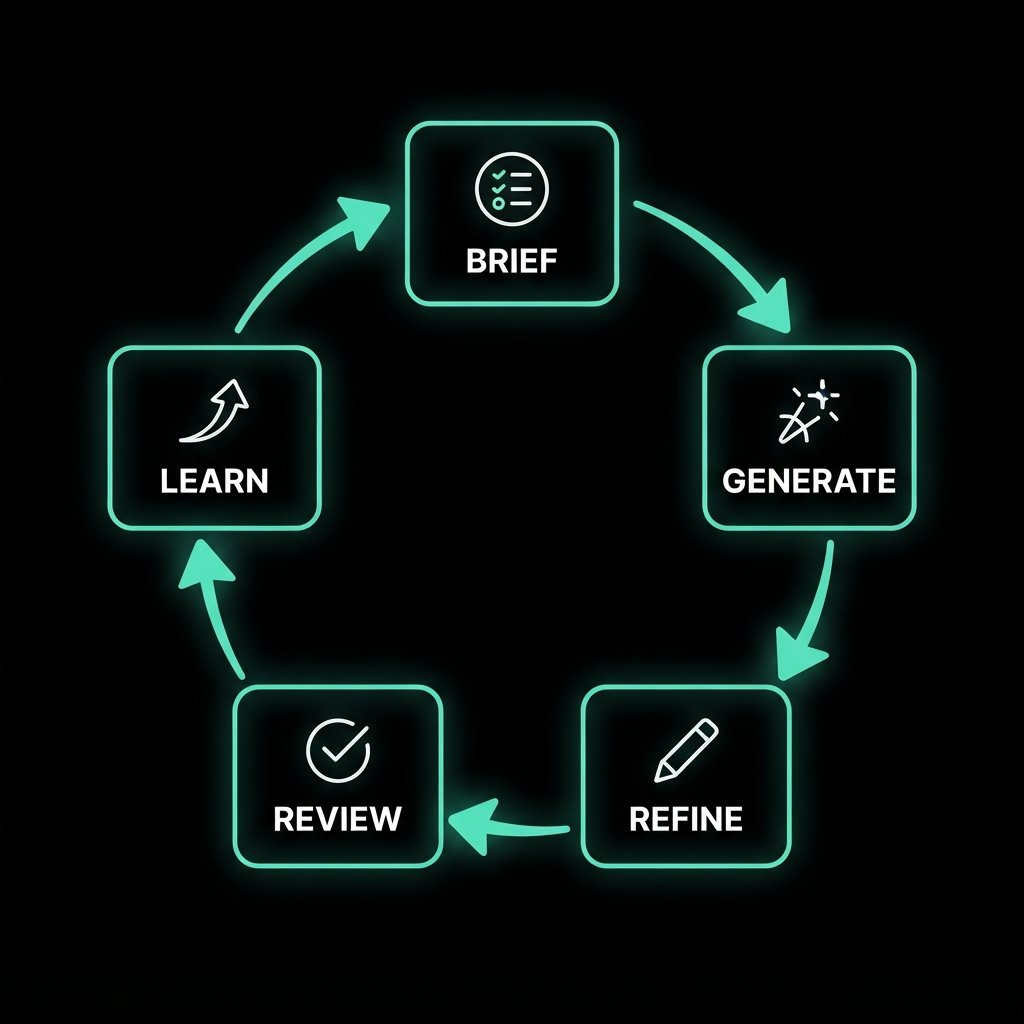
Most AI workflows fail not because the model is weak, but because there’s no structure around it. A workflow that scales looks like this:
- A structured brief that names audience, objective, tone, and constraints — not a one-line prompt
- AI generates three to five variants against that brief
- A strategist selects and edits, applying judgment the model doesn’t have
- A specialist reviews for brand accuracy, compliance, or localization
- Performance data from what shipped feeds directly into the next brief Skip any one of these steps and quality drops immediately — usually the review step, which is the one most teams cut first under deadline pressure.
Where the Leverage Compounds
The same brief-generate-refine loop that powers ad creative also powers content built for AI search visibility. This is exactly where a GEO agency lens adds value: structured, citation-ready content follows the identical workflow as paid creative, so one system serves two growth channels instead of requiring separate teams for each.
Before You Post the Job Listing
Map where drafts actually stall before adding a person to the team. If the bottleneck sits between brief and first draft, that’s a workflow problem, not a headcount problem. Test the five-step loop on a single campaign before rolling it out further. Teams already working with a Meta Partner Agency for paid media should ask whether that partner has built AI-assisted creative production — increasingly, that capability is what separates a media buyer from a genuine growth partner.
FAQs
A: Not necessarily — it means the hire should sit above the workflow, not inside it. Teams that build the AI workflow first often still hire, but for strategic or channel-specialist roles rather than production support, because production is no longer the bottleneck.
A: Whatever produces the most repetitive drafts with the least strategic judgment — usually first-draft ad copy, social captions, or variant testing. Start narrow, prove the workflow on one output type, then expand.
A: Most teams see faster turnaround within two to three weeks of running the structured loop consistently. The bigger gain — output scaling without cost scaling — becomes visible over a full quarter as the brief-toperformance feedback loop matures.
Key Takeaways
✓ Hiring into a broken process produces the same bottleneck one layer down — the fix is workflow structure, not headcount.
✓ AI replaces repetitive production work, not strategy or judgment; the strategist still makes every final call.
✓ A five-step loop — brief, generate, refine, review, learn — is the minimum structure that keeps quality consistent at scale.
✓ The same workflow that powers ad creative also powers GEO-ready content, giving one system two growth channels.
Meta Social — Dubai’s #1 Performance Marketing Agency
Meta Social builds AI-powered creative and content workflows for growth teams — turning structured briefs into performance-ready output without adding headcount.
Performance Marketing | SEO & GEO | AI Creatives & Video | Attribution Architecture
metasocial.ae | Dubai, UAE
About Meta Social
Meta Social is Dubai’s leading performance marketing agency and the GCC’s AI-native growth partner. We specialise in Performance Marketing, SEO & GEO, AI Creatives & Video, and Attribution Architecture — managing AED 50M+ in paid media across real estate, fintech, e-commerce, and hospitality.