
Why Great Marketing Makes Buying Feel Easier—
Not More Convincing
Direct Answer
Most buyers aren’t short on motivation; they’re short on clarity and confidence. Confusing messaging, too many choices, and unresolved doubt create friction that stalls decisions that would otherwise happen naturally. Instead of adding more persuasive elements — urgency, incentives, longer copy — great marketing removes the friction sitting between interest and action: clearer messaging, simpler choices, visible trust signals. As a Meta ads agency, we’ve found the result isn’t more convincing marketing. It’s marketing that gets out of the buyer’s way.
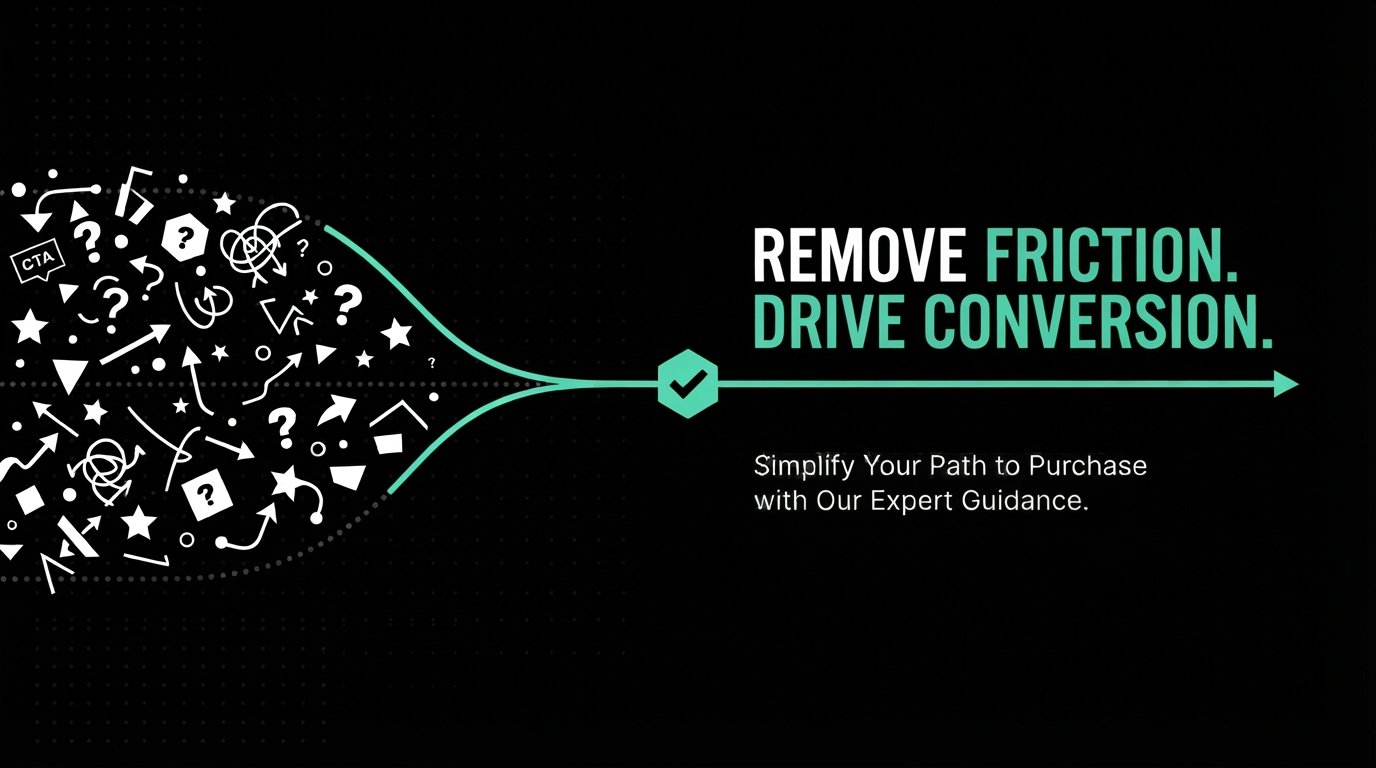
Most marketing tries to convince people to buy. The best marketing does something different — it gets out of the way of a decision that was already halfway made.
This distinction sounds subtle. In practice, it’s the difference between campaigns that quietly outperform and campaigns that pile on more urgency, more incentives, more copy, and still can’t move the needle.
Why Persuasion Isn’t the Bottleneck Most Businesses Think It Is
By the time someone reaches a landing page or engages with an ad, they’re usually already interested — that’s what brought them there. The job at that stage isn’t to generate more desire. It’s to avoid losing the desire that already exists.
Most businesses respond to a stalled conversion by adding more persuasive weight: more urgency banners, more incentives stacked on top of each other, longer explanations of value. This treats a friction problem as a motivation problem, which is often exactly backwards.
The Friction Ledger: What Adds and Removes Doubt
Every marketing touchpoint either adds friction or removes it. Think of it as a ledger with two columns: confusing copy, too many competing CTAs, and unclear pricing add friction. A single clear CTA, visible pricing, and specific social proof remove it.
A simple example: two versions of the same ad. One stacks three offers together, hoping more incentives will close the deal. The other has one clear CTA and transparent pricing. The second version consistently outperforms — not because it’s more persuasive, but because it’s easier to say yes to.
Call this the Friction Ledger. The goal isn’t to maximize persuasive volume. It’s to get the ledger net negative — removing more friction than you add.
Cognitive Load: The Psychology Behind the Friction
This isn’t just intuition — it’s grounded in how decisions actually get made under cognitive load. More choices and more competing claims increase the mental effort required to decide, and mental effort is what buyers abandon
first when a decision starts to feel hard. Adding more persuasive claims on top of an already-cluttered decision doesn’t increase desire. It increases the effort required to act on desire that’s already there.
What This Looks Like for AI-Driven Search and Discovery
As more buyers interact with AI-generated answers rather than browsing directly, clarity matters even more. A GEO agency approach to this shift isn’t about writing more persuasively — generative answers compress information regardless of how persuasive the source is. It’s about making sure the core answer is unambiguous enough to survive that compression intact.
Auditing Your Marketing for Friction, Not Just Persuasiveness
Instead of asking “how do we make this more convincing,” try auditing for what to remove:
- Where are we asking for more than we need to?
- Where are we offering more choices than necessary?
- Where is our pricing, process, or next step unclear?
FAQs
Motivation and friction are separate variables. A motivated buyer can still abandon a decision if the path to acting on that motivation is confusing, cluttered, or unclear — the fix is removing friction, not adding more persuasive pressure.
Persuasive marketing tries to increase desire through claims, urgency, and incentives. Friction-reducing marketing assumes desire already exists and focuses on making the decision easier — clearer messaging, simpler choices, obvious next steps.
Look for competing CTAs, unclear pricing, or unnecessarily long forms — anything that requires extra mental effort before someone can act. If a buyer has to work to understand what to do next, that’s friction, not persuasion.
Key Takeaways
- Most buyers aren’t short on motivation — they’re short on clarity and confidence.
- Great marketing removes decision friction rather than adding more persuasive pressure.
- As AI-driven search grows, clarity matters more than ever, since there’s less room for lengthy persuasion.
Meta Social — Dubai’s #1 Performance Marketing Agency
Meta Social builds demand-generation systems, not just traffic campaigns — content, positioning, and trust-building that convert cold clicks into buyers.
Performance Marketing | SEO & GEO | AI Creatives & Video | Attribution Architecture
metasocial.ae | Dubai, UAE
About Meta Social
Meta Social is a Meta Partner Agency and performance marketing agency focused on reducing the friction between interest and action — not just increasing persuasive noise. metasocial.ae
META SOCIAL — DUBAI’S PERFORMANCE MARKETING & AI-NATIVE GROWTH PARTNER