
Why Most Businesses Don't Have a Marketing System — They Have Marketing Tasks
Direct Answer
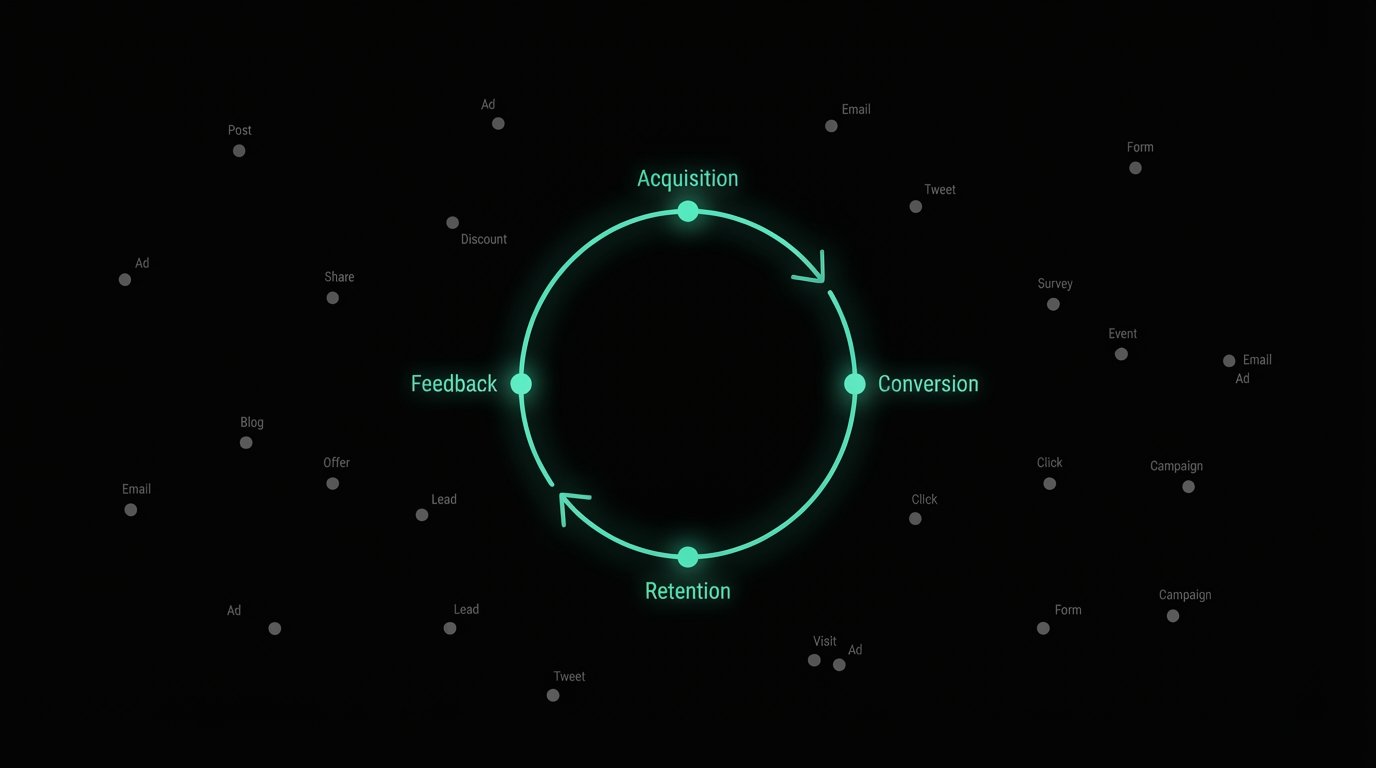
Most businesses run marketing as a list of disconnected tasks — a social post here, a boosted ad there, an email when someone remembers — rather than a system where each activity feeds the next. A marketing system connects acquisition, conversion, and retention into one loop with clear ownership and a feedback mechanism. Without that structure, more tasks just produce more activity, not more revenue. A performance marketing agency’s real job is building the system, not adding items to the list.
The Task List Disguised as a Strategy
A weekly content calendar, a boosted post, a newsletter, a discount campaign around a slow month — each one looks like marketing. None of them are connected to what happened before or what should happen next. This is the most common failure mode in growing businesses: activity without architecture. Ask most marketing teams to draw their process on a whiteboard and what shows up is a calendar, not a system. There’s no arrow connecting the ad campaign to the email sequence, no line showing how a first-time buyer becomes a repeat one. Each function operates as its own island, measured by its own activity rather than its contribution to a shared outcome.
What a System Actually Requires
A system has four properties a task list doesn’t: a defined entry point where prospects enter, a conversion mechanism that moves them forward, a retention loop that keeps existing customers active, and a feedback signal that tells the team what’s working. Whether paid media is run internally or through a Meta ads agency, none of that matters if there’s no system connecting the campaign to what happens after the click. Each of those four properties needs an owner, not just a description. A retention loop with no one responsible for checking whether it’s actually retaining anyone is a slide in a deck, not a working part of the business. The businesses that get this right assign a name to each stage of the journey — not just a department.
Where Businesses Get Stuck
Most businesses build isolated pieces — a good landing page, a decent ad account, an email list nobody nurtures — without ever connecting them. A Meta Partner Agency evaluating an account for the first time almost always finds the same gap: strong individual tactics, no system linking them, and no one accountable for the handoff between stages.
Building the System, Not Adding to the List
Start by mapping the actual customer journey, not the org chart’s version of it. Identify where each stage hands off to the next, and who owns that handoff. Fix that first, then consider a GEO agency content layer once the underlying system exists — content added on top of a broken system just becomes another task. This mapping exercise usually takes a single working session, not a quarter-long project. The value isn’t in the diagram itself — it’s in the honest conversation it forces about where a prospect currently falls through the cracks, and who in the room has actually been responsible for catching them.
The Test That Reveals Which One You Have
Ask what happens automatically if the person managing this stops checking in for two weeks. If nothing moves without them, it’s a task list. If the system keeps functioning, it’s a system.
FAQs
A: Run the two-week test above. A real system has defined stages, ownership, and a feedback loop that keeps functioning without daily manual intervention.
A: It produces more activity, rarely more revenue. Without a system connecting stages, additional tasks tend to duplicate effort rather than compound it.
A: Map the current customer journey exactly as it happens today, not as it’s supposed to happen. The gaps that surface in that map are almost always where the system needs to be built first.
Key Takeaways
✓ A task list produces activity; a system produces a repeatable, connected process from acquisition through retention
✓ Individual strong tactics — a good ad account, a decent landing page — don’t add up to a system without a defined handoff between stages.
✓ The two-week test — does it keep functioning without the manager checking in — reliably reveals which one a business actually has.
✓ Content and campaigns layered onto a broken system just become additional disconnected tasks.
Meta Social — Dubai’s #1 Performance Marketing Agency
Meta Social builds connected marketing systems for growth-stage brands — linking acquisition, conversion, and retention into one accountable loop.
Performance Marketing | SEO & GEO | AI Creatives & Video | Attribution Architecture
metasocial.ae | Dubai, UAE
About Meta Social
Meta Social is Dubai’s leading performance marketing agency and the GCC’s AI-native growth partner. We specialise in Performance Marketing, SEO & GEO, AI Creatives & Video, and Attribution Architecture — managing AED 50M+ in paid media across real estate, fintech, e-commerce, and hospitality.