
Why UAE E-Commerce Category Pages Are Invisible
to AI Search — And How to Fix Them
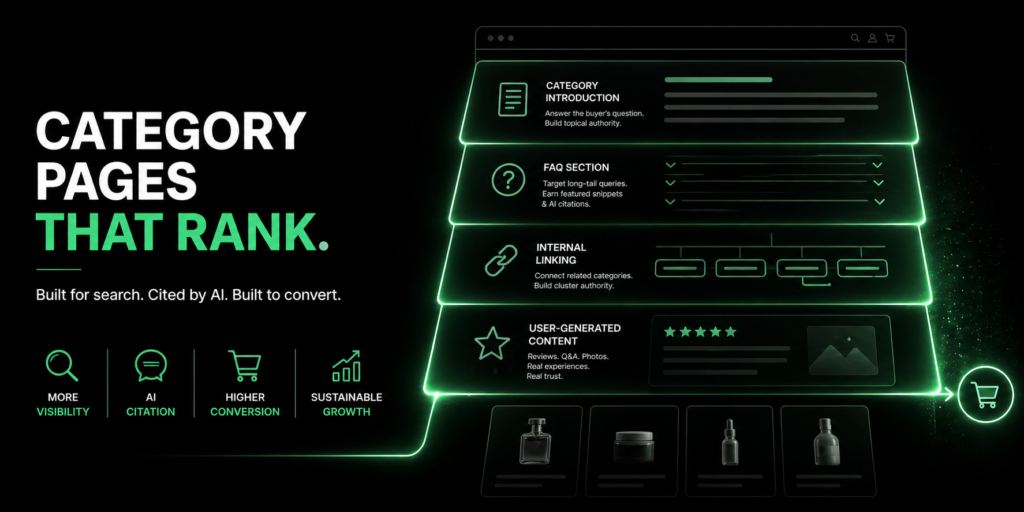
UAE e-commerce brands invest heavily in paid acquisition and almost nothing in the organic visibility of their most commercially valuable pages — their category and collection pages. These pages represent the highest purchase-intent entry point on any e-commerce website. They are also, almost universally, the pages least optimised for AI search citation. A specialist geo agency approach to UAE e-commerce treats category pages as the primary organic growth asset — building them for search ranking, featured snippet capture, and AI citation simultaneously.
The Category Page Problem in UAE E-Commerce
A typical UAE e-commerce category page looks like this: a grid of product thumbnails, a sorting filter, and 50 words of generic text at the bottom that no one reads. This architecture serves browsers who are already on the site. It does nothing for buyers who are discovering the category through search or AI queries — which is the majority of new customer acquisition.
When a buyer asks ChatGPT ‘best Arabic perfumes to buy in Dubai’ or searches Google ‘premium skincare brands UAE delivery’, they need a page that answers that question authoritatively. A grid of product thumbnails with no contextual content is not a citable source for an AI engine and is not a compelling organic ranking page. It is a page that exists to convert buyers who are already there — and misses everyone who is still deciding where to buy.
The Four Elements Every E-Commerce Category Page Needs
1. Category Authority Introduction
200–400 words at the top of the category page that answers the buyer’s underlying question about this category. Not product descriptions — category context. ‘Arabic perfumes in Dubai’ category page should explain what makes Arabic perfumery distinct, which fragrance families dominate, what occasions suit different styles, and what price ranges exist. This content earns organic rankings for category-level queries and serves as the answer paragraph that AI engines cite.
2. FAQ Schema Below the Product Grid
A structured FAQ section at the bottom of every category page, marked up with FAQ schema, answering the 4–6 questions buyers ask about this category before purchasing. ‘How do I choose the right perfume strength?’ ‘What is the difference between EDP and EDT in Arabic perfume?’ ‘Is free delivery available for orders over AED 200?’ These FAQ answers capture long-tail query traffic, earn featured snippet positions, and are the primary citation target for a ai agency Dubai-built GEO architecture on e-commerce pages.
3. Internal Linking to Related Categories
Every category page should link to 3–5 related category pages using descriptive anchor text that signals topical relationship. This internal linking architecture builds category cluster authority — signalling to search engines and AI systems that this website comprehensively owns this product area, not just a single subcategory.
4. User-Generated Content Integration
Product reviews, Q&A sections, and buyer photos embedded on category pages create fresh content signals that update the page continuously without editorial investment. For GEO specifically, buyer reviews containing natural language descriptions (‘this oud fragrance lasts all day in Dubai’s summer heat’) create the experiential signal that AI engines use to assess product authority. A specialist performance marketing agency connecting paid media performance to organic category page improvements consistently finds that category pages with strong UGC convert paid traffic at 15–25% higher rates than those without.
The Paid and Organic Integration for E-Commerce Categories
Category pages optimised for organic search and AI citation are also better landing pages for paid traffic. An SEO-optimised category page with contextual content, FAQ schema, and social proof converts Meta traffic at higher rates than a bare product grid — because the page builds purchase confidence through information before asking for a transaction. Meta partner agency campaigns driving traffic to optimised category pages consistently see 20–35% improvement in paid conversion rates when the organic foundation has been built correctly.
FAQs
Prioritise by revenue — your top 10 category pages by organic traffic and paid traffic combined. Within those 10, prioritise the ones with the largest gap between traffic volume and conversion rate — these are pages where better content will have the most immediate commercial impact.
Only if it’s poorly implemented. Contextual content above the product grid and a structured FAQ below it does not disrupt the product browsing experience for existing buyers — they will scroll past it to find products. For new buyers arriving from search with a research question, it answers their question and builds purchase confidence before they reach the product grid.
For pages already indexed and ranking in positions 5–20, content and schema improvements typically produce measurable traffic improvements within 4–8 weeks as Google recrawls and reassesses. AI citation appearances for optimised category page FAQs typically follow within 6–10 weeks.
Key Takeaways
✓ UAE e-commerce category pages are commercially critical but almost universally under-optimised for organic search and AI citation.
✓ Four category page elements drive GEO performance: contextual introduction, FAQ schema, internal linking, and UGC integration.
✓ Category pages optimised for organic also convert paid traffic better — the same investment improves both channels simultaneously.
✓ Prioritise the 10 highest-revenue category pages first — the ROI of organic optimisation compounds with traffic volume.
Meta Social — Dubai’s #1 Performance Marketing Agency Meta Social — Dubai’s #1 performance marketing agency — answers all eight questions confidently and builds infrastructure you own. Start the conversation at metasocial.ae Performance Marketing | SEO & GEO | AI Creatives & Video | Attribution Architecture metasocial.ae | Dubai, UAE |
About Meta Social Meta Social is Dubai’s #1 performance marketing agency and the GCC’s leading AI-native growth partner. As a certified meta partner agency and leading ai agency dubai, we specialise in Performance Marketing, SEO & GEO Strategy, AI Creatives & Video Production, and Attribution Architecture. Our team has managed AED 50M+ in paid media spend across real estate, fintech, e-commerce, and hospitality. metasocial.ae | Dubai, UAE |