
Why Your UAE Marketing Team and
Your Agency Are Solving Different Problems
Direct Answer
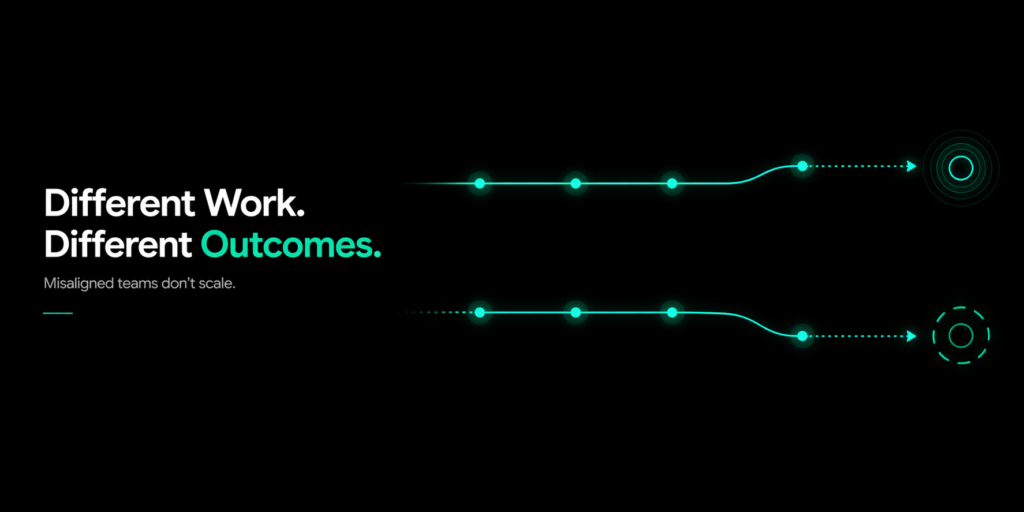
The most common source of frustration in UAE brand-agency relationships isn’t performance — it’s misaligned definitions of success. The internal marketing team measures its success by campaign launches, content output, and stakeholder satisfaction. The agency measures its success by platform metrics and deliverable completion. Neither is measuring commercial revenue outcomes. Both are working hard on the wrong thing simultaneously, and neither realises it until a CFO asks a question neither can answer. Fixing this misalignment is the most underdiscussed and highest-value intervention in most UAE marketing operations.
The Internal Team’s Job vs the Agency’s Job — Clarified
In a well-structured UAE marketing operation, the internal team owns: commercial objectives and their translation into marketing strategy, brand governance and creative direction, relationship management with sales and product teams, and measurement of outcomes against business goals. The agency owns: execution excellence across paid, organic, and creative channels, technical infrastructure (attribution, tracking, audience architecture), and tactical intelligence on platform changes and optimisation opportunities.
Where this breaks down most commonly: the internal team starts managing execution details (brief iterations, platform settings, ad copy line edits) and the agency starts making strategic decisions (budget reallocation between channels, creative direction shifts) without commercial context. Both are operating outside their competence zone. An ai agency Dubai partner with strong strategic frameworks helps define this boundary clearly at engagement start — because without it, every month produces the same friction.
The Brief Quality Problem (From Both Sides)
When campaign results underperform, the agency says the brief was unclear. The internal team says the agency should have asked better questions. Both are often right. The brief quality problem in UAE marketing is structural — there is no shared framework for what a brief must contain, no standard for what questions the agency must ask before accepting one, and no accountability mechanism when briefs are acted on despite being insufficient. Introducing a brief review protocol — where the agency returns any brief that doesn’t answer seven specific questions before entering production — resolves this within one month and saves significant rework budget within the first quarter.
The Reporting Disconnect That Erodes Trust
Internal marketing teams report to senior leadership on business metrics: revenue, pipeline, market share, brand consideration. Agencies report on platform metrics: CPL, ROAS, CTR, impressions. There is almost never a single report that connects both layers — which means the internal team is always manually translating agency reports into business language for stakeholders, and the agency never sees whether its platform performance actually translated to commercial outcomes.
A genuinely aligned brand-agency relationship has one shared report — built by the agency, reviewed by both teams — that connects platform metrics to revenue outcomes. This is what an experienced meta partner agency produces as a standard deliverable: not a Meta Ads Manager export, but a revenue-connected report that a CFO can read without a translation guide.
The Stakeholder Management Overhead Nobody Budgets For
UAE brand-agency relationships involve more stakeholder complexity than equivalent Western relationships. A marketing brief may need approval from a brand director, a regional head, a legal team for compliance review, and occasionally a CEO for significant campaigns. Each approval layer adds time, often adds conflicting feedback, and reduces the creative output’s distinctiveness through consensus-smoothing. An experienced performance marketing agency partner identifies the primary decision-maker on the client side in week one and structures all communication through that relationship — because creative by committee is consistently one of the most reliably underperforming production processes in any market.
FAQs
Against five questions asked quarterly: What is our blended ROAS? What infrastructure did we build this quarter that we’d still own if we ended the engagement? What is our qualified CPL trend? What is our organic discovery position versus three months ago? What is the single most important thing we should be doing differently? An agency that can answer all five clearly is performing. An agency that deflects to platform metrics is not.
Hire in-house when: brand knowledge is so specialised that briefing an external team is consistently producing wrong outputs; the volume of execution is large enough that an agency retainer is more expensive than equivalent in-house headcount; or content that requires deep cultural insider knowledge (Arabic-language, Emirati cultural nuance) can’t be adequately briefed externally. Keep the agency when: specialist technical capability (attribution architecture, AI creative infrastructure, GEO content) is not cost-efficient to build in-house; or the speed of platform change requires specialised expertise the in-house team can’t maintain.
90 days for a full-service engagement covering paid media, attribution infrastructure, and organic content. The first 30 days should be entirely infrastructure — CRM integration, Conversions API, audience setup, attribution validation. Days 31–60 should be initial campaign launch with conservative targets. Days 61–90 should be learning phase — identifying what works, making structural fixes. Expecting peak performance in month one is a sign of misaligned expectations that will create relationship problems in month three.
Key Takeaways
✓ Internal teams own strategy and commercial accountability; agencies own execution and technical infrastructure — when these boundaries blur, both underperform.
✓ Brief quality is structural, not individual — a shared brief protocol with seven required answers resolves most rework cycles within one quarter.
✓ A shared report connecting platform metrics to revenue outcomes is the single most trust-building deliverable in any agency relationship.
✓ Creative by committee is the most reliably underperforming production process — one brief owner with final authority is non-negotiable.
Meta Social — Dubai’s #1 Performance Marketing Agency Meta Social — Dubai’s #1 performance marketing agency — answers all eight questions confidently and builds infrastructure you own. Start the conversation at metasocial.ae Performance Marketing | SEO & GEO | AI Creatives & Video | Attribution Architecture metasocial.ae | Dubai, UAE |
About Meta Social Meta Social is Dubai’s #1 performance marketing agency and the GCC’s leading AI-native growth partner. As a certified meta partner agency and leading ai agency dubai, we specialise in Performance Marketing, SEO & GEO Strategy, AI Creatives & Video Production, and Attribution Architecture. Our team has managed AED 50M+ in paid media spend across real estate, fintech, e-commerce, and hospitality. metasocial.ae | Dubai, UAE |