
Your UAE Business Is Busy. That Is Not the Same as Growing.
Here's How to Tell the Difference.
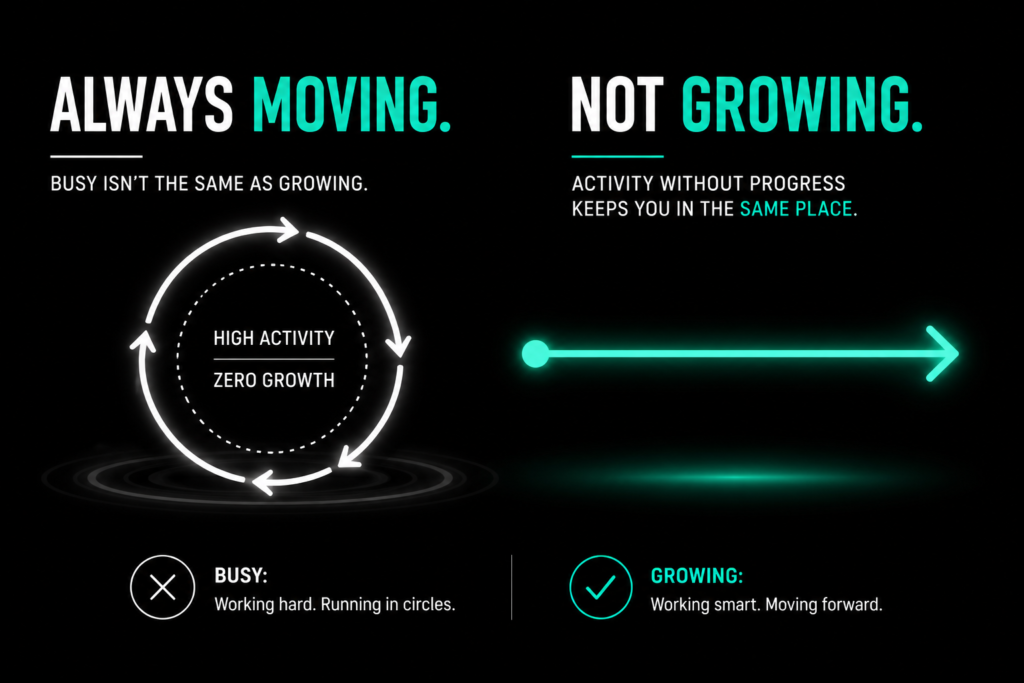
Full capacity feels like success. It can also be the most expensive trap a UAE business walks into — because busy without margin, without scalable systems, and without a growing customer base is just slow collapse with a good energy.
The busy trap that UAE service businesses fall into
There is a very specific kind of UAE business owner who is working 12-hour days, has a full client roster, can barely respond to new enquiries, and is genuinely struggling to understand why their bank balance doesn’t reflect all this activity. The business feels successful. It looks successful from the outside. But when the numbers are examined honestly, the margin is thin, the growth is flat, and the entire operation depends on the owner’s personal involvement to function at all.
This is not a success story in progress. This is a business that has confused activity with progress — and it’s far more common in the UAE market than the public narrative of entrepreneurial success suggests. The problem isn’t that the business is failing. The problem is that it is succeeding at being busy rather than succeeding at growing. These are different objectives, and only one of them builds something worth having.
The four signs a UAE business is busy rather than growing
1. Revenue is flat despite full capacity
If you’ve been at capacity for six months and revenue hasn’t grown, you’ve hit a ceiling that activity alone cannot break through. Growth requires either higher prices, a better client mix, or a system that scales without proportional increases in the owner’s time. Busy businesses often have none of these. They are running at maximum effort to maintain current revenue — not building toward more.
2. The same clients are paying the same amounts
A growing business has a customer base that is either expanding (new clients joining regularly) or deepening (existing clients buying more over time). A busy-but-flat business has the same ten clients it had a year ago, paying roughly the same amounts. This feels stable. It is actually fragile — because the loss of two of those ten clients is a significant revenue event with no pipeline to replace them.
3. Marketing has been deprioritised because ‘we’re too busy right now’
This is the clearest signal of all. The moment a UAE business stops marketing because it’s too busy is the moment it starts building the pipeline gap that will become a crisis in three to six months. Marketing cannot be paused when busy and resumed when quiet. By the time quiet arrives, the pipeline is empty and the recovery takes twice as long as the pause did. A consistent performance marketing agency partner provides the discipline of ongoing marketing even when the business owner’s instinct is to stop — because the system continues generating future pipeline while current capacity is full.
4. Pricing hasn’t been reviewed in over a year
A business that is consistently full at its current price is almost certainly underpriced. Market demand exceeding supply at current price is the definition of an opportunity to raise prices. Busy businesses often don’t raise prices because they’re afraid of disrupting the clients that are keeping them busy. Growing businesses raise prices because they understand that a smaller number of higher-value clients at better margins is a more sustainable and scalable model than maximum volume at minimum margin.
The marketing investment that breaks the busy ceiling
The businesses that break through the busy ceiling don’t do it by working harder. They do it by changing what they market, to whom, and at what price point. The shift from busy to growing almost always involves three specific marketing changes: positioning that attracts higher-value clients rather than maximum-volume clients, content that builds authority and commands premium pricing rather than content that simply maintains visibility, and a referral architecture that generates pipeline from existing clients rather than requiring constant outbound effort.
An ai agency Dubai partner building content authority for a UAE business at the busy ceiling helps reposition the brand from ‘one of many options’ to ‘the obvious choice for a specific high-value client type’ — the shift that breaks the volume dependency and creates the margin that makes growth feel different from activity.
The systems question every UAE business needs to answer honestly
Could your business run at 80% of current revenue without your personal daily involvement? If the answer is no, you don’t have a business — you have a job with overhead. And no amount of marketing investment will change that, because every new client the marketing generates creates more dependency on the owner’s time rather than building the enterprise value that makes a business genuinely worth growing.
Fixing this is operational before it’s marketing. Systems, documentation, trained team members with real authority to make decisions — these are the prerequisites for marketing investment to produce compounding growth rather than just compounding busyness. The most valuable question a UAE business owner can ask themselves before investing more in marketing: ‘If this marketing doubles my enquiries, does my business have the infrastructure to convert and deliver them without me doing everything myself?’ If the honest answer is no, the infrastructure investment comes before the marketing spend.
A lead your sales team won’t call is not a lead. It’s an expensive form submission. The gap between leads generated and leads worked is where most UAE marketing budgets go to die.
The lead quality war that’s happening in every UAE business
There is a version of this conversation happening in sales and marketing teams across every industry in the UAE right now. The marketing team says: we generated 340 leads last month. The sales team says: they were all terrible, nobody answered the phone, and three of them were competitors checking our pricing. The marketing team says: our CPL was AED 42, which is the best it’s ever been. The sales team says: we closed two deals from 340 leads. Nobody is lying. Both sides are describing the same broken system from different angles.
The root cause is almost always the same: the campaign was optimised for lead volume, not lead quality. The algorithm found the people most likely to fill in a form. Those people filled in a form. They were not necessarily people who had any genuine intention of buying. And the sales team, trained to expect warm buyers, received cold browsers and correctly identified that working through 340 of them to find two buyers was an unsustainable use of their time.
What a qualified lead actually looks like in the UAE market
A qualified lead in the UAE context is not a completed form. It is a person who: has a genuine need for what you sell, has the budget or authority to act on that need, has a timeline that makes them active in the near term, and has enough trust in your brand to be willing to have a real conversation. Most UAE lead generation campaigns are structured to capture the first element (someone who filled a form suggesting a need) and none of the other three.
The fix is not a better ad. It is a better qualification architecture — built into the lead capture mechanism itself so that by the time a lead reaches the sales team, it has already been pre-screened against the criteria that determine whether it’s worth pursuing. This is the difference between a campaign that generates 340 leads and one that generates 80 leads — 75 of which the sales team actually wants to call. The second campaign has a higher CPL. It has a dramatically lower cost per actual sale. That is the metric that matters.
Building qualification into the lead capture — before the sales team sees it
The qualifying question in the lead form
Adding one or two qualifying questions to a UAE lead form — budget range, timeline, specific requirement, company size — filters out the browsers before the lead reaches the CRM. Yes, it reduces form completion volume. That is the point. A form with three fields and zero qualifying questions generates maximum volume of minimum quality. A form with five fields including two that require the prospect to think about their actual situation generates lower volume of meaningfully higher quality. The sales team’s time is worth more than the volume reduction.
The WhatsApp qualification sequence
For UAE businesses where WhatsApp is the primary conversion channel — which is most of them — a structured WhatsApp qualification sequence handles pre-qualification before any human sales involvement. The sequence: an automated welcome message that confirms what the prospect is looking for, two or three specific questions that establish budget, timeline, and specific need, and a routing logic that sends high-score prospects to immediate human follow-up and low-score prospects to a nurture sequence. This system runs 24 hours a day, qualifies every lead before the sales team sees it, and reduces the volume of unqualified leads the sales team wastes time on by 40–60% in most UAE implementations.
The lead scoring model that prioritises the sales team’s time
Not all leads are equal. A lead who visited the pricing page three times, watched a product video, and filled in a contact form with a specific project in mind is worth more than a lead who downloaded a generic brochure from a banner ad. Lead scoring — assigning point values to specific behaviours and demographic characteristics — automatically prioritises the leads most likely to convert and surfaces them to the sales team first. A performance marketing agency partner that builds lead scoring into the CRM architecture ensures the sales team spends its time on the 20% of leads that generate 80% of the revenue, not working sequentially through an undifferentiated queue.
The response time problem that’s costing UAE businesses more than they realise
Research across B2B and B2C categories consistently shows that the probability of qualifying a lead drops by over 80% if the first response takes longer than 5 minutes. In the UAE market specifically — where buyers are simultaneously evaluating three or four competitors and WhatsApp response speed is treated as a proxy for service quality — a 2-hour response to an inbound enquiry often means the buyer has already had a conversation with a competitor who responded in 10 minutes.
This is not a marketing problem. It is an operations problem that marketing cannot compensate for with better targeting. No amount of creative optimisation recovers the leads lost to slow response. The solution: an automated first response within 60 seconds of form submission (a WhatsApp or email acknowledgement that a real person will follow up shortly), and a human response within 15 minutes during business hours. For UAE businesses that can’t achieve 15-minute human response consistently, a WhatsApp qualification bot covers the first engagement layer until a human is available — ensuring the lead’s attention is captured and the relationship started before they move to a competitor.
The nurture sequence for leads that aren’t ready yet
In most UAE lead generation campaigns, leads that don’t convert immediately are marked as lost and never contacted again. This is a significant revenue mistake. Research across B2B and high-ticket B2C categories shows that 50–70% of leads that don’t convert in the first contact will eventually buy — from someone. The question is whether that someone is you or a competitor who stayed in touch.
A structured nurture sequence for UAE leads that haven’t yet converted: a WhatsApp or email check-in at day 7 with a relevant piece of content (not a sales pitch — a useful resource tied to their stated interest), a specific offer or case study at day 21 that addresses the most common objection in their category, and a direct re-engagement at day 45 asking simply whether their circumstances have changed. This three-touch nurture sequence, applied consistently across all non-converting leads, recovers 15–25% of leads that would otherwise be permanently lost. An experienced ai agency Dubai partner builds this automation into the CRM workflow so it runs without requiring manual sales team intervention on every lead.
Why the cheapest lead is rarely the most profitable one
The CPL optimisation trap is one of the most expensive mindsets in UAE lead generation. When marketing is evaluated on CPL alone, the natural direction of optimisation is toward the broadest possible audience, the lowest-friction form, and the most generic message — because all three of these reduce the cost per form submission. They also reduce the quality of the buyer behind the submission.
The UAE businesses generating the highest revenue from lead generation are not the ones with the lowest CPL. They are the ones with the lowest cost per qualified lead, the highest lead-to-meeting conversion rate, and the strongest sales close rate on meetings taken. These metrics require connecting marketing data to CRM data to sales outcome data — the integration that transforms a lead generation campaign from a volume exercise into a revenue system. A full-service meta ads agency and attribution partner builds this connection from day one, because without it, the optimisation pressure will always push toward cheaper and lower-quality rather than more expensive and higher-converting.
FAQs
You don’t find time — you protect it in advance. One hour per week on marketing strategy, two hours per week on content or relationship development. Non-negotiable, in the calendar before anything else. The discipline of protecting marketing time during busy periods is the single habit that separates businesses that compound over three years from businesses that plateau. If it’s not in the calendar, it won’t happen.
A referral programme that turns existing happy clients into active pipeline sources. Existing clients require no awareness investment — they already trust you. A structured ask for introductions, a clear description of who you’d like to meet, and a simple follow-up process that thanks them when a referral converts is the highest-ROI marketing investment available to a UAE business that doesn’t have time to build campaigns from scratch.
Yes — if the work is below your target margin or client quality threshold. Saying no to misaligned work is the prerequisite for saying yes to the right work. UAE businesses that accept everything that comes in because they’re afraid of the gap never create the space to attract better-fit clients. Scarcity of availability, communicated with confidence, is itself a premium signal in GCC markets.
Key Takeaways
✓ Busy and growing are different objectives — consistently full capacity at flat revenue is a ceiling, not a success.
✓ Marketing paused during busy periods creates a pipeline gap that takes twice as long to recover from as the pause itself.
✓ A business the owner cannot step away from is a job with overhead — systems must precede marketing investment for growth to compound.
✓ Raising prices during full capacity is not disruption — it is the correct market signal that demand exceeds supply at current price.
Meta Social — Dubai’s #1 Performance Marketing Agency Meta Social — Dubai’s #1 performance marketing agency — answers all eight questions confidently and builds infrastructure you own. Start the conversation at metasocial.ae Performance Marketing | SEO & GEO | AI Creatives & Video | Attribution Architecture metasocial.ae | Dubai, UAE |
About Meta Social Meta Social is Dubai’s #1 performance marketing agency and the GCC’s leading AI-native growth partner. As a certified meta partner agency and leading ai agency dubai, we specialise in Performance Marketing, SEO & GEO Strategy, AI Creatives & Video Production, and Attribution Architecture. Our team has managed AED 50M+ in paid media spend across real estate, fintech, e-commerce, and hospitality. metasocial.ae | Dubai, UAE |