
Why “Near Me” Searches Behave Differently in a City Built
Around Towers and Malls, Not Street Blocks
“Near me” searches are not simply about adding the words “near me” to a business page. In Dubai, local intent can be shaped by proximity to towers, malls, districts and landmarks, so businesses need location signals that help search engines connect the right place with the right searcher.
Meta Social approaches local SEO by building location relevance around real-world entities — accurate business information, useful location pages and consistent local signals — rather than trying to manufacture “near me” relevance with keyword repetition.
“Near Me” Is a Proximity Problem
A user searching “coffee near me” is rarely asking for a page that contains those three words repeatedly. They are asking a practical question: which relevant business is close enough and useful enough for me right now?
That makes local search fundamentally different from a normal informational query. Relevance matters, but so does the relationship between the searcher, the business and the physical environment around it.
For a business in Dubai, that environment can be unusually dense. A single area may contain dozens of businesses inside towers, malls or mixed-use developments, while a nearby landmark can be more meaningful to a customer than a street name.
Dubai’s Location Signals Are More Layered Than an Address
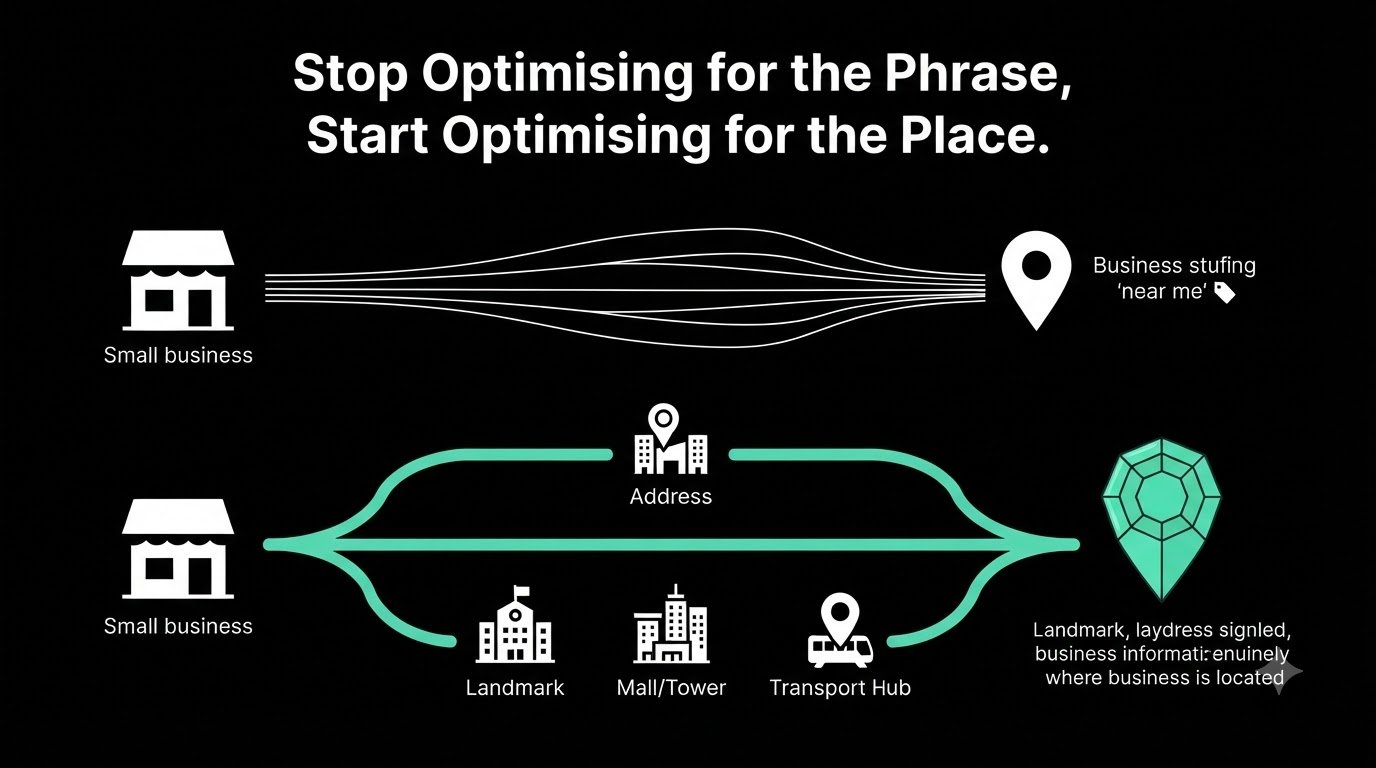
A postal address is important, but it does not always describe how customers actually locate a business. Someone may think in terms of a mall, neighbourhood, tower, metro station or major landmark before thinking about the exact street address.
That does not mean businesses should stuff every nearby landmark into their pages. It means the location information should be understandable to both people and search engines.
A useful location page can make the relationship clear: what the business is, where it is, which area it serves, how customers can reach it and what makes that location distinct.
A geo agency should therefore think beyond address consistency. Local relevance is partly an entity problem: the business needs to be connected clearly to the place customers associate with it.
What Businesses Should Actually Optimise
For stronger local visibility, start with the fundamentals that describe the real location:
- Accurate business information. Keep the business name, address, phone and other core details consistent wherever the business is represented.
Useful location pages. Give each genuine location a page with information that helps a customer understand and reach that specific place.
Distinct local context. Explain relevant neighbourhood, building, mall or landmark context naturally when it genuinely helps the visitor.
Consistent external signals. Make sure important business directories and local profiles represent the same real-world entity and location.
Customer usefulness. Include practical information such as access, parking, entrances or nearby transport when it is genuinely useful and accurate.
The last point is easy to overlook. A page that helps a customer reach a business can be more valuable than one written primarily to satisfy a keyword.
For example, an AI agency Dubai may serve clients across the UAE without needing a separate “near me” page for every district. A physical clinic, restaurant or retail branch has a different local-search problem because proximity is directly connected to the transaction.
The strategy should follow the business model, not force every company into the same local SEO template.
Stop Optimising for the Phrase and Start Optimising for the Place
The biggest mistake with “near me” SEO is treating the phrase as the target instead of treating the location as the target.
A customer does not need a business to say “near me” ten times. They need enough trustworthy information for a search engine to understand what the business is, where it exists and why it is relevant to the local query.
This also means local SEO should not operate in isolation. A meta partner managing paid acquisition may drive users to a location page, while organic search, business profiles and the website all need to describe the same location consistently.
Strong local visibility comes from making the real-world business easier to understand — not from pretending the phrase itself is a ranking trick.
Make the Physical Location Searchable
Dubai’s built environment makes local search especially interesting because proximity is often experienced through places people recognise: towers, malls, districts and landmarks.
Businesses do not need to game that behaviour. They need to represent their real location clearly, consistently and usefully.
For a performance marketing team, that means the location page is not just an SEO asset. It can become part of the conversion path, giving a customer the information needed to move from search to visit.
“Near me” works best when the business itself is genuinely easy to find — both online and in the physical world.
How Meta Social Helped a Dubai Business Capture Local Intent
A Dubai business had strong overall organic visibility but was struggling to attract enough customers searching with immediate local intent. Its website mentioned the areas it served, but the location information wasn’t structured around how customers actually searched for nearby services.
Meta Social reviewed the business’s location pages, local information and search intent, then strengthened the connection between each service and the locations customers were actually looking for. Instead of simply adding more “near me” keywords, the focus was on making each location more useful and locally relevant.
The result was a clearer local-search structure and a stronger foundation for capturing high-intent searches where proximity was part of the customer’s decision
FAQs
Not by itself. Search engines can understand local intent without businesses repeatedly inserting the phrase. Accurate location information, relevance and other local signals matter more.
If the business has genuine, distinct physical locations, dedicated pages can make sense. Each page should provide useful information about that specific location rather than creating thin duplicate pages.
Mention them when they genuinely help customers understand or reach the business. Avoid creating artificial landmark lists that add no useful context.
Local visibility depends on the business model and the query. A service-area business should accurately describe where it operates rather than implying that it has physical branches in places where it does not.
Key Takeaways
- Near me” is about local relevance, not keyword repetition.
- Dubai’s towers, malls, districts and landmarks create layered location context.
- Each genuine location should have accurate, useful and distinct information.
- Optimise for the real-world place and customer journey, not the search phrase alone.
Meta Social — Dubai’s #1 Performance Marketing Agency
Meta Social builds local SEO around the real-world business — connecting location pages, entity information and local signals so UAE brands are easier for both search engines and customers to understand. Visit metasocial.ae
Performance Marketing | SEO & GEO | AI Creatives & Video | Attribution Architecture
metasocial.ae | Dubai, UAE
About Meta Social
Meta Social is Dubai’s leading performance marketing agency and the GCC’s AI-native growth partner. We specialise in Performance Marketing, SEO & GEO, AI Creatives & Video, and Attribution Architecture — managing AED 50M+ in paid media across real estate, fintech, e-commerce, and hospitality.
metasocial.ae | Dubai, UAE