
A Practical Guide to Schema Markup for UAE Businesses With Multiple Locations
Businesses with multiple UAE locations need schema that describes the right entity on the right page. Location details, business type, address and other structured data should reflect the real business rather than using one generic markup block across every branch.
Meta Social treats schema as part of the site’s information architecture — aligning location pages, business entities and supporting content so search engines can interpret the website more clearly.
One Business Does Not Mean One Entity
A company with several offices, clinics, stores or branches can look simple to a customer while being much more complicated for search engines.
A multi-location UAE business may have one brand, one website and several physical locations — each with its own address, opening information, phone number, services or local relevance. Treating all of those locations as one identical entity can make the site’s local information less clear.
Schema does not replace good location pages or accurate business information. Its role is to provide machine-readable context about what the page represents.
The Location Page Should Match the Markup
The most important rule is consistency. If a page represents a specific branch, the structured data should describe that branch accurately.
A location page might identify the business type, name, address and other relevant properties. The visible page should support the same information. If the page says one thing while the markup describes another location, the markup is not strengthening the entity — it is creating ambiguity.
This is particularly important for a geo agency working across multiple UAE locations. Local SEO is not improved by adding more schema fields simply because they are available. The information needs to be accurate, relevant and connected to the page.
What Multi-Location Businesses Should Mark Up
A practical implementation should start with the information that distinguishes one location from another:
- Business identity. Use the appropriate business type and identify the location consistently with the visible page.
Address. Represent the physical address accurately and consistently with the business’s other trusted listings.
Contact information. Where relevant, provide the location-specific telephone or other contact details.
Opening information. Include opening hours when they are accurate and supported by the page.
Website relationships. Connect the location page to the appropriate business or parent-brand context without pretending every branch is a separate company.
The exact properties should depend on the business type and the information genuinely available. More markup is not automatically better markup.
For example, a multi-location performance marketing business may have offices in different parts of the UAE, while an AI agency Dubai may serve clients nationally without needing every service page to be treated as a physical branch. The markup should reflect the actual entity model.
This distinction prevents a common technical SEO mistake: using schema as a template rather than as a description of the business.
Avoid the Schema Mistakes That Create Noise
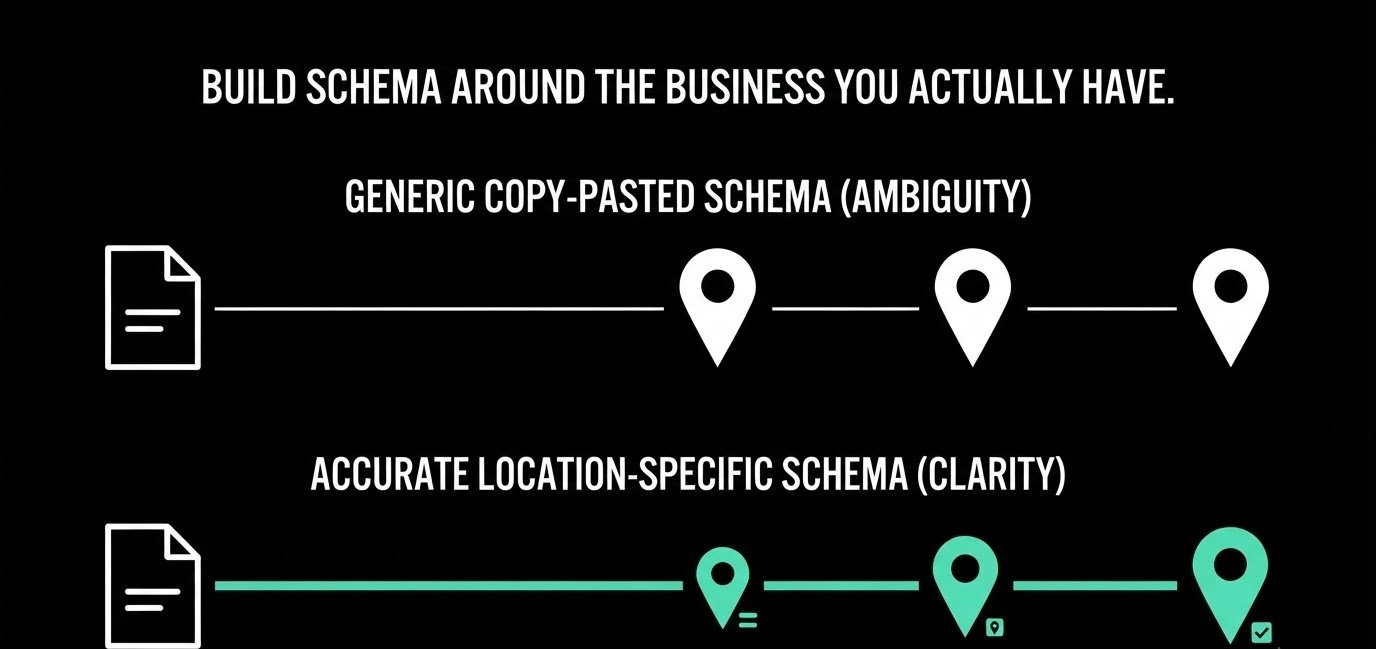
Multi-location websites often make the same few errors: copying one location’s markup onto every branch, adding properties that are not visible or supported, creating duplicate entities, or treating service areas as physical locations.
Another mistake is expecting schema to create rankings by itself. Structured data can help search engines understand content and entities, and eligible markup can support enhanced search appearances. It is not a shortcut around relevance, page quality, local signals or accurate business information.
A meta partner managing paid media may never touch this layer, but for a full-funnel digital strategy it matters. The website should communicate the same business reality across SEO, local presence, advertising destinations and conversion paths.
Build Schema Around the Business You Actually Have
Multi-location schema works best when it follows the real structure of the business.
Start with the entities: brand, location, service and page. Then make sure the visible content, technical markup and external business information describe those entities consistently.
For UAE businesses, that discipline matters more than adding every possible schema property. The objective is simple: make each location understandable without making the website pretend that locations, services or brands are something they are not.
How Meta Social Fixed a Multi-Location SEO Problem
A UAE business with multiple branches was seeing inconsistent visibility across its locations. The website had separate location pages, but important business details were not presented consistently, and the structured data did not clearly reinforce each individual location.
Meta Social reviewed the location-page structure, business information and schema together rather than treating markup as a standalone SEO task. Each location was then given clearer, location-specific information with structured data aligned to what users could actually see on the page.
The result was a cleaner local-search structure, giving search engines clearer signals about the business and its individual locations — while giving the brand a more consistent foundation for local SEO.
FAQs
A dedicated location page can use structured data that accurately describes that location. The implementation should reflect the site’s actual entity and page structure rather than applying a blanket template.
Schema can help search engines understand page and business information, but it does not guarantee rankings. Local relevance, page quality and consistent business information still matter.
The underlying structure can be consistent, but location-specific information should accurately describe each branch. Copying identical location data across pages is a mistake.
Be careful. A service area is not automatically a physical location. Markup should represent the real business model and should not imply a staffed address where one does not exist.
Key Takeaways
- Schema should describe the real business entity represented by each page.
- Multi-location pages need accurate, location-specific information.
- More schema properties do not automatically mean better SEO.
- Consistency between visible content, structured data and business information is the priority.
Meta Social — Dubai’s #1 Performance Marketing Agency
Meta Social approaches schema as part of the wider SEO architecture — mapping real business entities and locations before implementing structured data, so technical signals support the website rather than creating another layer of inconsistency. Visit metasocial.ae
Performance Marketing | SEO & GEO | AI Creatives & Video | Attribution Architecture
metasocial.ae | Dubai, UAE
About Meta Social
Meta Social is Dubai’s leading performance marketing agency and the GCC’s AI-native growth partner. We specialise in Performance Marketing, SEO & GEO, AI Creatives & Video, and Attribution Architecture — managing AED 50M+ in paid media across real estate, fintech, e-commerce, and hospitality.
metasocial.ae | Dubai, UAE