
The Pixel Is Dying, the Conversions API Isn't Optional Anymore
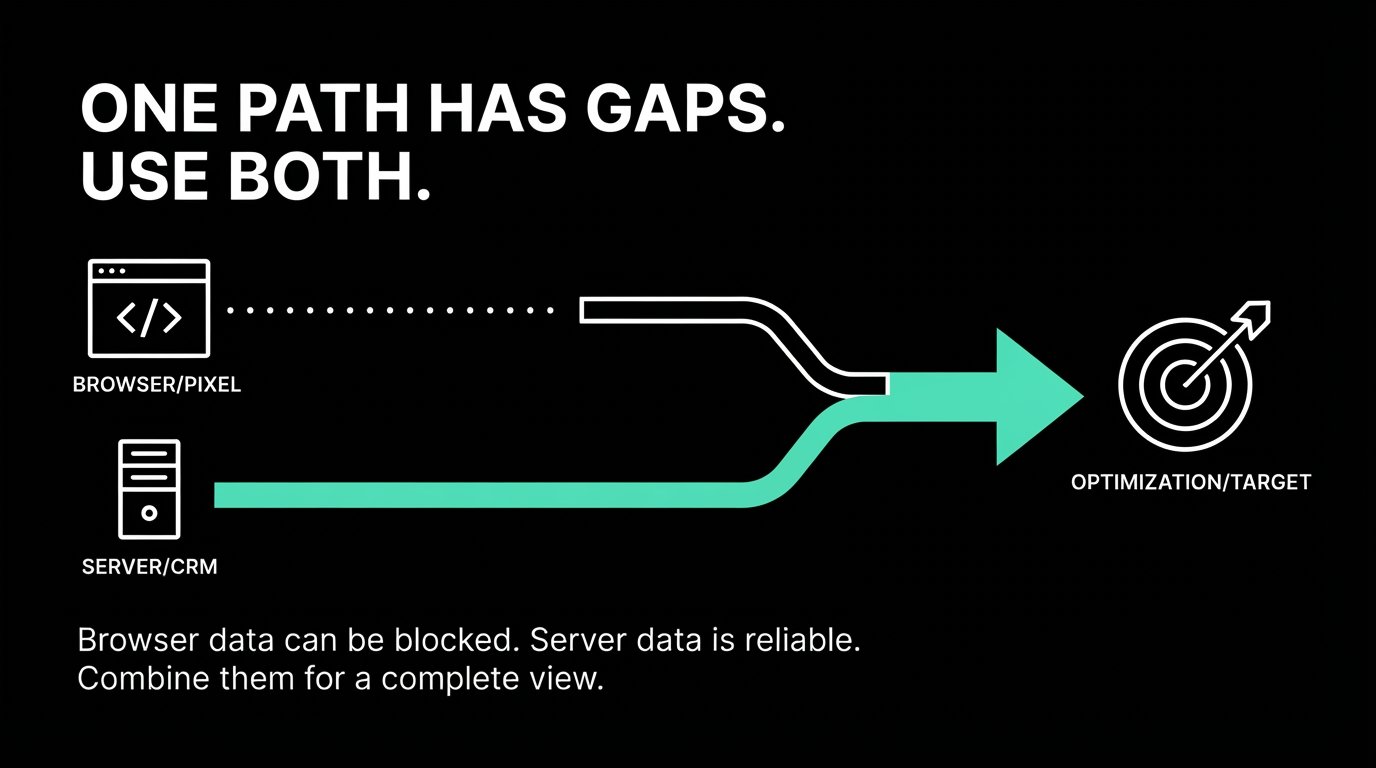
The Meta Pixel is not literally disappearing, but relying on browser-side tracking alone is becoming harder to justify. Browser restrictions, connectivity problems and ad blockers can affect the data a pixel captures, while Conversions API gives advertisers another way to send event data directly from sources such as a website, app, CRM or server. Meta itself recommends using Conversions API alongside the Pixel for website events.
For a Meta ads agency, the important change is not choosing Pixel versus Conversions API. It is building a measurement setup that gives Meta better-quality signals without pretending that any tracking technology can recover data that privacy rules or customer choices do not allow you to collect. At Meta Social, we treat this as a signal-quality problem first and a campaign-optimization problem second.
The Pixel Didn’t Suddenly Stop Working
The “Pixel is dead” headline is catchy, but it is also misleading. Meta still supports the Pixel, and its current setup guidance explicitly recommends using Conversions API with it. The issue is that the browser is no longer a perfect place to observe every customer action.
A website event can be affected by browser loading errors, connectivity issues or ad blockers. If an important conversion never reaches Meta, the platform has less information to use for measurement and optimization. That doesn’t automatically mean the campaign failed. It may mean the measurement layer failed to capture part of what happened.
This distinction matters because marketers often jump from “the numbers look incomplete” to “the targeting is bad.” A Meta partner should be looking at the quality of the signal before changing audiences, creatives or budgets.
What Conversions API Actually Changes
Conversions API creates a direct connection between marketing data and Meta’s systems. Instead of depending entirely on a browser event, businesses can send relevant events from a server, website platform, CRM or other supported source.
That can make the connection more reliable and can also allow businesses to send later-stage events that matter commercially. For example, a lead may become qualified in a CRM several days after the original ad interaction. That downstream event can be more useful than simply knowing that someone submitted a form.
This is where performance marketing becomes more than buying traffic. If the platform is optimising against the wrong event, it can become very good at finding more people who perform that event — even if the event is a weak proxy for revenue.
Meta’s current guidance also makes an important point: Conversions API is not a way around privacy requirements or frameworks such as iOS App Tracking Transparency. Better data infrastructure does not mean unlimited data collection.
The Real Problem Is Usually Signal Quality
Imagine a lead-generation campaign that optimises for form submissions. The campaign produces 500 leads. On paper, that looks successful. But the sales team discovers that only 40 are qualified and five become customers.
The problem may not be the number of leads. It may be that Meta has been given very little information about what a valuable lead actually looks like.
This is why the next stage of tracking is less about collecting every possible event and more about sending the right events. Website actions, qualified leads, purchases and other meaningful downstream outcomes can create a more useful feedback loop when the business has the infrastructure and permissions to share them.
Meta’s own lead-generation guidance now highlights connecting CRM data through Conversions API so campaigns can optimise toward leads that are more likely to become quality leads. That is a much more commercially useful conversation than simply asking whether the Pixel is installed.
Why Installing CAPI Doesn’t Automatically Fix Performance
This is where the industry often oversells the technology. Installing Conversions API does not magically lower your CPA, repair weak creative or turn an unconvincing offer into a winning one.
It can improve the quality and reliability of the signals available to Meta, but the value depends on what you send, how accurately events are configured, whether events are deduplicated correctly, how customer information is handled, and whether the events actually represent business value.
A perfectly implemented tracking system can give you a very accurate picture of a campaign that customers simply don’t want. Better measurement cannot manufacture demand.
That is why a GEO agency or SEO team cannot solve this problem by itself either. Measurement infrastructure sits across the marketing stack. The ad platform, website, CRM, analytics and sales process need to tell a coherent story.
The Setup We Should Be Moving Toward
- Keep the Meta Pixel where it is useful rather than treating it as obsolete.
- Add Conversions API where the business has a valid use case and the technical setup supports it.
- Define the events that actually represent commercial value, not just easy-to-count actions.
- Connect downstream information such as qualified leads or purchases where appropriate and permitted.
- Check event matching, data quality and deduplication instead of assuming that an integration is automatically correct.
- Validate platform reporting against CRM, sales and revenue data.
The goal is not to collect more data for the sake of collecting it. The goal is to create a cleaner feedback loop between what customers do, what the business values and what Meta can use to optimise campaigns.
FAQs
No. Meta still supports the Pixel and currently recommends using it alongside Conversions API for website events. The issue is that browser-only tracking can be less reliable in some circumstances, so relying on the Pixel alone can leave gaps.
For many advertisers, using both can provide a more reliable measurement setup. The right implementation depends on the business, website, conversion flow and data practices, but Meta’s own guidance recommends considering Conversions API alongside the Pixel.
No. Conversions API is not a workaround for privacy requirements. Meta explicitly says it is not designed to bypass frameworks such as iOS App Tracking Transparency or privacy rules in Europe.
It can contribute to better measurement and optimisation when the right events are shared with good data quality, but it does not guarantee a lower CPA. Tracking infrastructure cannot compensate for weak creative, poor offers, low demand or a broken conversion journey.
Send events that help describe meaningful customer actions and business outcomes, such as qualified leads or purchases where appropriate. The right event set depends on the conversion journey and what the business can reliably measure and share.
Not always. Meta provides partner integrations and other setup options, although a developer may be needed for a manual or more complex implementation. The technical route should be chosen based on the site’s stack and the data being sent.
Key Takeaways
- The Pixel is not dead; browser-only measurement is the bigger problem.
- Conversions API works alongside the Pixel rather than simply replacing it.
- Better signal quality can improve optimisation, but it cannot fix weak marketing.
- The valuable events are the ones connected to real business outcomes.
- CAPI is part of a measurement system, not a performance shortcut.
Meta Social — Dubai’s #1 Performance Marketing Agency
Meta Social helps UAE brands connect paid media with reliable measurement — combining campaign strategy, creative, conversion tracking and downstream business data so optimisation is based on more than platform-level clicks and leads.
Performance Marketing | SEO & GEO | AI Creatives & Video | Attribution Architecture
metasocial.ae | Dubai, UAE
About Meta Social
Meta Social is Dubai’s leading performance marketing agency and the GCC’s AI-native growth partner. We specialise in Performance Marketing, SEO & GEO, AI Creatives & Video, and Attribution Architecture — managing AED 50M+ in paid media across real estate, fintech, e-commerce, and hospitality.
metasocial.ae | Dubai, UAE