
When Should You Stop Testing Meta Ads Creative?
The Difference Between Learning and Noise
You should stop a Meta creative test when the result has become useful enough to make a decision — not simply because one ad has a higher CTR or because a fixed number of days has passed. A meaningful test needs enough spend, conversions and comparable conditions to distinguish a repeatable signal from normal variation.
Meta Social treats creative testing as a decision system: define the variable being tested, give it enough room to produce evidence, then scale, iterate or stop based on the quality of the signal rather than chasing a winner for its own sake.
The Problem Is Not Testing Too Little
Most creative testing advice focuses on volume: launch more concepts, produce more variations and let the algorithm find the winner.
Volume matters, but it creates a second problem. If a team keeps changing creative before a test has produced useful evidence, the account can accumulate activity without accumulating learning.
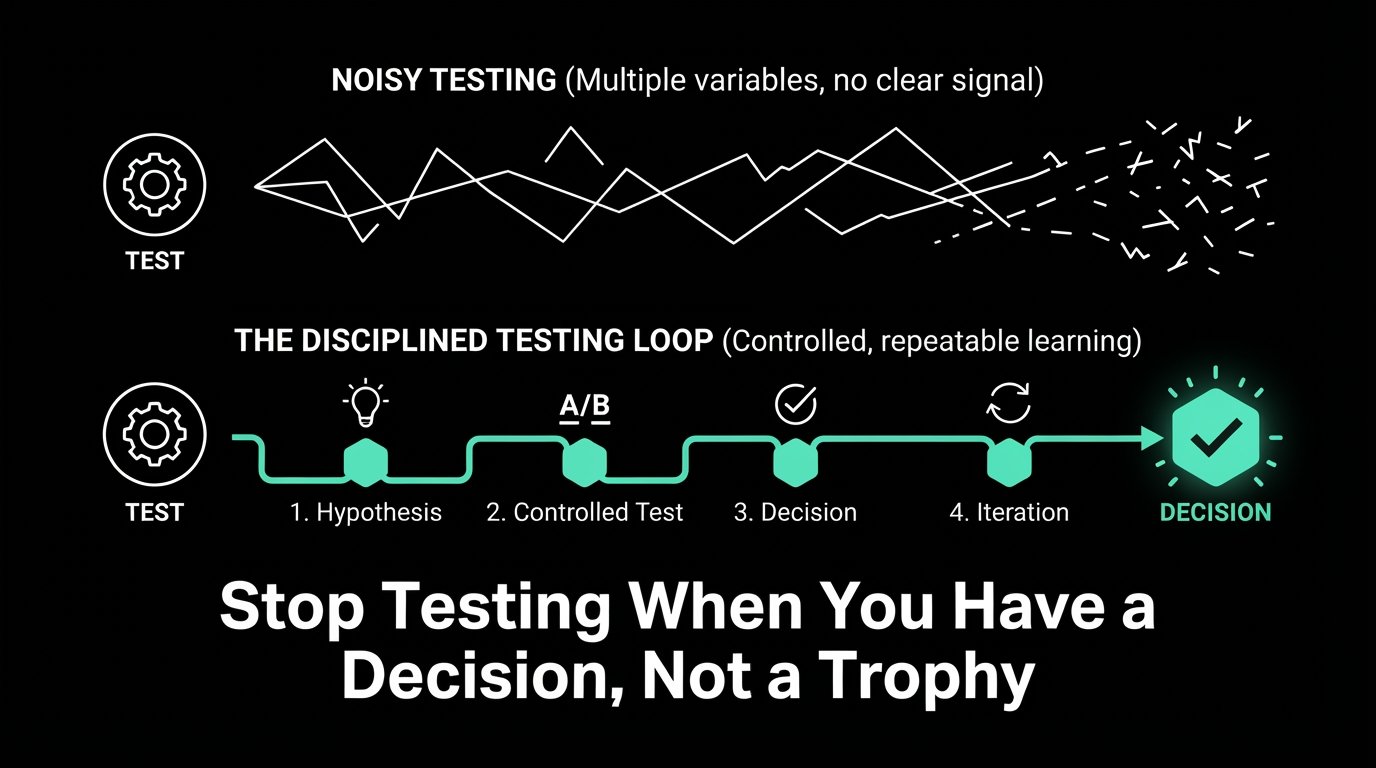
A test that changes the hook, format, offer, audience and landing page at the same time cannot tell you what caused the result. Likewise, a tiny difference in CTR is not automatically a meaningful creative insight.
The real skill is knowing when the test has answered the question it was designed to answer.
Test One Meaningful Variable at a Time
A useful creative test starts with a hypothesis. Maybe a stronger price-led hook will improve qualified lead volume. Maybe a product demonstration will outperform a polished brand video. Maybe a creator-style opening will hold attention better than a conventional ad.
The more clearly the variable is defined, the more useful the result becomes. You do not need every asset to be identical, but you need enough control to understand what changed.
For a meta ads agency, that means separating genuine creative learning from simple performance fluctuations. The question is not only which ad won. It is what the winning result tells you about the next creative iteration.
Know the Difference Between Signal and Noise
Before declaring a winner, look at the quality of the evidence:
- Spend and conversion volume. A result based on a handful of conversions is less reliable than a pattern supported by meaningful delivery and conversion data.
- Comparable conditions. Large differences in audience, budget, placement or offer can make creative comparisons misleading.
- Business outcome. CTR or cheap clicks can be useful diagnostics, but qualified leads, purchases or revenue may tell a very different story.
- Repeatability. A useful insight should influence what you test next. If the result cannot produce a sensible next hypothesis, it may not be much of a learning.
This does not mean waiting forever for statistical certainty. Advertising decisions often have to be made before a perfect experiment exists. The practical goal is enough evidence to make the next decision with more confidence than the previous one.
A performance marketing team should therefore think in terms of decision thresholds, not arbitrary testing calendars. If an ad is clearly failing on the business metric that matters and the evidence is sufficient, continuing to spend simply to complete a predetermined test period is not disciplined testing.
The opposite is also true: stopping a test because one ad is 15% ahead after limited data can turn random variation into a false strategy.
Every Test Should Produce the Next Test
A strong creative testing loop can be simple:
- Define what you believe will improve and why.
- Controlled test. Change the intended creative variable while keeping the comparison interpretable.
- Scale the useful signal, stop the weak concept or keep testing when the evidence is still unclear.
- Turn the result into a new creative hypothesis instead of endlessly repeating the same test.
This is where creative testing connects to the broader Meta system. A meta partner should not simply deliver a monthly list of new ads; the testing process should build an increasingly specific understanding of which messages, formats and commercial angles work for the business.
That learning can also inform other channels. If a particular customer pain point consistently performs in paid creative, it may influence landing-page messaging, SEO content or even how an AI agency Dubai positions a service. The value of testing is therefore bigger than the winning ad.
Stop Testing When You Have a Decision, Not a Trophy
The goal of creative testing is not to find one permanent winner. Creative eventually fatigues, audiences change and offers evolve.
The goal is to build a repeatable process that tells you what to keep, what to change and what to test next.
For UAE brands managing fast-moving Meta campaigns, that distinction matters. More creative can create more opportunities, but only structured testing turns those opportunities into usable learning.
Stop when the evidence is sufficient to make the next decision. Keep testing when the result is genuinely unclear. That is the difference between learning and noise.
How Meta Social Helped Stop Unproductive Creative Testing
A UAE e-commerce client was continuously launching new ad variations, but performance wasn’t improving consistently. The team was judging creatives mainly by early CTR and engagement, which meant some tests were stopped too quickly while others continued without producing a useful decision.
Meta Social introduced a clearer testing framework built around a specific hypothesis for each creative test. Instead of testing indefinitely, the team evaluated whether each variation had generated enough meaningful conversion data to support a decision, then used the result to determine what should be scaled, changed or tested next.
The result was a more disciplined creative testing process, with fewer inconclusive tests and clearer decisions about which creative ideas were actually contributing to performance.
FAQs
There is no universal number of days. Run it long enough to collect meaningful evidence for the business metric you care about, while avoiding unnecessary spend once the decision is already clear.
Usually not. CTR can show how well an ad attracts attention, but the stronger decision metric depends on the objective — such as qualified leads, purchases or revenue.
It depends on budget, conversion volume and how different the concepts are. Testing more variations than the account can meaningfully support can create thin signals rather than better learning.
Yes, but the purpose changes. Keep the winner active while testing new concepts around it, because a current winner can eventually fatigue or stop matching changing customer behaviour.
Key Takeaways
- Do not stop a test just because a calendar says it is finished.
- Define the creative variable and the business outcome before testing.
- Separate useful evidence from small or misleading performance differences.
- Every completed test should create a clearer hypothesis for the next one.
Meta Social — Dubai’s #1 Performance Marketing Agency
Meta Social structures creative testing around decisions rather than arbitrary test cycles — defining the hypothesis, measuring the business outcome and turning each result into the next iteration. Speak to our team at metasocial.ae
Performance Marketing | SEO & GEO | AI Creatives & Video | Attribution Architecture
metasocial.ae | Dubai, UAE
About Meta Social
Meta Social is Dubai’s leading performance marketing agency and the GCC’s AI-native growth partner. We specialise in Performance Marketing, SEO & GEO, AI Creatives & Video, and Attribution Architecture — managing AED 50M+ in paid media across real estate, fintech, e-commerce, and hospitality.
metasocial.ae | Dubai, UAE